 By admin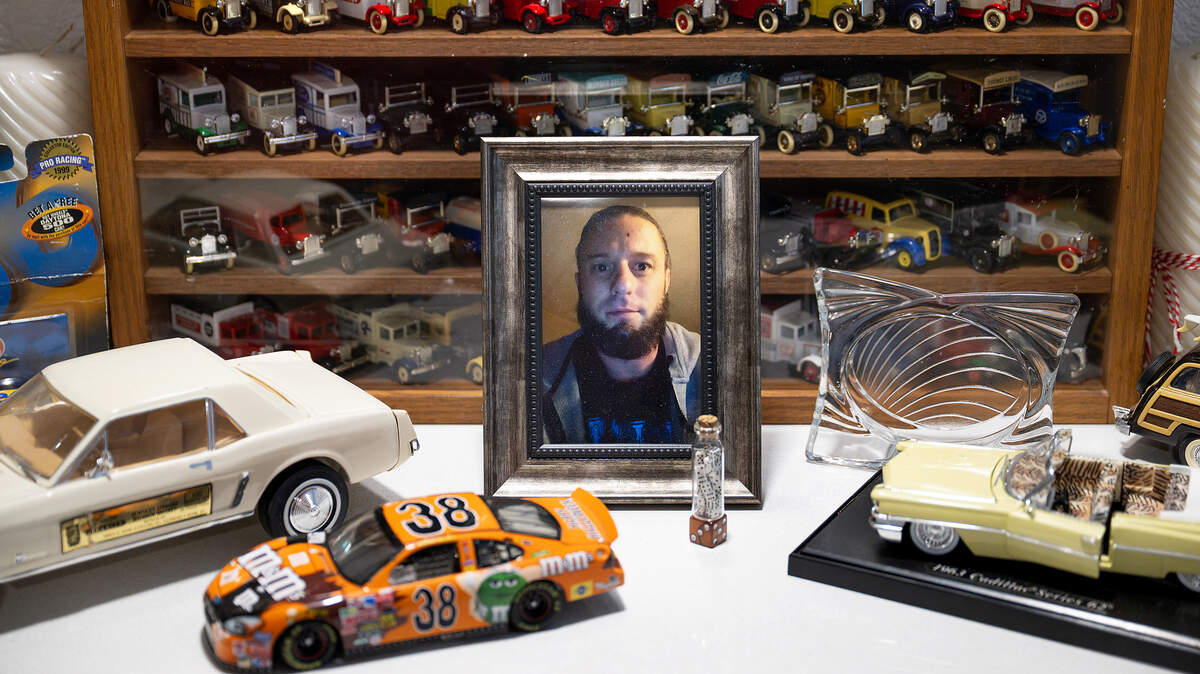
Dorothey Heimbach lives in a recently renovated, three-bedroom, one-bath, midcentury single-family home in the small Central Valley city of Oakdale. The front lawn is freshly mowed. A narrow garden borders it with newly planted flowers.
Read more What to know for back to school: Join The Sacramento Bee for a supply drive and Q&A
Her home is in a peaceful farm-and-ranch town in Stanislaus County, just outside of Modesto, about 75 miles from Sacramento, 100 from Fresno. On a sweltering summer day in July, she takes shelter inside, where air conditioning keeps her house at a much more comfortable temperature.
The home’s interior features hardwood floors and a roomy kitchen with granite countertops. New furnishings congenially decorate the rooms. There’s a new pool table among other, more sentimental possessions.
“I love this house,” said Heimbach. “It’s old-fashioned, but it’s my style.”
On a mantle scores of toy and model cars surround a framed photo of her son, Anthony Silva. Some are unboxed, presumably in mint condition. Collecting them, she said, was a shared hobby of theirs. On the opposite side of the room is a pile of boxes, some empty, some not.
“There’s a lot of memorable things in there that I haven’t gotten uncovered yet. That there’s a box of stuff that I know is my son’s,” Heimbach said. “I just haven’t gotten to it.”
Unpacking memories of her son has not been easy. Heimbach bought the home about two months ago with the remainder of a $5 million settlement she received after legal fees as part of a wrongful-death lawsuit against the Stanislaus County Sheriff’s Office.
Her previous home, for several years, was her car. Every other night, she would park in a self-serve car wash after it closed. Heimbach felt safe there, she said. Silva experienced homelessness, too, often sleeping under the cover of a gazebo at the Riverbank Community Center.
The community center was the same place Silva was detained by Stanislaus County sheriff’s deputies during Riverbank’s Cheese and Wine Festival in October 2022. Why deputies were called to the festival is unclear, other than they responded to a “disturbance,” according to court records. The entire interaction was recorded on the responding deputies’ body cameras.
When they arrived, Silva was immediately placed on the ground and in handcuffs. He was then taken over to the gazebo, his refuge at night, to be searched. During the search, Silva was forced down onto the concrete head-first.
The impact, and possibly his movement by deputies after he was taken down, left him paralyzed from the neck down. Silva spent almost a year in the hospital before he died from his injuries on Sept. 10, 2023.
How deputies, the Sheriff’s Office and the Stanislaus County District Attorney’s Office handled the entire affair, before, during and after, was scrutinized publicly and in court proceedings. Some of the sharpest criticism came from that of Silva’s grieving mother.
Accountability sought
“I don’t like them, I don’t like the Sheriff’s Department,” Heimbach said. “It’s not all of the cops, it’s the ones that hurt my son, and who think they’re bullies or they’re better. Their badge makes them big and strong. Their badge is supposed to be protect and serve, not protect and murder.”
Silva and his mother did not have easy lives, even before he was paralyzed. Heimbach said her son was an active kid who studied karate. Symptoms of schizophrenia began to appear after a blow to his head during a sparring match when he was 10 years old. Still, he went on to teach karate before his mental state worsened around his 18th birthday.
In his adult life, Heimbach said they lived with her mother for a while until she died in 2020 — the first event in a series that shrouded their lives in darkness. A few months later, the family dog died. A few months after that, Silva’s girlfriend, who was diabetic, died, Heimbach said.
“Him and I didn’t get along after his girlfriend died… he was lost, you know. He just didn’t want to be with mom, or didn’t want to be around me, you know. He wanted to do his own thing, and that’s what basically what he was doing,” she said.
This was the period of Silva’s life when Deputies Justin Camara, Za Xiong and Eric Bavaro encountered him. Heimbach holds nothing against Bavaro, who was later dropped as a defendant in the lawsuit, but believes justice fell far short for the other two deputies, especially Camara.
She wished, at the very least, the Sheriff’s Office would have taken away his badge. Camara’s use-of-force history alone should have been enough to take him off the streets, she hoped. In a separate incident, Camara was a trainee when Alejandro Sanchez was killed during a struggle with deputies in 2018.
Read more Data center company proposes 100-year lease on WWII Japanese detention site in CA
Like Silva, Sanchez’s family sued the county in federal court. Camara was named as a defendant. The county settled with Sanchez’s family for $1.5 million in 2024.
But the kind of accountability or justice Heimbach sought never came.
During court proceedings in Silva’s case, attorneys representing the county admitted they did not report Silva’s injury to the California Department of Justice. Court documents also show the Sheriff’s Office did not conduct an internal investigation, nor were any of the deputies reprimanded.
The District Attorney’s Office was not informed of Silva’s injuries and death until The Modesto Bee inquired in January 2024 — more than a year after he was injured and about three months after he died. The DA’s Office decided several months later not to bring any criminal charges against the deputies
“They know right there they’re guilty of what they did, and it was wrong for what they did, and they should be punished for what they did,” said Heimbach. “But no, somebody or something is protecting them and I don’t know what it is. I know it’s not God, because God wouldn’t want it that way. That’s one thing I do know.”
‘They’re not creatures, they’re humans’
Heimbach talked of the time, just under a year, that her son spent in the hospital. She was still living in her car but would visit often. His mind, she said, was sharp, but his body deteriorated. Silva was on a strict liquid diet; he pleaded for solid food but could never have it. His muscles and body slowly withered.
At first, he begged his mom to help him leave the hospital. But Heimbach said that after doctors told Silva he’d be paralyzed and on a ventilator tubed through his trachea for the rest of his life, he begged her to let him die.
“There was nothing there and I couldn’t change it. If I could have, I would have. But I couldn’t. I’m not a miracle worker. But I tried. I tried to keep him happy as much as possible. But he kept asking me to ‘please let me go see Grandma.’ Well, we know where Grandma was,” said Heimbach.
“And when he kept saying it over and over, repeatedly, I said, ‘Now you need to make your decision, Tony. Because once you go away, I won’t see you for a while… So you got to remember that, too. It’s going to be a while before we can reunite. …’ I don’t want ever to see another parent go through what I’ve been through. Ever.”
Now, sitting at the dining room table in the safety and comfort of her new house, Heimbach reckons with the reality that owning the one thing she believes would’ve prevented her son’s death, a home, wouldn’t have been possible without it.
But she tries not to concern herself with this hypothetical. What happened happened because they were homeless at the time. Now a homeowner and a millionaire, Heimbach wants to use her son’s death to raise awareness for the plight of her community’s most vulnerable people — a community she can deeply relate to.
She said she plans to use some of the settlement money to finance efforts to provide resources, housing or aid to homeless and unhoused people living in Stanislaus County, particularly in Riverbank.
“It takes a big toll on people, homeless life is not fun. … Homeless life is hard to conquer, and especially when you get it coming from all ends. … They have nowhere else to go. They have no family, no friends, no nothing,” she said.
Heimbach doesn’t believe that all law enforcement officers see homeless people as revolting, but some do. The same is true for all people, she said; some people hold prejudice, some don’t, and some are apathetic. But for those who don’t see the unhoused, impoverished or vulnerable as human, deserving of rights or even life, Heimbach has some advice.
“I think they should regroup themselves and really think about how the homeless could be them. It could have been them, but it wasn’t. So give them a little bit of support. Help them… They’re not creatures, they’re humans, just like we are.”
The Sheriff’s Office has not responded to The Bee’s requests for comment on the stories it has published about Silva.
This story was originally published July 24, 2026 at 3:44 PM with the headline “Once homeless, a California woman is now a millionaire. The cost was her son’s life.”
Read more Once homeless, a California woman is now a millionaire. The cost was her son’s life