 By admin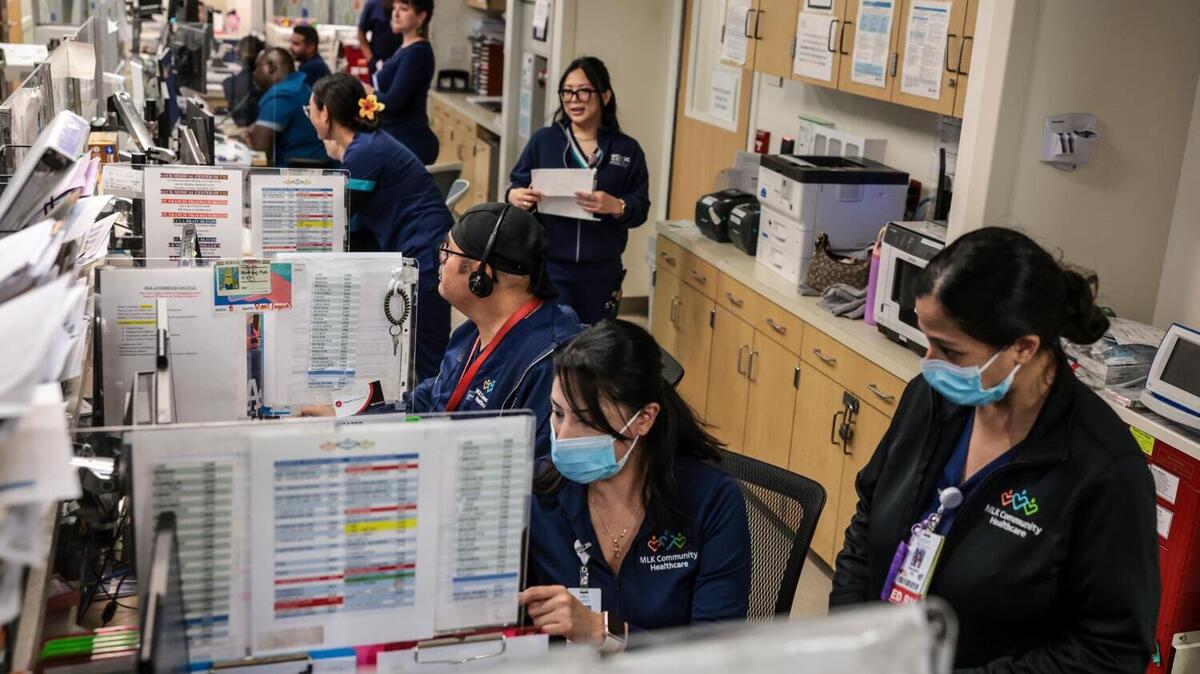
Martin Luther King Jr. Community Hospital in Willowbrook is the main emergency medical care option for hundreds of thousands of South Los Angeles residents, but space is so tight that many patients are treated in large metal-frame tents on the pavement outside.
Read more Factbox-Which midterm candidates is the crypto industry backing?
On a recent summer day, loud air conditioners blew cool air as nurses drew blood and tended wounds, calling to mind the makeshift spaces used during the early days of the COVID-19 pandemic.
The tents are a stark indication of the dire financial state of the hospital, whose leaders say it could be forced to close if it doesn’t find a way to consistently bring in more money. The hospital recently reported $14 million in net income for its most recent fiscal year, but operated in the red each of three prior years.
Next year, it anticipates losing $80 million to $100 million in annual funding as a result of 2025’s One Big Beautiful Bill Act, or HR1, which mandated changes to Medicaid eligibility and financing.
“One of the wealthiest cities in one of the wealthiest states in the country, in the wealthiest country in the world, in modern-day America, and we’re caring for patients in four white tents on black concrete,” Tony Weiss, MLK Community Healthcare’s director of media relations, said during a tour of the hectic emergency department. “That’s crazy.”
As MLK hospital struggles against severe financial headwinds, its leaders are calling on the Los Angeles County Board of Supervisors to reevaluate how it awards the funds the county collects via Measure B, which levies a form of property tax. In fiscal year 2025, funds brought in via the measure totaled approximately $427 million, according to the county.
The ballot initiative, which was approved by county voters in 2002, described “an annual special tax to raise revenue to support the Countywide System of Trauma Centers, Emergency Medical Services, and Bioterrorism Response.”
Despite that, “ongoing” or recurring funds collected via the measure are allocated to county hospitals and private hospitals with trauma centers. Private hospitals without trauma centers, such as MLK hospital, are left to vie for a cut of a pool of any “leftover” funds that exceed the amount the county projected raising via the measure.
Between 2023 and 2025, MLK hospital had to be bailed out by the state and county four times for a total of $68 million, $29 million of which was provided via two, one-time disbursements of “leftover” Measure B funds.
The hospital – which opened as a private nonprofit in 2015 after county-operated Martin Luther King Jr./Drew Medical Center closed in 2007 amid a crisis over substandard medical care – has never received any “ongoing” Measure B funds.
All told, $126 million of Measure B funds were awarded to 13 private hospitals with trauma centers in L.A. County last fiscal year, including Cedars-Sinai Medical Center in Beverly Grove. With nearly 900 beds and 2,100 doctors, Cedars-Sinai is one of the biggest and most capable hospitals in the U.S.
Cedars-Sinai reported net income of about $1.1 billion on more than $5.8 billion in revenue last fiscal year on its federal 990 tax form in May. It reported net assets of $9.9 billion, an increase of $1 billion over the previous fiscal year.
Cedars-Sinai, which received about $9.4 billion in Measure B funds last year, has opposed significant changes in how the money is awarded.
Changes to how the funds are allocated “could shift Measure B away from its intended purpose,” Stephanie Cohen, Cedars-Sinai’s vice president of government and industry relations, said in a July 8 letter to L.A. County officials. “Existing funding is already insufficient to sustain these services.”
Cedars-Sinai spokeswoman Sally Stewart added in an emailed statement that “changing the allocation formula risks undermining the system that Measure B was designed to protect and sustain.”
Weiss of MLK hospital described the stark gap in the two medical providers’ financial pictures as “a tale of two hospitals.”
Read more SpaceX’s first results put Musk’s AI spending under Wall Street microscope
On a recent weekday, dozens of emergency department patients were lying on gurneys next to a nursing station, waiting on hard plastic chairs lined up in hallways, and undergoing treatment in rows of tiny spaces separated only by low, cubicle-style walls. The hospital has also doubled up many of its single-occupancy hospital rooms, converted its gift shop to a procedure room and resorted to treating patients in what were once meditation and waiting rooms.
For years, MLK hospital’s leaders have wanted to renovate under-utilized interior spaces at its Willowbrook campus to expand the emergency department. But it hasn’t been able to afford to do so, so it has relied on the tents in recent years to help manage the severe overcrowding in its emergency department, which has 29 beds and was built for 25,000 patient visits a year, but now sees more than 120,000 patient visits annually.
The hospital has already taken a series of major steps to make ends meet, according to Dr. Elaine Batchlor, its chief executive.
The disparity in “ongoing” Measure B funds awarded is even more concerning, she said during an interview in her office at MLK hospital, because of the different populations served by the facility as opposed to other facilities that receive millions of such dollars each year.
Rethinking how Measure B funds are allocated, Batchlor said, is a way of helping to ensure that hospitals that serve communities with the most financial needs and fewest healthcare options receive more financial assistance. Like many of the patients it serves, MLK hospital’s very survival is on the line.
“Why is it considered appropriate to only give this money to these 13 trauma centers when some of them clearly are doing well financially?” she added. “There are communities that are much more in need and under-served than Beverly Hills and West L.A.”
Dr. Naman Shah, director of the L.A. County Department of Public Health’s Division of Medical and Dental Affairs, said that the way Measure B funds have been doled out in the past “didn’t really reflect the economics of healthcare in the county in terms of which hospitals needed more support.”
If MLK hospital closed, he said, “it would be devastating, and we would have untold misery from lack of access to care.”
The population MLK hospital serves in South Los Angeles is among the least financially secure in the region. In 2023, MLK hospital had nearly 85,000 Medicaid/Medi-Cal patient visits to its emergency department, the most in the state, while Cedars-Sinai had nearly 17,000, according to the California Department of Health Care Access and Information.
In 95% of the visits to MLK hospital’s emergency department in fiscal year 2025, the patients were either on Medicaid/Medi-Cal or Medicare, or uninsured. Because of that, billed patient revenue makes up just 44% of the hospital’s fiscal-year 2026 budget; the remainder comes from state and county funding.
Pastor Robert Taylor of Beulah Baptist Church in Watts has advocated for greater resources for MLK hospital in his role as president of Watts Area Ministers. Measure B funds, he said, should be “distributed in a way that best meets the needs of the community” instead of going to “hospitals who don’t really need it.”
“If that hospital shuts down in our community, it’s going to be devastating,” he said, noting that the next closest emergency department is St. Francis Medical Center, several miles away in Lynwood. “It could be deadly to have to travel that far to get to an emergency department.”
Los Angeles County Supervisor Holly Mitchell, whose district includes Willowbrook, wants the Board of Supervisors to take steps to reconsider how Measure B funds are allocated. She plans to introduce a measure at Tuesday’s board meeting to hire a consultant to examine the issue and make recommendations for the best use of the money.
“Hospitals like Martin Luther King Jr. Community Hospital, which serves some of the highest volumes of emergency room patients despite having less financial stability, underscore the reality that not all hospitals face the same challenges in keeping their doors open,” Mitchell said in an emailed statement.
“Yet every hospital plays a critical role in our emergency care system,” she said. “We owe it to the public to ensure – through an independent review – that Measure B funds continue to fulfill its intended purpose of supporting and stabilizing a strong, countywide trauma and emergency care system.”
Read more Wall St futures edge up on Mideast deal hopes; healthcare in focus
This story originally appeared in Los Angeles Times.
Copyright 2026 Tribune Content Agency. All Rights Reserved.
This story was originally published August 3, 2026 at 3:15 AM.