 By admin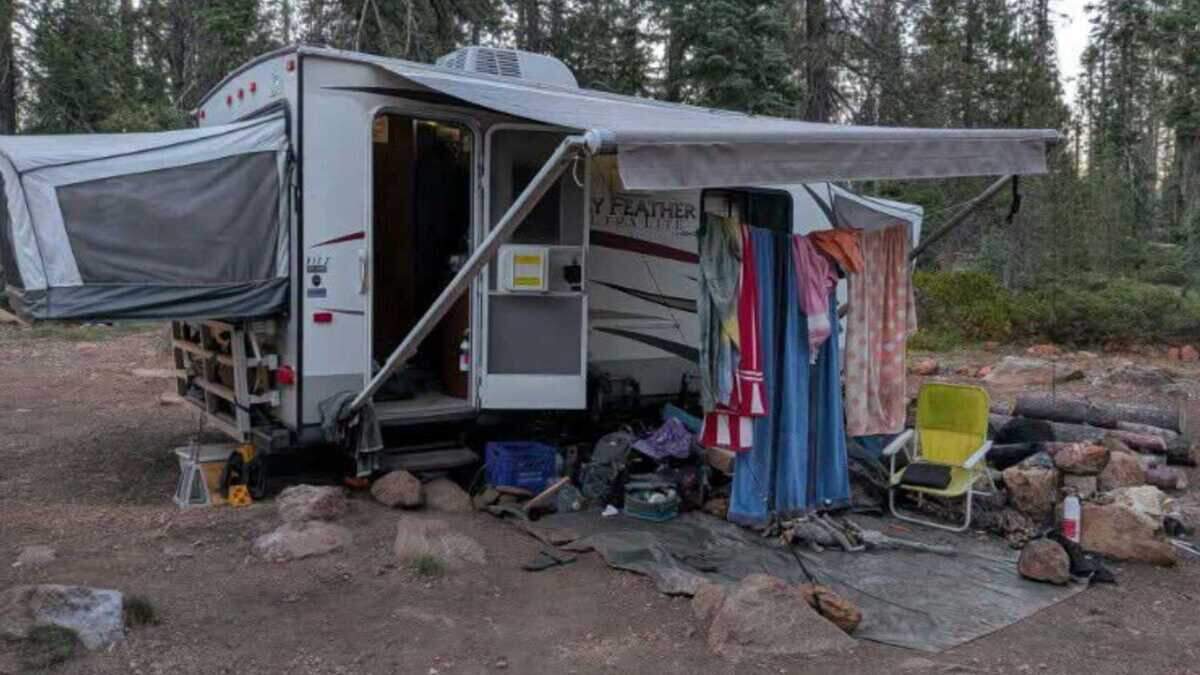
To those familiar with the often isolated work of federal land management employees, the scene was nightmarish – two U.S. Forest Service biologists went out to survey frogs only to find themselves bound and held captive in a small backwoods trailer by a bearded man who, according to charging documents, emerged from the trees with an assault rifle.
Read more California canning peach crop yield sees roughly 29% dip after Del Monte bankruptcy
Prosecutors have not said whether they believe the elder Henrichsen carried any special animus toward Forest Service, which manages 193 million acres of land nationwide, or toward the federal government generally. Henrichsen had a history of possible mental illness that appears to have driven violent threats against his neighbors in a Washington State suburb three years earlier.
Federal employees, especially in the American West, have long faced threats from citizens angry at their government – and at times attuned to conspiracy theories and heated political rhetoric – who choose to act out against its individual representatives.
An initial indictment against Henrichsen and his son, Phoenix Henrichsen, gave only limited insight into phone calls he made after the kidnapping to alert authorities to what he’d done, but he was clearly aware of who he’d seized. In one voicemail he said he had “taken two fed biologists hostage from the Forest Service” and wanted to speak to officials.
“So what I’d like to have happen, I’d like to have you send me a f*****g fed investigator, with a goddamn badge, preferabl[y] from the FBI,” Henrichsen said. “And we can talk things through a little bit.”
The two biologists were zip tied and largely kept in a trailer during a fifteen-hour standoff, until their release was negotiated by an elite hostage team flown in from the Federal Bureau of Investigation’s headquarters in Quantico, Virginia. Officials say they could be left with lasting trauma.
One longtime forest service employee said it was the type of scenario he’d feared throughout his career — and not without reason.
“It’s constantly on your mind what’s going to happen out there,” said Bill Avey, a former supervisor of the Helena-Lewis and Clark National Forest and current chair of the National Association of Forest Service Retirees. “If you’re a ranger or forest supervisor who is responsible for people it really gets on your mind… unfortunately you have to think about these kinds of encounters.”
Henrichsen and his son on Thursday pled not guilty to the federal charges against them, which for the elder Henrichsen include kidnapping, assault and weapons charges. Phoenix Henrichsen faces just the kidnapping charges. Both men appeared in court Monday, still bearing the ruddy complexions of people who had spent an extended period of time outdoors.
Elements of the Northern California kidnapping – a backwoods dweller armed with an assault rifle, a standoff in a remote area, the targeting of federal employees, and even its location in the mythical “state of Jefferson,” an area of California known for its anti-government leanings – stirred reminders of past armed standoffs on federal lands.
“This dates all the way back to the creation of the Forest Service,” Char Miller, a history professor at Pomona College who studies the history of land and water management in the western United States, said. “One of the things Gifford Pinchot (the agency’s first chief, appointed by President Theodore Roosevelt) did every summer was to go out west and try to calm the anguish and occasional gun play that targeted his staff.”
Far from the first standoff
In more recent history, no name evokes such tensions more than the Bundy family, Nevada ranchers who twice squared off with the federal government in armed confrontations. The first of those events, in 2014, occurred in Nevada, when representatives of the Bureau of Land Management, sought to round up the Bundy’s livestock after an ongoing dispute over unpaid grazing fees.
Cliven Bundy, the family patriarch, rallied hundreds of supporters to block the roundup of his cattle, sparking a days long armed standoff between law enforcement and the Bundy group near the town of Bunkerville, outside of Las Vegas.
Two years later, in January 2016, two of Bundy’s sons, Ammon and Ryan Bundy, were among a group of armed militants who took over the Malheur National Wildlife Refuge in Oregon, managed by the U.S. Fish and Wildlife Service, in response to the federal government’s prosecution of local ranchers for arson. That standoff lasted 41 days, ending with the arrest of the militants and the death of one, rancher Robert LaVoy Finicum, who was shot by law enforcement.
The Malheur standoff also drew in the FBI’s elite Hostage Rescue Team, which Northern California sheriffs credited for talking down the Henrichsens and ending last month’s kidnapping without bloodshed.
Read more After 80 years, traditions shine at Sacramento’s Japanese Cultural Bazaar
Prosecutors failed after both standoffs to convict the Bundys, either Cliven Bundy following the Bunkerville episode or his sons after the Malheur standoff. (Ammon Bundy went on to mount a failed campaign for Idaho governor.)
There is so far no evidence the Henrichsens were driven by any political motivations. Still, a dislike of the federal government could be a factor in the case, said Zoe Nemerever, a researcher at Montana State University who has studied violence against federal land management employees..
“It could have just been a crime of convenience,” she said. “They didn’t set out to attack a federal employee or kidnap federal employees, but they were there at the same time as them and they had this underlying dislike for the federal government.”
Avey, the retired Montana supervisor, recalled receiving death threats against him and his family in 2015, after the Forest Service sought to enforce environmental rules against gold miners in the national forest he managed.
The miners put out a call to militia groups and ultimately drew the support of armed members of the Oath Keepers, who would go on to play a prominent role in the riot at the U.S. Capitol on Jan. 6, 2021.
That standoff lasted around six weeks, Avey said.
“I was doing my job and following the law,” he said.
While such high-profile incidents grab national attention, individual acts of violence toward employees of the Forest Service, BLM and other land agencies are more widespread, Nemerever said. She reviewed over two decades of reports of violence filed by BLM employees from 1995 to 2015 in a large swath of western counties.
Not every report of violence carried political overtones, she found, but many did.
In Nemerever’s research, she quotes a report from a woman Forest Service ranger who’d been assaulted while on duty.
“He started getting even more upset and said oh your (sic) just another one of those BLM sluts who think you can do whatever you want to make all our recreation go away.… He said your (sic) just one of those environmental b—-es who just think that you know it all well you don’t know anything that everything is just fine you are just as stupid as the BLM.”
The employees who run into such anger, whether it’s political, or the result of mental illness, intoxication or some combination of factors, aren’t always well-equipped to respond or even defend themselves, Nemerever said. Of the 29,500 workers employed by the Forest Service outside its Washington, D.C., headquarters, for example, just 650 are trained law enforcement personnel, according to agency numbers.
“Some will have law enforcement powers,” Nemerever said, “but a lot of them on the flip side are like 23-year-old environmental biology graduates, and this is their first job, and they’re headed out with, you know, a can of bear spray and doing an inventory of like owl nests in a certain area.”
Last month’s kidnapping has led to some discussion in the National Federation of Federal Employees, a labor union that represents federal workers including in the public land agencies, about whether additional safety measures might be needed, such as better ability for workers to send an alert or be tracked in remote areas, Steven Gutierrez, an official with the union, said.
“What we can take away from this, even if we never know the motives of these two individuals,” Nemerever said, “is that federal bureaucrats who work in remote areas, they are vulnerable to harassment and assault, and we’ve seen that not just in this case.”
Read more 17 arrests in Sutter County undercover enforcement of online child exploitation