 By admin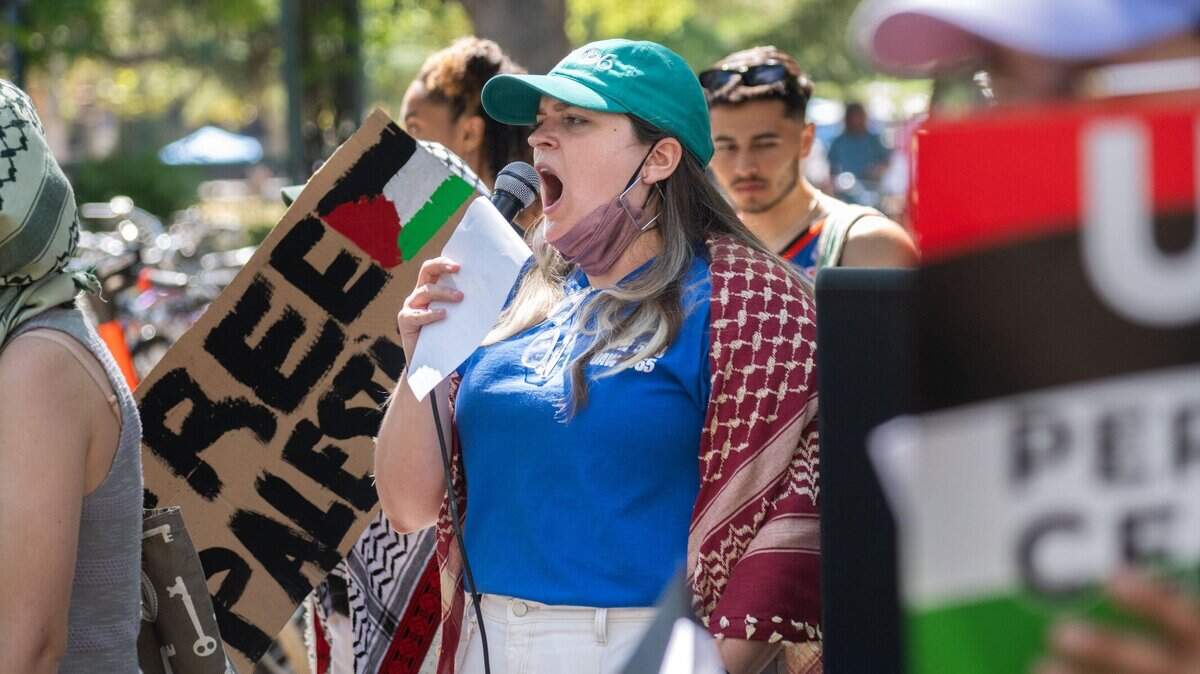
Early this year, a California lawmaker began hearing stories from university students of the disciplinary action they had faced for violating campus protest policies.
Read more Ramos’ California Indian Freedom Act hits an impasse with opponents
A felony charge for putting food dye in a water fountain. A block on class registrations for using amplified sound at a demonstration without a permit. Campus police involvement when a protest ran a few minutes over its designated time.
Not only did Assemblymember Sade Elhawary, D-Los Angeles, feel the punishments seemed disproportionate to the infractions, she also noticed that the stories she was hearing were mostly coming from Muslim, Black and Brown communities, she said.
In June, she decided to “gut-and-amend” a healthcare bill she had authored and the Assembly had already passed, and replace its contents entirely with a new proposed law to address the students concerns in the current legislative session.
Assembly Bill 2551 would require the California State University and request the University of California to provide annual data on student code of conduct violations during protests disaggregated by race and gender. The reports would also have to include descriptions of the disciplinary action imposed on those students.
The measure also asks that an open forum be held before the end of 2027 to elicit student feedback on current time, place, and manner policies that restrict when, where and how protests are conducted on campuses. The UC and CSU systems, even after major amendments, remain opposed to the bill. They say it could create uncertainty around their current policies and compromise student privacy.
“Students have been at the forefront of every movement we can think of in this country,” Elhawary said. “If we take away their right to protest on their campuses, we are taking away a critical part of our democracy that has made us who we are as the United States of America and as California. As someone who was a student activist myself, I can’t even imagine what it would have been like had these restrictions been around when I was a student. So many students are now afraid to exercise their right to raise their voices.”
In 2024, the state legislature required the UC and CSU systems to develop uniform protest policies to be enforced at each of their campuses. This came in response to encampments and rallies protesting the ongoing war in Gaza that swept California campuses early that year.
Although all UC and CSU campuses already had some version of time, place and manner restrictions on protests in place, that year both systems consolidated their policies. They prohibited encampments, restricted free movement and masking to conceal identity when violating policies, and put in place disciplinary actions to be utilized against those in violation.
Read more California could soon put limits on youth social media. Is it the right approach?
In September 2024, with Jewish groups reporting antisemitic incidents on campuses, the state passed a law asking the CSU and UC systems to publish and enforce those protest restrictions and “prohibit violent, harassing, intimidating or discriminatory conduct” that creates a hostile environment on campus. Meanwhile, hundreds of student and faculty who participated in pro-Palestinian protests had already been slapped with legal and academic repercussions amid a crackdown on the movement.
In a 2025 report, the Council on American-Islamic Relations-California raised concerns over the newly strengthened restrictions, especially given what it called “targeted enforcement” of the existing policies. The report said several California universities used law enforcement disproportionately in response to pro-Palestinian protests when compared with other events that violated the same policies. A year later, the University of California Student Association, a coalition of student governments across the system, shares those concerns.
“Many different student groups are reporting inconsistent enforcement that really harms students and their communities,” UCSA President Candice Phan said. “This growing issue of criminalization of dissent across the nation, seeing it bubble up at home at our own campuses is deeply concerning.”
For Elhawary, these unintended consequences of the 2024 legislation — substantiated only anecdotally, without concrete data — necessitated her new bill. Earlier, she included a provision to sunset the earlier law by 2029. However, following strong opposition from Jewish California, an umbrella advocacy organization for Jewish groups statewide, the bill was watered down to leave the time, place and manner policies intact while pushing for greater transparency and conversation around their implementation.
Jewish California said repealing the earlier law amounted to sacrificing hard-won protections for Jewish students.
Although Jewish California has now taken a neutral position on the bill, both the CSU and UC systems remain opposed. The UC system raised concerns over privacy if student violators’ data is disaggregated by demographics. Both systems flagged that the new bill could create uncertainty around current policies which they had invested time and effort in.
In a letter of opposition, the CSU system said the current policies had been successful, noting there had been “less disruptions to the academic environment” since 2024. The UC and CSU also said they already provided opportunities for campus communities to share their opinions through avenues like public comments at board meetings, making the open forums mandated by the new bill unnecessary.
Now, as the measure continues to move through the Legislature, Elhawary said she plans to return to the next legislative session with even stronger solutions to the problem.
Read more Flock Safety to tighten police access to license plate data amid privacy concerns