 By admin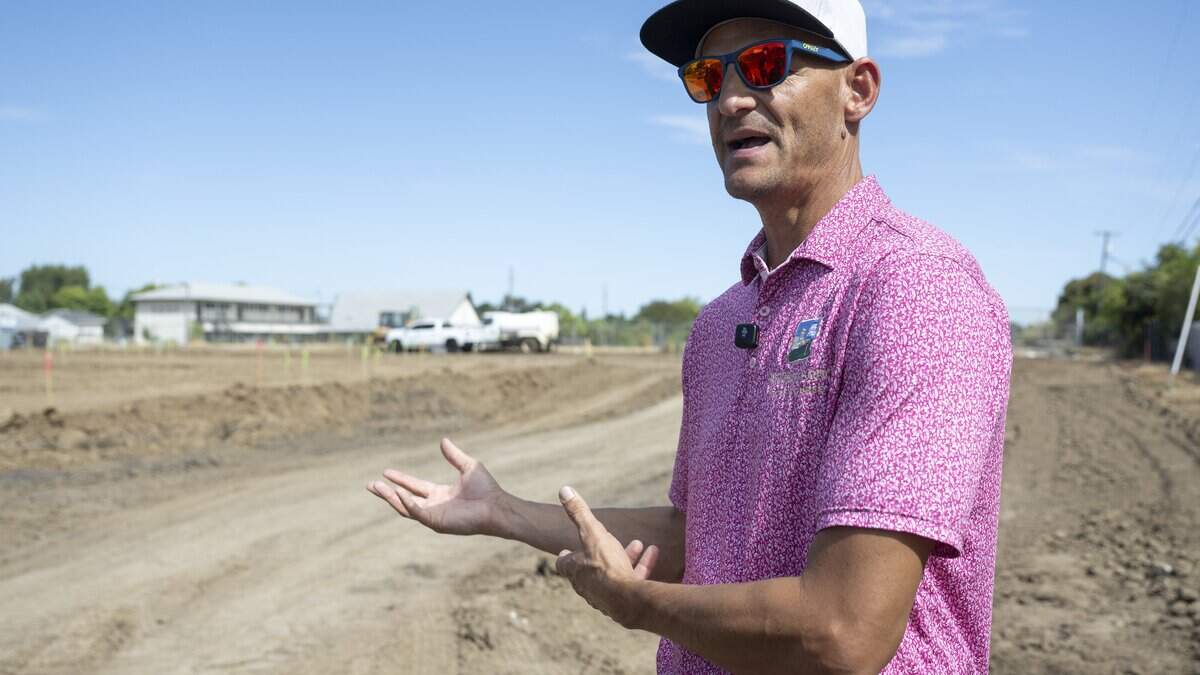
As Mayor Kevin McCarty walked the perimeter of a dirt lot across the street from the Martin Luther King library in south Sacramento, he gushed about the seniors who could leave the streets to be housed in 30 tiny homes to be erected this month.
Read more California Legislature passes slavery disclosure bill, sends to Gavin Newsom
It was supposed to be 40, but amid a ballooning budget, the city of Sacramento reduced the project to stay under the threshold that would give City Council the power to stop it.
Tiny homes may be more expensive they bargained for, but McCarty still believes in their viability to be an economic solution to house people temporarily in the face of Sacramento’s homelessness crisis.
The first of three tiny home communities for homeless seniors, 2461 Gardendale Road, broke ground this month. The Department of Community Response, the arm of the city that manages homelessness services, estimated in a May budget that building one 40 unit site would cost $3.7 million and cost about $500,000 annually in ongoing costs, amounting to about $92,500 per unit.
The final cost of the project amounted to $4.9 million for 30 units, according to City Manager Maraskeshia Smith. This puts the per-unit cost at $163,000.
For Mayor Kevin McCarty, the micro-communities’ surging costs are a frustrating reality of any city building project, but not prohibitive to the goal of housing seniors who are currently living on the street.
“It’s still 30 more people who can get into housing,” he said. “It’s our hope that by December, Christmastime, we will have seniors who are currently living in shelters coming out here and having some stability.”
Originally pitched as a cost-effective alternative to permanent supportive housing, which can cost the city more than $400,000 per unit, the city committed to building 40 tiny homes on three identified sites across the city, with a possible fourth site at a yet to be determined location somewhere near Land Park.
The shelter set for Arena Boulevard in Natomas was halted, Smith confirmed at a City Council meeting Tuesday, because of its projected $7.1 million price tag. Despite Councilmember Lisa Kaplan’s online triumph over the perceived death of the Arena Boulevard project, city officials maintain that the project is only paused — “like you can pause a Beyoncé song on your iPhone,” McCarty said.
McCarty called the resistance to the Arena Boulevard project “classic B.S. NIMBYism,” with opponents committed to narratives about proximity to parks and bodies of water playing a disingenuous game to prevent homeless shelters from being built equitably throughout the city, rather than just in low-income neighborhoods. He called Kaplan’s resistance to the project “hypocritical” given her identification of the site last year and her endorsement of a similar model of housing for young adults in North Sacramento.
Both Smith and Mayor Kevin McCarty said they are committed to the promise that tiny homes represent for homeless residents, despite their ever-increasing price tag.
In light of the complications at the Arena Boulevard site, Smith and McCarty are focused on completing the sites on Gardendale and at 6360 25th Street, which is also estimated to cost $4.9 million for 30 units, or around $163,333 a bed. They said that completing the first two sites will give them the info they need to potentially move forward with Arena Boulevard and a potential fourth site near Land Park.
If the cost of any one facility reaches more than $5 million, the item must go back to the City Council per a 2023 ordinance championed by former Mayor Darrell Steinberg to get temporary housing projects moving faster and distributed more equitably across the city. Previously, council had to vote on any contract more than $250,000, and the result was that zero projects moved forward in the two years after the city identified 20 potential sites.
Read more California Legislature passes slavery disclosure bill, sends to Gavin Newsom
City spokesperson Jennifer Singer confirmed that the project was reduced to 30 units to stay under the $5 million threshold. Smith said if costs continue to escalate, she will consider bringing it to them for a vote.
McCarty is open about avoiding a council vote, seeking to move the sites forward without the friction that bringing it to council members could
Why have tiny home village costs gone up?
In September, DCR Director Brian Pedro estimated that one tiny home community would cost the city $3.5 million to build and $500,000 in annual maintenance costs for 40 units. Now the city is projecting annual maintenance costs of about $750,000 for 30 units.
Assistant City Manager Ryan Moore said that at the time they started pursuing the micro-community model, other cities in California were doing them for closer to $50,000 a door, with $90,000 looking like the upper limit.
“Once you start looking at specific site issues and fast-forward to today’s economy, the costs turned out to be higher than that,” he said.
“Prior to my arrival, there was the concept that maybe we’ll do 40 at each site. These are the locations, but we all know in between that time things have changed — tariffs have changed, gas has gone up, construction costs have gone up,” Smith said.
A key part of Mayor McCarty’s six-point plan to address homelessness, micro-communities of 120-square-foot homes with shared restroom, shower, laundry and cooking facilities were likened to a Toyota Corolla as opposed to more expensive traditional forms of permanent supportive housing with more amenities and services — the “Rolls-Royce” of homeless housing.
Is that Corolla still worth it at almost two times the expense? City leaders say yes. For Smith, the micro-communities are still one viable solution of many to get people off the streets.
“There’s no one size fits all when we talk about how we’re going to house people,” she said.
“So, does there always need to be a long-term conversation: Is this cost effective for our constituents? Is it the best use of our taxpayer dollars? That is always an ongoing conversation in my mind. So right now, the operating understanding at the current costs we’re looking at for Gardendale and at 25th is that yes, this is still worth it to us.”
The city has already purchased 120 tiny homes plus bathroom and laundry facilities for three sites for a total of $3,344,161. With two projects reduced and one paused indefinitely, that leaves 60 tiny homes without plans for utilization in the city’s possession. Smith said that these will eventually be used for other sites.
Read more Data centers not included under CEQA reform proposal, officials assert