 By admin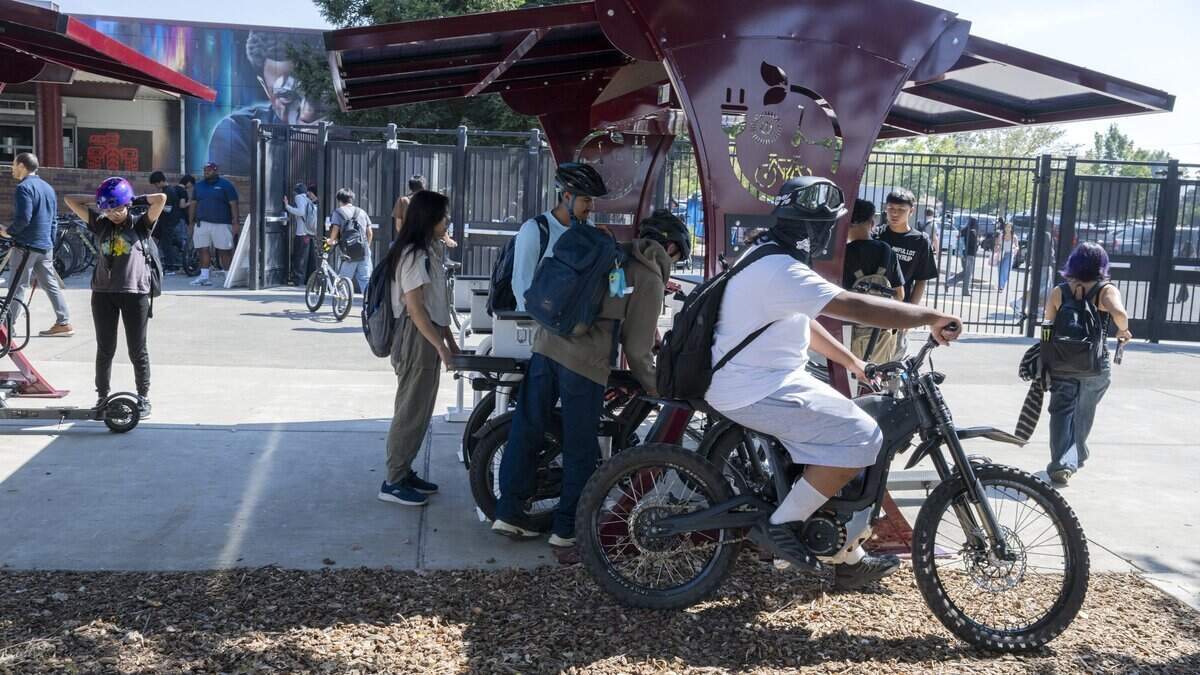
School is back in session in the capital region, and more students than ever before are pulling up to class astride electric bicycles and scooters.
Read more Analyzing 49ers’ final cuts: Injuries shaped several surprising roster decisions
Law enforcement and school officials say students and parents should familiarize themselves with laws and school district rules, not just to follow regulations but to keep children safe and prevent crashes involving the electric devices, which have increased in the past few years.
Like them or not, the popularity of the electric devices — including both legal vehicles and electric dirt bikes not allowed on roads — has continued to grow. They are so ingrained in student culture that Hiram Johnson High School installed two bike racks with solar-powered chargers — at a cost of about $75,000 in grant funds — to accommodate at least 28 devices.
The devices shorten students’ commutes and, in some cases, help them arrive on time. However, as use has risen, so has the number of injuries. The number of patients treated at UC Davis Medical Center for e-bike or e-scooter crashes increased more than fourfold from 2021 to 2025, with more than 340 patients in 2025.
Even legal devices used by some teens can reach speeds of up to 28 mph. So families should take safety precautions seriously as they head into the school year and navigate pickup and drop-off traffic, said Kendra Ramsey, executive director of the California Bicycle Coalition.
Legal e-bikes and e-scooters
There are legal restrictions on which electric devices are allowed on streets and how old students need to be to use certain ones.
Legal electric bicycles fall into three categories in California.
Class 1 bikes provide pedal assistance up to 20 mph. Class 2 bikes include a throttle but stop providing assistance at 20 mph. Class 3 bikes provide pedal assistance up to 28 mph and require riders to be at least 16 years old.
E-scooters are legal for people 16 and older. Their top speeds vary.
E-motos, which are faster and often resemble dirt bikes, are not legally allowed on city streets.
Marketing for some of these devices, especially online, has made it difficult for some shoppers to determine what is and isn’t legal, according to a state-commissioned report about e-bike usage published in 2025. A state bill introduced this year — Senate Bill 1167 — is seeking to cut through the confusion by clarifying which vehicles fall into California’s three legal electric bicycle classes and requiring e-motos and other more powerful devices to be classified and advertised as mopeds or motor-driven cycles.
The bill passed the Legislature on Friday and is awaiting action by Gov. Gavin Newsom.
Safety considerations
Helmets are key.
That message has been repeated for years for traditional bicycles and is even more important to emphasize for e-bike and e-scooter use, Sacramento County Sheriff’s Office Sgt. Jeremy Day said.
“If you wreck on them, you’re going a lot faster, and you could get injured more,” Day said.
All bicyclists under 18 must wear a properly fitted helmet, according to the California Department of Motor Vehicles. Yet children continue to break this rule, Sacramento Fire Department Capt. Justin Sylvia said.
The Fire Department responds to at least one crash involving an e-device and a larger vehicle per day, he said. A helmet makes it less likely that one of those crashes will be severe.
“You can break an arm, you can break a leg. That can heal,” Sylvia said. “But once you start getting like any type of skull fractures or any type of head trauma, that’s where long term medical effects can happen.”
Rob Youngren, project manager for Sacramento Area Bike Advocates, said parents should look for helmets with MIPS, a plastic low-friction layer inside the helmet that helps to reduce rotational motion of the brain.
“We find that a lot of traumatic brain injuries, should the worst case scenario happen, come from when a twisting impact occurs,” Yongren said.
Riders should also avoid using headphones or earbuds while riding so they can pay attention to their surroundings, Sylvia said.
Before getting on an e-bike, riders should do a little homework, Ramsey said. Preferably, they should have some experience on a traditional bike, but if that is not possible, some online training via SABA, Safe Routes to School or the California Highway Patrol can be helpful.
“I would definitely caution folks to maybe not have the e-bike as the first wheeled device their teenager is using,” Ramsey said. “Even small e-bikes are heavier than a traditional non-motorized bike, and so just the ability for someone’s body to handle that heavier, faster device is something I’d want to consider.”
Beyond riding safely, families should be careful with the batteries, Sylvia said.
“We do see lithium-ion battery fires from scooters or e-bikes, and that’s from damage to the actual battery pack themselves, or using the wrong charger for that particular appliance,” he said. “Just because the charger fits, it may not be designed for that specific battery.”
Read more SAFE Credit Union members begin voting on proposed merger with Seattle-area firm
The safest option is to use the charger recommended by the manufacturer. People should also never leave batteries charging while they are sleeping or away from home. If a battery is swollen, leaking, unusually hot or has an odor, the battery may be damaged and could start a fire, Sylvia said.
School district rules
While California has some laws governing electric bicycles, school districts may have varying rules.
Some school rules simply mirror existing law. Others, such as those in the Rocklin Unified School District, impose additional restrictions.
In the Sacramento City Unified School District, all students are required to wear and fasten a helmet. At Hiram Johnson High School, students must wear a helmet and have a bike lock to use an e-bike charging rack.
Just ahead of the school year, both Washington Unified and San Juan Unified school districts adopted new rules related to devices that are not allowed on certain school campuses.
Washington Unified in West Sacramento is only allowing Class 1 e-bikes to be used and stored at elementary and middle schools. Class 2 devices are banned.
San Juan Unified in the eastern suburbs like Carmichael adopted similar restrictions. However, the district is also requiring students 16 and older who use e-scooters to have a valid permit or driver’s license. Class 3 e-bikes and e-skateboards are allowed for high schoolers.
“We recognize that e-bikes and other e-devices can be a convenient transportation option for students and families, and our hope is that students who use them do so safely and responsibly,” San Juan Unified spokesperson Raj Rai said. “The updated policy is intended to provide clearer, age-appropriate expectations.”
The additional restrictions at these school districts come a few months after the school district and police department in Rocklin banned Class 2 and Class 3 e-bikes on elementary and middle school campuses.
This school year, up to three students per elementary school campus are using Class 1 e-bikes, Rocklin district spokesperson Sundeep Dosanjh said. Middle schools have seen up to 30 students riding the allowed bikes to class.
Local law enforcement is also a factor in capital region communities, including Rancho Cordova and Folsom.
Folsom Police Department Cmdr. Andrew Bates said his department is planning to continue stationing officers near middle school bike racks to look for students with potentially illegal devices or those who are not wearing helmets. The targeted operations started as an educational campaign in which children were issued warnings and educational materials, and eventually shifted to enforcement.
“There were a few kids that continued to violate the law, those kids did get cited,” Bates said. “In some cases, the parents had to come and pick up the bike because the kids weren’t allowed to ride at home either.”
These enforcement periods will continue throughout the school year.
E-bike resources
One place to start is a reputable bike shop, where CalBike’s Ramsey said residents can expect more reliable information and honest conversations about what is and isn’t legal.
Sacramento’s ATV Wholesale Outlet CEO Jacob Stabler said one benefit of visiting the shop in person is that the business selects established brands, which means a better chance of finding replacement parts, and assembles the devices. Otherwise, assembly can fall to new e-bike owners who may not know how to properly fine-tune their devices.
“We spend about 90 minutes not only assembling but performing a quality control inspection on the bike,” Stabler said. “Every time we put a bike together, before it reaches the floor, we discover no less than a handful of minor discrepancies that need to be tuned.”
Shopping in person also allows people to try out the vehicle and learn the exact type of e-bike it is, Stabler said.
Programs such as Safe Routes to School, which partner with local school districts, also offer educational materials on how to safely ride e-devices or use other alternative modes of transportation.
SABA created e-bike educational videos and runs the Community Bike Shop in Oak Park, which offers bike repairs and maintenance.
Other resources, including those that incentivize e-bike use can be found throughout the capital region. In North Sacramento, students who decide to use e-bikes, or other alternative modes of transportation to get to school can apply for a Trip Scanner Card through North Natomas Jibe and earn points every time they walk, roll or “scoot” to class. Those points can be traded for prizes at an on-campus event.
Though classes have begun, students and parents still have the opportunity to review rules, practice more and make adjustments before the school year is in full swing.
Read more What is the California Legislature still waiting to pass? 5 bills to watch