 By admin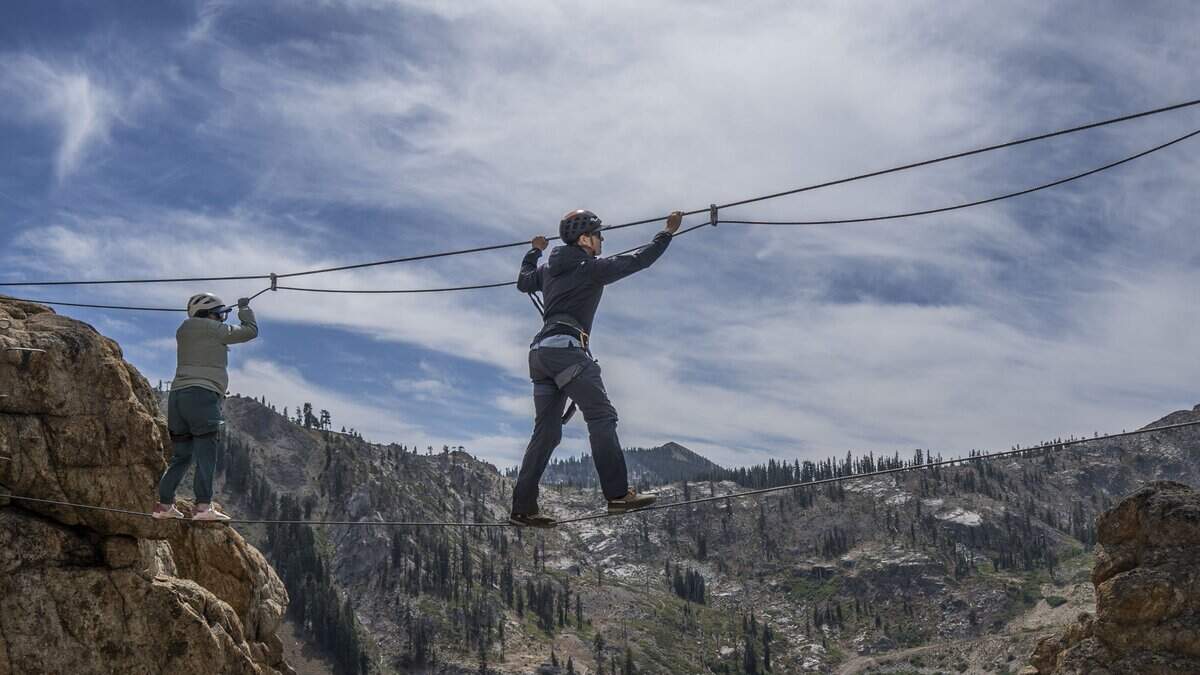
“The only way down is up.”
That’s the mantra I found myself living by recently while strapped to a cliff face in the Sierra Nevada for four hours.
Read more Sacramento’s top stories: Lumber on the I-5, school contract standoff and more
Once a young child who quit gymnastics, too scared to jump from the low bar to the high bar, I now was an early-career journalist shuffling across a suspended high-wire bridge and stretching across a deep gully to grasp the next iron rung.
By the end of the day, my hands were raw and ankles sore, and I asked myself: Did I just conquer my lifelong fear of heights?
At the Palisades Tahoe ski resort, the Tahoe Via Ferrata offers warm-weather visitors an opportunity to touch areas of the resort usually considered out-of-bounds when covered in snow. Over 2-4 hour guided tours, climbers of all ages ascend one of the Sierra Nevada’s smaller summits to get a hit of adrenaline in their system and take in a stunning view.
The via ferrata stays open as long as there is no snow on the ground. This year, Palisades Tahoe expects to open its ski runs Nov. 25, the day before Thanksgiving.
In other words, the autumn months are a prime time for adventure seekers to try out the via ferrata, while it’s too cold for water sports at Lake Tahoe but still too early to hit the slopes.
Historic wartime tool becomes Northern California attraction
Though described as safe to all regardless of experience level, the via ferrata’s steep sections do little to conceal the hundreds of feet of open air beneath, making the struggle between self-preservation instincts and adventurous spirits a truly uphill battle.
Via ferratas — Italian for “iron paths” — are relatively new to the U.S., but they have been around for more than a century. During World War I, European troops laid iron rods and cables along the Alps to navigate difficult mountain terrain without needing extensive rock climbing experience.
Following the war, the via ferrata infrastructure stayed in place, and outdoor adventurers took them on as challenges. In the decades since, hundreds of recreational via ferratas have popped up on mountains across the globe.
The first of its kind in the U.S. was opened in Kentucky’s Red River Gorge region in 2001 and remains 25 years later. Since then, there have been more than two dozen via ferratas built across the country.
Though similar to rock climbing in the setting, via ferratas differ in that they do not require as much technical experience as bouldering or climbing natural formations, as the paths are human-made and set at specific difficulty levels based on factors including their length, steepness and height.
The Tahoe Via Ferrata, considered one of the best in the U.S. by various outdoorsy publications, was created in 2018 by expert climber Adrian Ballinger, founder of Alpenglow Expeditions. Miles of steel cables were drilled at least a foot deep into the mountain rock, to ensure dozens of climbers are safe to traverse the mountainside simultaneously.
Tahoe’s via ferrata is one of two in California. A via ferrata at Mammoth Mountain opened just months before the Palisades system, and offers a more straightforward up-and-down experience, compared to the meandering routes of the Tahoe Via Ferrata.
Four unique climbing routes offer different experiences when climbing the Palisades slope, ranging from small loops of half the mountain to full summits to the top of the 1,200-foot peak. While some via ferratas cater to expert rock climbers looking for tough challenges, Tahoe’s encourages visitors of all ages and fitness levels to try it out and test their abilities.
‘The only way down is up’
When I visited in early September, my small group consisted of myself, Alpenglow guide Tim Mincey and veteran Sacramento Bee photographer Hector Amezcua, who will be the first to admit his knees certainly have a few decades on mine.
We suited up and packed ample snacks and water in Alpenglow’s The Village at Palisades office, then Mincey shared the plan of action. It was a particularly windy and chilly early fall morning on the mountain, so of the two main summit routes, we were to climb the Sundial Arete — named for the French term for “ridge.” This was the more interior and wind-sheltered of the two routes, whereas the Skyline Traverse path hiked up the mountain’s western, wind-whipped ridgeline.
In case you’re not feeling nervous and nauseous enough, the trip begins with a 10-minute drive in a converted truck bed up to the base of the climb. Riders in “The Beast” are tossed around on the bumps and potholes formed by months of skiers and snowboarders ripping runs.
Thankfully, Mincey’s quick harness safety spiel on solid ground helped settle our stomachs before we connected ourselves to the mountain for four hours. I asked him if any guests ever turn around and bail at this point; only a handful had, in his eight years guiding Tahoe Via Ferrata tours.
Tackling the ‘monkey bridge,’ ‘splitter’ and more
Various points on the climb allowed climbers to bail out if vertigo or physical strain was becoming overwhelming, but Mincey maintained it wasn’t a very frequent occurrence. It helped that Mincey was a cool, calm and encouraging presence, doing everything he could to coach climbers through tricky sections and welcoming water and snack breaks whenever necessary.
The first climbing section, called “Flamingo Buttress,” was something of a tutorial, with short horizontal and vertical sections to showcase their unique features, as well as a miniature “monkey bridge,” which teased the much longer tightrope wires installed near the summit.
Read more Federal judge indefinitely blocks Trump’s mail-in ballot rules
We set off, for real this time, on the “Tahoe Traverse” section, a relatively easy start with a good mixture of casual hiking and ladder climbing. The final vertical push of this chunk brought us to our first fork, aptly called “The Splitter.” This was where groups climbing the “Skyline Traverse” path and the 2-hour “Great Escape” route would veer from the others.
Unbeknownst to me, the following portion would be the last “easy” part of the via ferrata. For about 20 minutes, we eased our way up along the hillside, getting to know Mincey and his path to professional adventure guiding. (Turns out, it’s not hard to open up to someone you’re strapped to the same mountain with.)
Facing a lifelong fear
“Sylvester’s Slot” and “Bonsai Tower” were the first true mental challenges I faced on the climb. The deep couloir followed by a tall, rounded column pushed me to trust the steel cable, my climbing guide and myself.
Looking down showed an unforgiving shaft to hard ground, while looking up only reminded me of the hundreds of feet left to ascend.
During a big reach across Bonsai Tower’s gorge, I thought back to the young gymnast who was too fearful to do this exact movement in an arguably safer environment, and was proud to leave her in the past.
We reached the final split off point shortly after surpassing the tree-lined rock section, where the 3-hour “The Loophole” route turned back toward the ground. Every step beyond this put us in an exclusive club of climbers who tackled the final push to the summit.
Reaching “The Roof,” an overhang section with a roughly 50-degree pitch, Mincey told us about a climber who decided this was their ultimate limit and turned back. This was when “the only way down is up” began chanting in my head.
In the last big vertical ladder section, Hector and I reached peak levels of awareness of our surroundings. As the ground fell away with each new rung step, our friendly banter turned to nervous chuckles and increasingly strained shouts of “You got this!” and “Keep going!” Whether we were encouraging each other or ourselves is still unclear.
Focusing on the hard granite wall in front of us and reminding ourselves that we must continue upward to get down was the only way we kept a modicum of composure in these moments.
At the “Island in the Sky” landing, Mincey encouraged us to face the via ferrata’s final boss: the “Super Monkey Bridge.”
A 50-foot-high wire spanned two protruding sections of rock with hundreds of feet of sloped rock underneath. We faced out with a panoramic view of the ski resort and greater Sierra Nevada while 20 mph winds buffeted us head-on. It was an apt final test of bravery, stamina and not losing your lunch over Palisades.
We rushed through the final quarter-mile of hiking and scrambling up the rock to the summit, eager to finish the route. “Cumbre!” Mincey yelled out as the climb leveled out for the final time.
The least glamorous part of the climb is the 30-minute hike across the resort’s ski runs to reach an area “The Beast” could pick us up to return to the office. Soreness began settling in, and Mincey taught us a technique for safely walking on locked knees to spare our tiring muscles, which got us through the steep and gravelly hike.
What to know before you go
The via ferrata closes once the first snowfall arrives, usually in late October, according to Mincey.
Once the snow melts fully, the season starts up once again, typically in April or May.
Climbers must be at least 3 feet, 11 inches tall to participate, and climbers weighing less than 88 pounds or more than 264 pounds must book a private group climb.
Our verdict: Is Tahoe Via Ferrata worth it?
Though the full 4-hour experience can cost $299 per person on weekends and $269 Monday through Thursday, it’s worth the price. Getting to push yourself out of your comfort zone, see sprawling views of the Sierra Nevada and climb with kind, knowledgeable guides is an unforgettable experience.
For shorter experiences, 2-hour tours go for $199 on weekdays and $209 on weekends, while 3-hour excursions cost $230 during the week and $251 on the weekend.
If you do take on the Tahoe Via Ferrata’s ultimate challenge, tip your guides and look for our note in the summit register. Cumbre!
Read more Police arrest five people in two burglary incidents at Woodland’s County Fair Mall
This story was originally published September 5, 2026 at 6:00 AM.