 By admin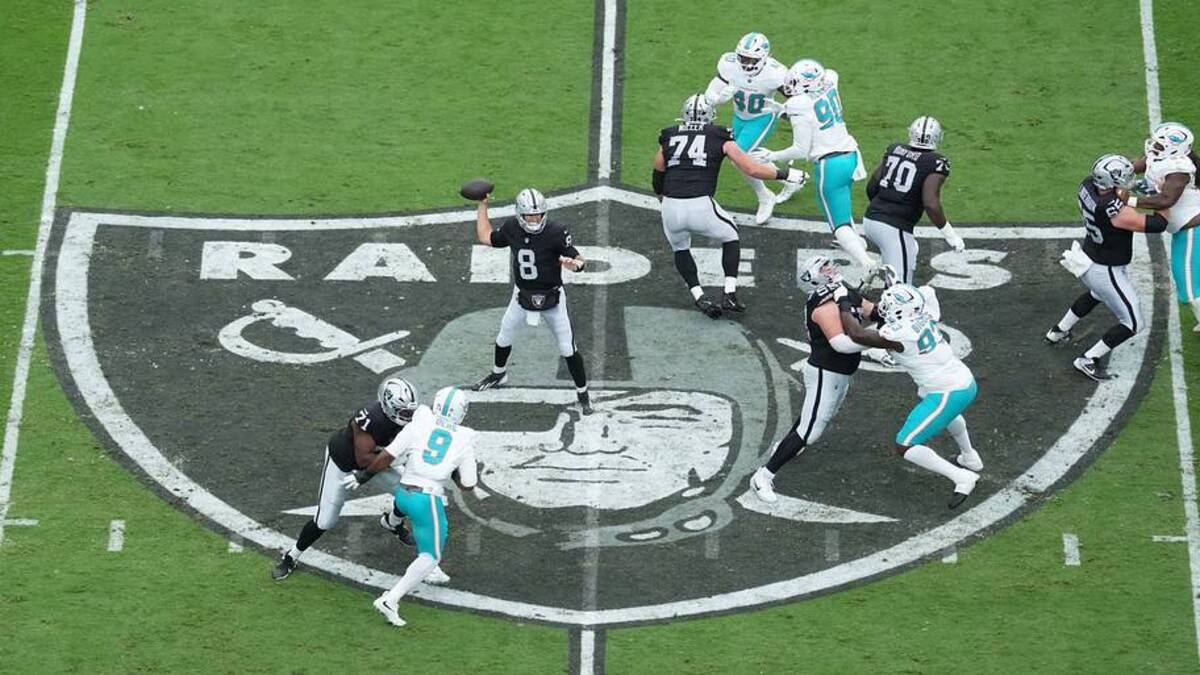
The Miami Dolphins opened the Jeff Hafley era with a 27-13 loss against the Las Vegas Raiders on Sunday.
Read more Texans LB Henry To’oTo’o to miss time with shoulder injury
Miami finished with just 31 fewer total yards than Las Vegas, and there were flashes from several of the team’s young players. But after losing to a Raiders team also expected to be among the league’s worst, there was plenty to clean up if Miami wants to prove it doesn’t still deserve to be grouped among the league’s worst teams.
The Dolphins converted just 2 of 10 third downs and scored a touchdown on only 1 of 3 trips to the red zone.
Meanwhile, Las Vegas controlled possession for nearly 35 minutes, converted five of 13 third downs (38.5%) and scored touchdowns on three of four red-zone trips (75%).
Here’s how each position group graded out in Miami’s season-opening loss:
THE DOLPHINS WEEK 1 GRADES
Quarterback: C-
Malik Willis flashed enough in his first start to show why the Dolphins were intrigued by him in free agency, but he wasn’t nearly consistent enough.
He completed 15 of 27 passes for 220 yards with no touchdowns and one interception, finishing with a 66.9 passer rating and 21.5 QBR. He added 39 yards on six carries, including a 14-yard touchdown that cut Las Vegas’ lead to 17-13 early in the third quarter. Willis was was sacked five times.
Not all of those sacks fell on the offensive line. There were multiple plays where Willis held onto the ball longer than he should have, and Las Vegas increasingly crowded the box and sent extra pressure as the game went on, taking advantage of his inability to consistently get through his reads quickly.
On his first sack, Willis stared down his first two options on the left side of the field and never saw Greg Dulcich crossing from the opposite side on a shallow crosser.
There were other instances where he seemed hesitant to pull the trigger even when he had a matchup worth attacking.
Some of that could come down to chemistry and trust in a new offense, but his processing speed and decisiveness will have to improve,
Late in the third quarter in the red zone. Las Vegas played man coverage, leaving rookie Chris Bell one-on-one up the seam from the slot. Willis appeared to work his way toward Bell in the progression but ultimately tucked the ball and scrambled rather than giving his receiver a chance.
Running Back: C-
If Miami’s offense is supposed to run through De’Von Achane, Week 1 didn’t go according to plan.
Achane finished with only 36 yards on 11 carries, averaging 3.3 yards per attempt, while catching four passes for another 30 yards. His longest run went for just 10 yards.
Much of that falls on the offensive line, as Achane rarely had much room to get going.
More encouragingly, Bobby Slowik showed some creativity in trying to get Achane involved. On one sequence, Miami lined up in a split-back look, motioned Achane out before bringing him back inside for a tunnel screen that gained 7 yards. On the very next play, Achane motioned into the slot, where Miami isolated him one-on-one. The outside receiver ran a post that created traffic underneath, allowing Achane to break free on a wheel route for a first down.
Those flashes never turned into sustained production, and 66 scrimmage yards from Miami’s biggest offensive weapon isn’t enough, especially when the Dolphins entered the game expecting the run game to be one of their strengths.
Miami’s other backs were barely involved. Jaylen Wright’s lone carry lost a yard, while Ollie Gordon II did not record an offensive touch.
Wide Receivers: B-
There weren’t many bright spots Sunday, but rookie receiver Caleb Douglas was a clear one.
The Texas Tech product caught five of seven targets for a game-high 94 yards, averaging 18.8 yards per reception. His 25.9% target share led all rookie receivers in Week 1, while his five catches, 94 yards and 35 yards after the catch also ranked first. It was the most receiving yards by a rookie in his debut since Puka Nacua had 119 in 2023.
Douglas showed his versatility, flashing the skill set that could eventually make him a true No. 1 receiver. From the slot, he swallowed a hit from Raiders safety Jeremy Chinn over the middle and fought through contact for a first down. Out wide, he beat press coverage, recognized the corner sinking into the flat in Cover 2 and throttled down to haul in a 25-yard completion that helped set up Miami’s first points of the game.
Chris Bell caught just one pass, but it went for 25 yards. Malik Washington added three receptions for 53 yards, including a 30-yard gain.
The grade takes a hit because Washington caught just three of eight targets and lost a fumble with two minutes remaining that officially ended Miami’s final possession. Rookie Kevin Coleman Jr. also went without a catch on two targets.
Still, for a position group viewed as one of Miami’s primary concerns entering the season, there were much more significant areas of concern Sunday, and Douglas’ debut was an encouraging start.
Tight Ends: D+
Greg Dulcich caught both of his targets for 18 yards, but the tight end room made no receiving impact outside of him.
Rookie Will Kacmarek was targeted once without a catch, and on seven run-blocking snaps, he earned a below-average 57.6 run-blocking grade from PFF.
It wasn’t a disastrous performance, but the group did very little to change the game.
Offensive Line: D-
This was one of the most disappointing position groups of the afternoon.
A solid argument can be made that most of Willis’ sacks were self-inflicted, but Las Vegas still recorded 11 quarterback hits, and the problems were even more obvious in the run game.
Achane averaged 3.3 yards per carry, and Miami’s running backs combined for just 35 yards on 12 attempts.
Read more NFL season opener ratings down 11% for Patriots-Seahawks
Penalties were another issue. Aaron Brewer was flagged twice, Patrick Paul drew another penalty, and Austin Jackson was called for illegal use of hands late in the game. Dolphins On SI’s Alain Poupart also noted Miami’s problems picking up twists up the middle, an issue that had previously surfaced during the joint practice against the Giants.
Willis willingly took part of the blame, but an offensive line Miami invested heavily in was supposed to look considerably more physical than this.
Defensive Line: F+
If there was one unit that fell furthest below expectations, this might be it.
Miami didn’t sack Kirk Cousins once and hit him just twice throughout the game.
Cousins is one of the least mobile quarterbacks Miami will face all year, and led the NFL in turnovers just two seasons ago before Atlanta benched him. The fact that Miami rarely forced him off his spot or made him uncomfortable in the pocket shows just how little impact the defensive front had.
Third-year pass rusher Chop Robinson entered the game coming off a strong training camp and was expected to emerge as Miami’s top pass rusher, but he was nearly invisible. He finished with just one assisted tackle and failed to record a quarterback hit.
Miami’s run defense struggled as well. Ashton Jeanty rushed for 102 yards on 23 carries, while Mike Washington Jr. added 41 yards on seven attempts. Zach Sieler remained one of the few consistent positives up front, finishing with two tackles for loss, but Jordan Phillips and Zeek Biggers generated little push against an interior offensive line featuring Spencer Burford, Tyler Linderbaum and Jackson Powers-Johnson, leaving Miami’s linebackers on mop-up duty at the second level.
For a team that has preached physicality since Hafley arrived, getting controlled at the line of scrimmage throughout the game deserves the lowest grade.
Linebackers: C+
Rookie Jacob Rodriguez looked like he belonged immediately, leading Miami with 14 tackles, including five solo stops. The Texas Tech product was also the NFL’s only rookie to wear the green dot in Week 1, and his 14 tackles ranked the second-most by any player in the league Sunday.
He was targeted three times, allowing two receptions for just seven yards. His 83.8 Pro Football Focus coverage grade ranked 10th among qualifying linebackers, while his overall grade ranked fifth at the position.
That grade doesn’t tell the whole story, however. Rodriguez also tripped over a lineman while trying to carry Jeanty on a wheel route, helping spring the running back for a receiving touchdown.
2025 first-team All-Pro Jordyn Brooks added nine tackles and one of Miami’s two quarterback hits.
The veteran linebacker wasn’t as effective in coverage, allowing receptions all five times he was targeted.
Defensive Backs: C+
This was Miami’s most encouraging defensive group, even if the performance wasn’t perfect.
Rookie Michael Taaffe intercepted Cousins on Las Vegas’ first possession of the second half, immediately setting up Miami’s only touchdown. Dante Trader Jr. added another interception later and returned it 14 yards.
Rookie Chris Johnson Jr. was active against the run, finishing second on the team with 11 tackles, along with two passes defended and a tackle for loss. There were still some issues in coverage, though. Johnson was beaten by Jack Bech on the Raiders’ opening touchdown, and Jeanty later got across his face for another score.
Cousins threw three touchdown passes despite finishing with only 160 yards through the air.
But considering Miami didn’t generate a consistent pass rush, holding Cousins to 5.3 yards per attempt and forcing two interceptions was a respectable effort.
Special Teams: D+
Miami produced one of the game’s best special teams plays and also allowed some of its most damaging ones.
Jaylen Wright returned two kickoffs for 106 yards, highlighted by a 79-yard return to the Las Vegas 18 late in the third quarter. Malik Washington also had a 17-yard punt return. Bradley Pinion averaged 45.8 yards on four punts and placed two inside the 20.
Now comes the negative.
Riley Patterson missed a 41-yard field goal immediately after Wright’s return, turning excellent field position into zero points.
Even worse was Miami’s kickoff coverage. Dylan Laube returned only two kicks but gained 95 yards, averaging 47.5 per return. His 50-yard return immediately after Willis’ touchdown gave Las Vegas the ball at midfield, and five plays later the Raiders had answered Miami’s score with another touchdown.
Miami isn’t talented enough right now to lose the special teams battle that badly.
Overall: D+
There were legitimate positives, with Douglas looking like a starting NFL receiver immediately, and Rodriguez piling up tackles while balancing his leadership responsibilities.
The safeties created two turnovers, and Willis already showcased a level of athleticism at quarterback that Miami hasn’t consistently had since Ryan Tannehill.
But the areas Jeff Hafley has emphasized most, physicality, line play and fundamentals , were the areas where Miami struggled most.
Las Vegas didn’t even need 300 yards of offense to win by two touchdowns. The Raiders simply controlled the trenches and capitalized when Miami made mistakes.
Today’s best reads
- Five Plays That Defined the Dolphins’ Week 1 Loss
- Four Winners And Four Losers In Dolphins Loss at Las Vegas
- Dolphins-Raiders Week 1 Halftime Observations
- Dolphins Poup-Porri: Willis, Expectations and Other Thoughts Heading into Week 1
- Dolphins-Raiders Week 1 National Predictions Roundup: How Many Dolphins Believers?
Copyright ABG-SI LLC. SPORTS ILLUSTRATED is a registered trademark of ABG-SI LLC. All Rights Reserved.
Read more Deshaun Watson expected to remain Browns’ QB1 in Week 2
This story was originally published September 14, 2026 at 12:56 PM.