 By admin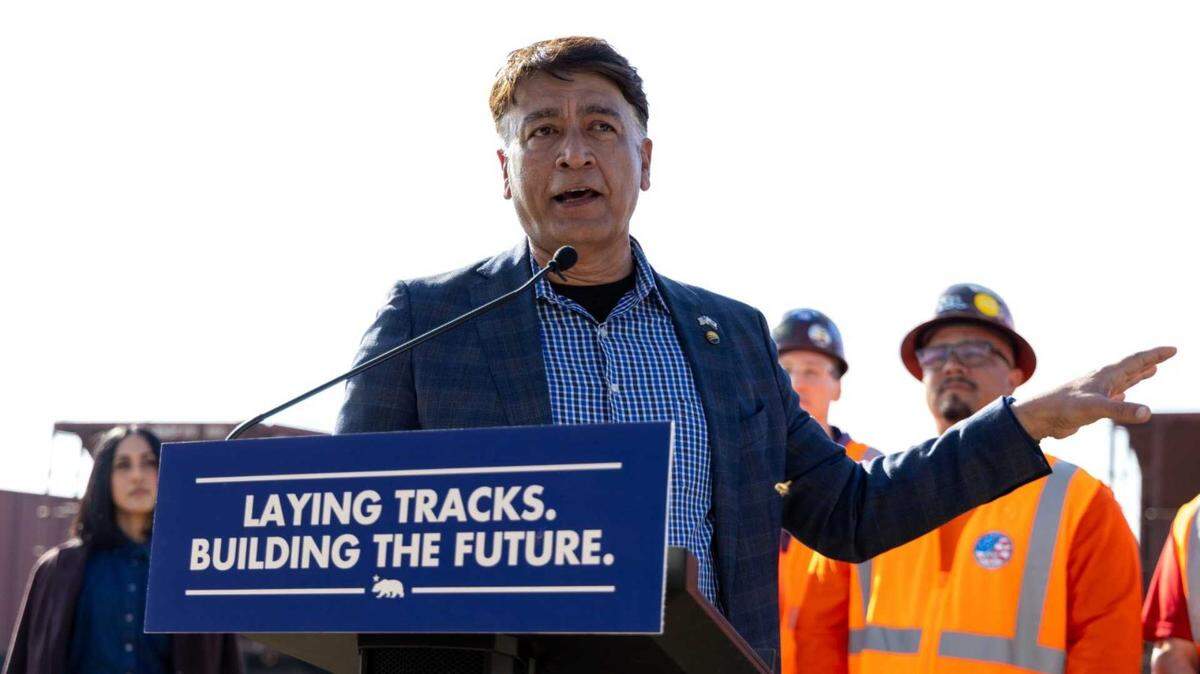
The agency overseeing California’s embattled bullet train system improperly paid almost $700,000 for consultants to take rideshares and luxury flights, and visit an escape room, restaurants, bars and a gym, published Tuesday.
Read more How a California gym, a farmers market and MMA fighters landed millions in the budget
Four consulting firms in charge of providing legal services, financial advising, program delivery and track and systems design billed the California High Speed Rail Authority around $2 million between June 2024 and April 2026, according to the agency’s Office of the Inspector General.
Authority officials, including chief executive Ian Choudri, improperly signed off on $680,500 worth of payments without verifying if the services were truly necessary, according to the OIG, in violation of state regulations. One legal consultant, a Denver transportation attorney, billed the agency nearly $130,000 in a single year for flights while charging almost $600 an hour for his services.
The firms named in the OIG report include the accounting giant KPMG, the Denver-based legal firm Nossaman LLP, and joint ventures Systra-Typsa and AECOM-Fluor, which are in charge of track and design systems and program delivery support.
The high speed rail project, which voters first approved nearly 20 years ago, has become a political liability for Democrats as budget estimates have ballooned and the project has been delayed for years due to litigation and regulatory hurdles.
Gov. Gavin Newsom recently installed several close aides on the agency board after police arrested Choudri earlier this year during a domestic dispute with his fiancée at his Folsom home. The Sacramento County District Attorney’s Office declined to file charges, and Choudri returned to the railway agency after a brief leave of absence.
KPMG, the accounting firm, employs Choudri’s fiancee. The High Speed Rail previously said she does not perform work that falls within the rail authority’s scope.
Some $543,400 of the billed payments violated state contracting rules with each firm, while $81,000 was not allowed under state travel rules, according to the OIG report.
The payments included private plane trips, premium rideshares to a restaurant and nightclub, international flights, and outings to a tiki bar, an escape room, a Washington, D.C. cigar lounge, and a Folsom steakhouse.
The OIG said the agency had agreed to adopt some of its recommendations to shore up internal guardrails around billing, and would review its progress later next year.
A High Speed Rail spokesperson said the agency took the watchdog’s findings “seriously.”
“In response, the Authority will strengthen internal controls around consultant travel, implement more rigorous documentation and approval requirements, and recover any improper costs identified,” the spokesperson said in an email. “We are also working closely with the OIG to ensure corrective action that is both accurate and fair.”
Senate Transportation Chair Dave Cortese, D-San Jose, said he would request that the rail agency be reimbursed.
“Consultants should expect that when they make an executive decision to travel without authorization, that they’re taking on the expense themselves,” he said in a statement. “Should there be any employee complicity at HSRA, I will demand management accountability.”
Read more New poll finds California voters feel pessimistic ahead of elections
Assembly Transportation committee chair Lori Wilson, D-Suisun City, said the consultants’ “abuse” of state resources was “unacceptable.”
“It is most concerning that these consultants serve in high-level roles and are directly responsible for delivering the high-speed rail project for the state,” she said in a statement. “I am very supportive of the work the Office of the Inspector General is doing and…strive to ensure the agency has every resource at its disposal so this project is delivered in a manner that upholds the investments made by the state’s taxpayers.”
The chamber’s Republican minority leader, Assemblymember Alexandra Macedo, seized upon the report as the party has criticized the project for years as an example of Democratic largesse.
“Only in California could a project that is years late and billions over budget somehow find money for consultant rides to a cigar lounge,” she said. “With his remaining time in office, Governor Newsom should make taxpayers whole and claw back every improper dollar. Californians are already paying some of the highest costs in the country. They should not be forced to subsidize consultant lifestyles for a rail project that still has not laid a single mile of track.”
Choudri is slated to speak at an international railway meetup in Berlin next week.
Officials frequently approved reimbursement after travel had already happened, and failed to require consultants to provide documentation like receipts, violating contract rules around wasteful spending.
“We often found little or no explanation of the need for consultants to travel, and when we did find stated purposes for travel those purposes frequently raised doubts about its necessity,” the OIG report read. “For example, the provided reasons were often vague, such as ‘meetings with HSR executives’ and at times described activities and services that appeared unrelated to the scope of work in the applicable contract.”
The legal services consultant, Colorado attorney Brent Butzin, billed the rail authority $127,000 for travel between September 2024 and September 2025, before switching to a financial advising contract, according to the inspector general report.
Butzin did not respond to two requests for comment.
Internal meeting minutes and public records showed Butzin traveled to Washington, D.C. at least once to speak at a conference on behalf of the railway authority while charging $570 an hour for his services.
“The amount of travel by other consultants we identified for the Legal Services contract was negligible (about $1,100),” the report read.
The OIG said only five of his trips were documented, and the official in charge of approving reimbursements was told Choudri or another agency executive had requested or wanted trip approval, without explaining why the trips were necessary or justifying their costs. Nor did contract managers have the authority to approve or deny trips, according to the report.
“In response to one of the contract manager’s emails, (the legal contractor) stated that it was not his responsibility to justify the need to be in-person when his presence at a meeting is requested by the Authority’s CEO,” the report read.
“He stated that it is not appropriate for him to second-guess or ignore direction received from the CEO, even if the CEO is not the contract manager, ‘as other consultants in other Authority offices are learning the hard way.’”
Read more For Diana Almendariz, the ‘real work’ keeps Indigenous cultural practices alive
The Capital Bureau’s Andrew Graham contributed to this article.
This story was originally published September 15, 2026 at 5:02 PM.