 By admin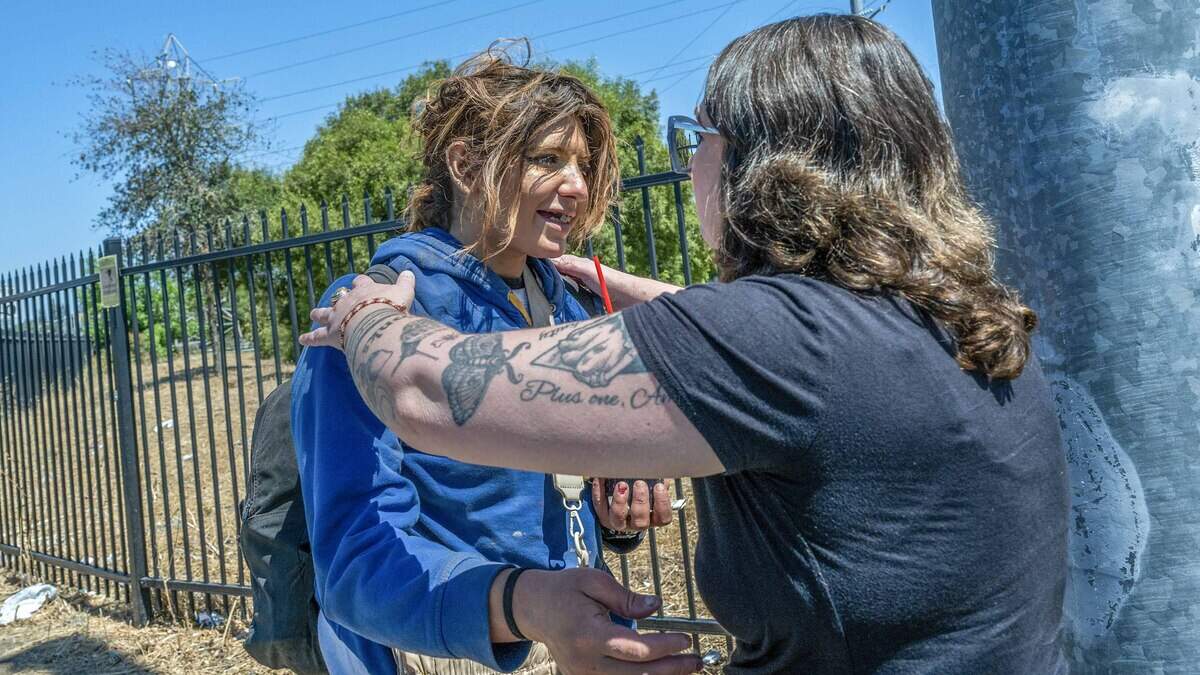
This column is the fourth of five detailing a promising college student’s descent into homelessness, and how government services have only exacerbated her downfall. It also is part of “The Poverty Line,” a series examining how safety-net systems are faring amid California’s rising affordability and mental-health crises.
Two Sacramento State students addicted to drugs, Jenna Mozdy and Califia Carlisle, met in 2015 in an inpatient group treatment program that didn’t exactly work. Carlisle soon taught Mozdy how to shoot heroin (a boyfriend snuck it in). A friendship in a fog was born.
Mozdy and Carlisle both dropped out of Sacramento State, slept on friends’ couches for a while, and ultimately became homeless in 2016. They stayed in touch but camped in different parts of the city (Califia near the university, Mozdy off Madison Avenue).
Mozdy has managed a remarkable transformation that started in 2018 because she became sober long enough to break out of her self-destructive cycle. She is now a certified drug treatment counselor in Santa Rosa.
Califia Carlisle, meanwhile, has lived on Sacramento’s streets for 10 years, rarely going more than a few days without access to drugs. Her father, Christopher, has sought court-ordered treatment for her three times, citing her addiction and schizophrenia. But California’s ineffective laws and progressive politics have left Califia in a cycle of addiction and homelessness. Her focus is on finding drugs, not on her own baby that Christopher this year adopted. Drug use has left her teeth badly decayed, yet her father has been unable to secure dental treatment because she refuses to stop smoking, a requirement for the work she needs.
The end result is that the people who love Califia, now 32, feel powerless.
“If nothing changes with our system,” said Mozdy, “I think (Califia) will be homeless until she dies.”
Yet Mozdy, now 38, is not giving up. She remembers the real Califia. “Her eyes smiled even brighter than her mouth. They really did twinkle.”
Hoping Califia would accept an offer of help, Mozdy traveled to Sacramento this summer to track down her old friend. Searching for Califia can be an ordeal whether you find her or not. On a mild Sunday morning in August, I joined the search, hoping for the elusive breakthrough. We checked all of Califia’s known nearby haunts.
The search started behind the Wendy’s restaurant at Folsom Boulevard and Power Inn Road. We then stopped by a Home Depot parking lot, a dumpster behind a nearby El Pollo Loco, a space between cinder block walls behind a Chevron station, an empty office building off Bicentennial Circle and the medians at Howe Avenue and Folsom Boulevard, where Califia begs motorists for cash. There is also the Express Stop liquor store near College Green, where on a cold night in November 2024, Califia gave birth to her daughter, Laura. Califia’s father and his wife, Anne, have since adopted their granddaughter.
Mozdy knows how to search for one of her own. The Pollo Loco dumpster, for example, stands inside a metal enclosure where there is enough space for someone to sleep. Mozdy looked inside but found nothing.
Off Kiefer Boulevard, where Califia has been known to camp, there is an abandoned home and a vast dirt lot that stands on private property behind a chain-link fence. Someone had cut a large opening in the fence. Mozdy snaked through, trespassing without a thought. “Hello!” Mozdy said at the front door. “Hello!” Nothing.
Mozdy knows a thing or two about crashing in unauthorized places. In 2018, her parents allowed her to stay in their Sacramento home while they were away. Unbeknownst to them was how Mozdy’s boyfriend, also an addict, planned to join. He entered the home through a front window. A neighbor was watching and called the police.
When officers arrived, “they realized I was still using drugs, despite being on probation and despite being on an ankle monitor,” Mozdy said. “I had to go back to jail.”
Califia has never been incarcerated long enough for her addictions and mental illness to be treated effectively enough for her to regain a sound mind. For Mozdy, jail for 10 days turned out to be her salvation. “I think I had enough time away from my drug of choice for my head to gain a little bit of clarity,” she said.
One gesture of humanity forever changed her life. Her mother, Wanda, a retired state data analyst and writer, had never abandoned her wayward daughter. At that pivotal moment, Wanda had the instinct to ask her daughter if she was finally ready for treatment, hoping for a different answer than Mozdy’s previous rejections. “I was able to say yes,” Jenna Mozdy said.
For the last six years, Mozdy has worked in various drug treatment roles. For the last 18 months she has been a certified counselor at Pura Vida Recovery in Santa Rosa. There, she helps clients on that treacherous path toward a clean life.
Read more Your guide to California’s Proposition 41
“You have to learn how to be a human being again,” she said.
On this Sunday, the last hope of finding Califia was at a Starbucks kitty-corner from the Home Depot on Folsom Boulevard. An adjacent encampment where Califia was living had been swept a few weeks before. She was nowhere to be found.
Mozdy walked over an embankment to scan the horizon at the corner of Folsom and Howe. She was about to give up the search.
And then it happened.
Waiting to cross eight lanes of traffic was a young homeless woman in shorts and a hoodie carrying a navy-blue backpack.
It was Califia.
She recognized Mozdy despite the cars whizzing by. The lights hadn’t changed before Califia started a dangerous crossing.
The reunion started with a long hug.
“You look beautiful!” Califia said to her friend. Mozdy asked if she had time for Starbucks. “I have to meet someone,” Califia said. So the two began walking eastbound along Folsom Boulevard.
Califia told Mozdy how she was getting dentures soon, having lost many teeth due to drugs (most likely methamphetamine). This was a lie, says her father. Califia had refused dental treatment months earlier because implants would require her to stop smoking cigarettes, something she refused to do.
“I hear you have a baby,” Mozdy said.
“I had a baby!” Califia said in a proud tone. She talked about how her dad has shown her pictures of her daughter.
But after that initial moment of joy, something began to happen to Califia in her interaction with Mozdy. The reunion was perhaps five minutes in all. And as it transpired, Carlisle was withdrawing. Something else seemed on her mind about that appointment up the street.
“I think she is probably scoring,” Mozdy said. Scoring, as in buying drugs. The addiction was overwhelming any other impulse, and Califia was too ill to know it.
In her final fleeting moment, Mozdy reached out. “If you ever want help,” she said to Califia, looking right at her, “I am here. I love you.”
Califia stared blankly at Mozdy for the longest time while saying nothing. And then she said, “I love you,” turned and walked away.
All Mozdy could do was burst into tears.
“She is in there,” Mozdy said of Califia. As for the person who had just walked away from a friend’s offer of help and her own daughter? “That’s not her,” Mozdy said.
These are loving, hopeful sentiments, but the reality is that Califia sleeps outside, begs for money, and chooses searching for drugs over people who love her because California sanctions this tragedy. Califia’s sad life is a reflection of her own bad choices in her zombie state, ineffective court systems and Democrats whose “progressive” politics have played a role in keeping Califia exactly where she is today, much to the dismay of the people who love her.
It is ironic that Califia has chosen to live about five miles away from the state Capitol. There, in the halls of power, lawmakers set the policies to manage homelessness in California. It is the one building where select Californians can alter policies to establish a better response to the humanitarian crisis. But the Democrats in charge, from Gov. Gavin Newsom on down, have not. Yet.
Read more What is Prop. 4? Measure allows public campaign financing in local elections