 By admin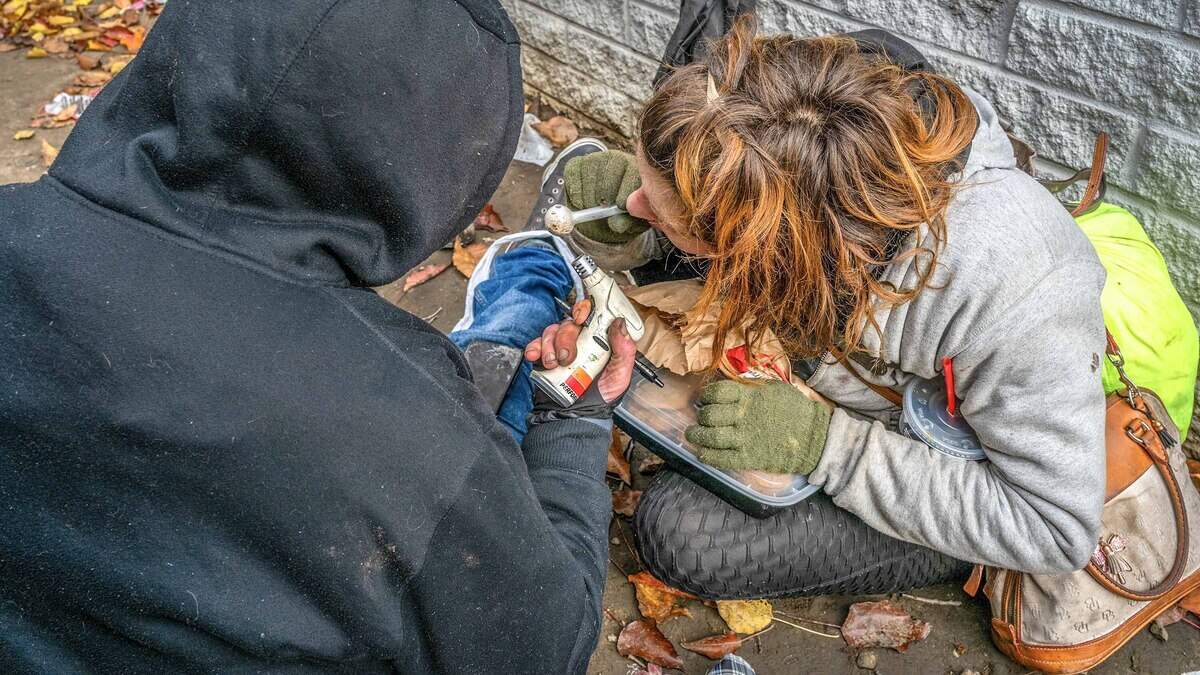
This column is the last of five detailing a promising college student’s descent into homelessness, and how government services have only exacerbated her downfall. It also is part of “The Poverty Line,” a series examining how safety-net systems are faring amid California’s rising affordability and mental-health crises.
Read more ‘Creating an experience of healing’ helps Shana Henry guide educators into leadership
For years, California Democrats have resisted compelling care for people needing mental health or drug abuse treatment. Consider what happened to State Senator Susan Eggman’s modest reform proposal back in 2021.
The legislator from Stockton sought to allow conservatorship courts, where treatment can be mandated, to allow testimony from behavioral experts based on their medical records when an in-person evaluation proved impossible. The law at the time considered such evidence hearsay and inadmissible. Allowing into the record this evidence could have led to more required treatment. This minor change proved so controversial among Democrats in charge of the Assembly that Eggman was denied a hearing on the legislation.
“It is not progressive to leave people lying in their feces on the street,” said Eggman, who left the Legislature in 2024 due to term limits.
Yet thousands of Californians without the capacity to fend for themselves are left to do so. Among them is Califia Carlisle of Sacramento. Now 32 years old, she has spent nearly a third of her life homeless, on the streets near The Home Depot off Howe Avenue and Folsom Boulevard.
Carlisle has never faced any requirement to treat her mental illness and addiction. Three different proceedings over the years have come up short.
Her father, 68-year-old Christopher Carlisle, has tried every process available in California to secure care. And now, after his daughter had a baby in 2024 behind a Sacramento liquor store — a child he and his new wife have since adopted — he doesn’t know what else to do.
“I want her to go to jail,” he said. “There’s at least the possibility that she might get some mental health treatment.”
His rationale is not far-fetched. Ten days in jail is what broke the cycle of addiction for one of Califia’s homeless friends, Jenna Mozdy, who now lives in Santa Rosa.
“I had enough time away from my drug of choice for my head to gain a little bit of clarity,” she said, after being arrested in 2018 for violating probation.
For the past six years, she has helped other addicts while working in one treatment center or another, now at Pura Vida Recovery in Santa Rosa. Mozdy has seen everything.
“The whole entire system needs to be redone,” she said. “That’s the big picture.”
Over the last generation, Democrats made admirable policy strides. They have confronted a failed war on drugs, reduced excessive sentencing for minor drug offenses and reduced California’s prison population.
Yet now the Democratic leadership finds itself out of step with the mainstream public. Most of us are fed up with repeat petty thieves forcing stores to hide their merchandise behind locked cabinets, or chronic fentanyl users that refuse treatment. As for the homeless, how did California become a state that considers it uncompassionate to get these desperate souls the help they need, even if it’s mandatory as the last resort? But that is the prevailing orthodoxy in Sacramento.
As examples at the Democrats’ reluctance to address real problems, in 2024 party leadership resisted classifying child sex trafficking as a serious felony. Democrats also initially fought elevating the solicitation of a 16-year-old by an adult to a felony in 2025. Gov. Gavin Newsom and his party leadership fought, and lost in a landslide, an initiative that mandated state-funded treatment as an option for a repeat fentanyl user as an alternative to a stiffer sentence. Despite this clear directive from voters, Newsom and fellow Democrats in Sacramento have refused to provide the necessary state funding for this treatment.
Read more A California cooldown with Sierra fire risks — this weekend’s temps and wind
This resistance to enhancing any enforcement approach to anything began to take hold just as homelessness exploded in California this decade. Califia Carlisle picked the wrong era to need help. Because no social service agency or non-profit organization, based on my interactions with her for nearly a year, seems to know she even exists.
“Right now,” Mozdy said, “I don’t think that Califia is of sound mind.”
What’s missing in the California Legislature is an approach to homelessness, addiction, and mental illness that matches the nuances of the real world. History suggests that a reform movement would face an uphill battle. Yet here are some places to start.
Bring back the teeth to CARE Court
Newsom’s signature legislative achievement to reform the state’s mental health system is falling short. All Democrats need to do is return to the original legislative proposal.
Democrats in 2022 approved the new “CARE Court” system so that nonprofits, law enforcement, behavioral health specialists and families could petition for treatment on behalf of someone who needs it. But they made this court strictly voluntary, stripping the ability of the court to order care from the original legislation.
So when Califia Carlisle refused to participate in a court-ordered evaluation after her father had petitioned the CARE Court in 2024, the process ended. That’s wrong.
So long as CARE Court remains a purely voluntary judicial system, “we have to temper our expectations,” Eggman said.
Embrace drug treatment, again
Not so long ago, Democrats sought to win the war on drugs by lowering demand through treatment rather than by incarcerating users. Then along came the passage of Proposition 36 in 2024. It directed the expansion of treatment as an alternative to longer sentences for repeat fentanyl use. An opponent of Prop. 36, Newsom has resisted a state role in funding the necessary treatment programs, saying it is the responsibility of counties, not him.
Democrats have managed to contort themselves into opposing more drug treatment. This represents a complete reversal of their earlier support of prevention to overcome addiction. The party needs to fight addiction the smart way by supporting treatment and prevention, even if it is compelled in some cases.
Commit to homeless funding
At a June meeting, Sacramento City Councilmember Karina Talamantes asked why the city didn’t require homeless residents in local shelters funded by the state to take advantage of available treatment programs. The staff explained how such a requirement would be illegal as part of the state’s philosophy.
Newsom and legislative Democrats have been waffling in recent years on consistently funding local shelters, with zero new funding in 2025, for example. They should do so to the tune of $1 billion a year as a bare minimum. There should be a little room in a $280 billion state budget to address California’s greatest humanitarian crisis.
And the Democrats should allow local governments like Sacramento to experiment some of these funds on shelters that require treatment so long as there is reporting on how the experiment went. It stands to reason that a homeless person seeking treatment for addiction doesn’t want to be in a state-funded shelter where drugs are readily available.
After working on mental health policy for decades and leading Sacramento as mayor for eight years, Darrell Steinberg came to a conclusion. “It is not a civil right to be living on the streets,” he said. “In this society, there should be a legal right to housing and treatment, and there should be a legal obligation to accept it when offered. End of story.”
Is there room in Sacramento for a political discussion about new responses to homelessness? Maybe so.
“I think the political winds have changed,” Eggman said.
A true effort to rescue those like Califia Carlisle from addiction and mental illness would be the humane, and progressive, thing to do.
Read more Moldy rice, rodent droppings. What else was found at these Sacramento-area eateries