 By admin
AI-generated summary reviewed by our newsroom.
Read our AI Policy.
- 50 years ago, on Oct. 21, 1976, three men died in a hot-air balloon crash in Charlotte.
- The balloon, thought to be the largest in the world, belonged to a father-and-son team.
- The balloon crash is largely forgotten today, and an aura of mystery surrounds it.
From a few hundred feet in the air, the utility poles are easy enough to see.
The wires are another matter.
Charles Page points them out from the basket of his hot-air balloon as it drifts over farmland and towering oak trees in the township of Cool Springs, about 50 miles north of Charlotte. Look for the poles, the veteran balloon pilot explains to the two men along for the ride, because sometimes the thin lines strung between them all but disappear against the ground below.
Read more Placer County puts up $6M loan for wildfire debris project. What are the risks?
“You see a pole,” Page says, “probably a line coming to it from somewhere.”
It is a beautiful September evening, almost impossibly peaceful between blasts from the propane burner overhead. The balloon floats on.
On another clear day, 50 years earlier, another balloon had floated above Charlotte. That one was enormous — at 10 stories tall the biggest hot-air balloon in the world, according to its owners — and well-known enough to have once played a co-starring role in a Hollywood movie.
It was Oct. 21, 1976, and three men had climbed into its basket on the football field at Johnson C. Smith University for what was supposed to be a flight over the city to promote a Mecklenburg County fair.
Less than half an hour later, at 12:53 p.m., the balloon descended toward North Myers Street and Belmont Avenue in uptown Charlotte, where 100,000-volt power lines that its pilot apparently didn’t see lay in wait.
The balloon struck the lines. The basket caught fire. All three aboard were killed.
Half a century later, the fatal flight of the balloon its owners called the “Spirit of America” has largely faded from Charlotte’s memory. The federal accident report is rather scant, and since no one aboard survived to tell the story, what went wrong on that day has largely remained a mystery.
But contemporary newspaper accounts and photographs, the memories of relatives and witnesses, and months of reporting by The Charlotte Observer reveal a fuller story.
It is the story of a series of seemingly ordinary decisions, made by three men who climbed into a balloon. It is the story of two people who, through accidents of circumstance, never did. And — perhaps most pointedly — it is the story of how the consequences of one tragic afternoon rippled through numerous families and shaped dozens of lives for decades afterward, in ways both devastating and unexpected.
A spectacle in the sky
Seven years earlier, the balloon had appeared in the 1969 comedy “The Great Bank Robbery,” starring Zero Mostel and Kim Novak. In the movie, the balloon served as a decidedly conspicuous getaway vehicle — a memorable role in an otherwise forgettable film that New York Times critic Vincent Canby dismissed as an “inept Western farce.”
The balloon was built to attract attention.
Its brightly colored envelope featured portraits of American presidents and other figures from U.S. history — a particularly fitting design for 1976, when the country was celebrating its bicentennial.
That October, the “Spirit of America” had come to Charlotte to help promote the Mecklenburg Jaycees’ Old Time Fair at the Metrolina Fairgrounds off Statesville Road.
The men who brought it were Sidney Gibson, 53, and his son Patrick, 28, of Pennsylvania.
For the Gibsons, the balloon was more than a novelty. It was a business proposition: an enormous, airborne advertisement that could attract crowds, generate publicity and, they hoped, make money.
Both the timing and the location seemed right.
Although modern recreational hot-air ballooning was still in its infancy in the United States, its popularity was soaring, with technological breakthroughs in the 1960s having made the sport safer and more predictable.
Meanwhile, the area around Statesville, just north of Charlotte, had blossomed into a ballooning hub in large part because the region offered gentle landscapes, open rural property, and weather patterns that supported frequent local launches; and those qualities helped the region birth a major hot-air balloon manufacturer as well as a reputed training school for pilots.
The co-founder of that school — Statesville native Bill Meadows, a pioneering balloonist who became the Southeast’s first FAA-licensed hot-air-balloon pilot in 1969 — understood the commercial possibilities from the start. Before he’d taken his first lesson, Meadows persuaded a local shopping center to advance him $300 to stage an airborne promotion. Then he used some of the cash to pay his new instructor, pulled off the publicity stunt, and pocketed the difference.
“I made money on my first training flight,” Meadows said in a recent interview.
Over the next decade, ballooning “just exploded,” he said, and in 1974, Meadows founded the National Balloon Rally in Statesville, bringing balloonists together and helping introduce the spectacle to growing crowds.
The Gibsons were hoping to capitalize on that same fascination.
At the Metrolina Fairgrounds, the idea was for the “Spirit of America” to rise about 150 feet above the festivities while remaining tethered to the ground, giving paying customers a taste of ballooning without actually going anywhere.
But on Oct. 21, the Gibsons saw an opportunity to reach an audience beyond the fairgrounds.
‘They loved an adventure’
Purchasing the massive hot-air balloon in 1975 — despite having no previous ballooning experience — was certainly an unusual idea.
But the Gibsons had a bold spirit that they nourished in part by owning and flying small airplanes. They enjoyed being high in the air, away from their day-to-day worries.
“They liked living on the edge,” said Sydney Gibson Churilla, who is now 82 years old, was named for her father Sidney and was the eldest of the three Gibson children. “They loved an adventure.”
They liked living on the edge. They loved an adventure.
Sydney Gibson Churilla
Daughter of Sidney Gibson and brother of Pat Gibson
Sidney Gibson had been a B-17 bomber pilot in World War II and had flown 38 missions for the Army Air Corps, his daughter said. He nicknamed the airplane he flew during the war “Yvonne,” which was his wife’s name. Patrick Gibson, the middle son, served in Vietnam with the Marines. “He was a bit of a rogue,” his sister said. “The ladies loved him.”
Churilla remembered that her brother once dated two Playboy bunnies in the early 1970s — at the same time.
Patrick was particularly close to his father.
“Oh yeah, they were the pair,” Churilla said. “It was the two of them against the world.”
As America’s 200th birthday approached on July 4, 1976, the Gibsons started to more thoroughly explore potential moneymaking opportunities with their balloon. In early 1976, Sidney Gibson tried at least twice to make the balloon a centerpiece of a small summer fair, envisioning thousands of people coming to marvel at and ride in the balloon.
These rides, he told local officials, would be safely tethered and go no more than 200 feet in the air.
But both attempts at creating the event — one near the family’s home in Levittown, Pa., and one in Trenton, N.J., about 15 minutes away — got tangled in red tape and never got off the ground.
No problem, the Gibsons decided.
There were plenty of other fairs around. They could simply barnstorm with their balloon to some of those instead. That’s how they ended up in Charlotte, having driven 570 miles from Pennsylvania to work the Jaycees’ inaugural Old Time Fair, which would run Oct. 19-24.
And the fair was old-timey, all right. It included prize livestock, as well as carnival rides, a petting zoo and contests for seed-spitting, tobacco-spitting, hog-calling and foosball. Admission was $4 for adults and $2 for children.
“There were animals, there was cotton candy, there were candy apples — it was a typical fair,” said Noelle Henderson Singleton, who attended the event that year as a little girl and also presented then-Charlotte mayor John Belk with a pair of overalls in a publicity stunt shortly before it began.
Advertisements for the fair and newspaper preview stories showed that the Gibsons planned to sell tethered balloon rides for $3 per person or $5 per couple.
But they also agreed on that fateful morning to allow a few people to fly for free.
How these 3 ended up together
One of the passengers was James Vogan, 29, of Towson, Md. A Navy veteran of the Vietnam War, he worked at the fair’s other headline attraction — a “jet helicopter” — helping arrange appearances and selling $6 tickets for rides.
Vogan had two boys back in Wyoming who knew him in very different ways.
His 13-year-old stepson, Brandon McNamara, lost his biological father in a car accident before he turned 2. After Vogan married Brandon’s mother, Brandon recalled, “He treated me like his own son. … He was my dad.”
He has fond memories of his stepfather. He remembers evenings spent swimming at the family’s apartment complex in Richmond. He remembers Vogan’s occasional attempt to shed a few pounds by putting on a plastic sauna suit and going for walks. He remembers Vogan taking him to watch the Baltimore Orioles practice, sitting together near the backstop, and that once, Vogan took him to a Baltimore Colts game where he met legendary quarterback Johnny Unitas.
Vogan’s biological son, Lee Jacobs, has no memories like that at all.
Lee was only about 3 when his mother, who was also Brandon’s mother, separated from Vogan. After that, he believes he never saw his father again. By the time Vogan climbed aboard the balloon in Charlotte, Lee was 8 years old and living in Wyoming with his mom, his stepdad, and his brother Brandon.
Asked if he remembers any particular moments he shared with his dad, Lee’s answer was brief: “Not really.”
But he did say his understanding is that Vogan was friends with the balloon operator — which mostly aligns with Churilla’s belief that Sidney and Patrick struck a deal with Vogan at the fair in Charlotte.
“My dad and brother had never been in that particular helicopter,” she said. “So they were trading rides. That’s what they planned to do.”
All hot-air balloon flights were canceled on the first two days of the fair because of high wind conditions. But on Day 3 — Oct. 21, 1976 — the Gibsons and Vogan drove the balloon six miles from the Metrolina Fairgrounds to Johnson C. Smith University. If launched from there, the prevailing winds meant that the balloon would float over Charlotte.
The idea was, simply, to promote the fair.
Newspaper reports at the time said the men planned to fly at a low altitude of 50 to 100 feet — and yell down to passersby with a bullhorn.
‘The worst day of my life’
The balloon took off at 12:30 p.m. from the J.C. Smith football field, according to a 1976 report in The Charlotte News.
At first, the flight seemed to go as planned. The balloon was certainly visible: It was seen by Charlotte office workers on their lunch break, schoolchildren who were outside playing for recess, and people outside in their backyards as it sailed over uptown Charlotte.
Because there were so few hot-air balloons in the world at the time, and since the balloon was taller than most of Charlotte’s “skyscrapers” in 1976, it’s easy to imagine the wonder the balloon provoked.
The wind ushered the balloon southeast for about two miles. But at some point, trouble began.
The balloon, which wasn’t supposed to rise much above 100 feet for this ride, was thought by some witnesses to be 10 to 15 times higher than that. Then it inexplicably began a sudden, steep descent.
It was 12:53 p.m. when the balloon crashed.
One witness who was outside eating his lunch told a newspaper reporter at the time that he saw the balloon sail over a pecan tree, hit the power lines and then explode “like dynamite.” If you were anywhere in the uptown area, even if you didn’t hear the explosion, your lights flickered on and off.
As the balloon and its occupants fell to the ground, the nylon envelope and the gondola separated, and the wreckage scattered over a roughly 100-yard area, parts of it blackened by the explosion and resulting fire.
Onlookers and policemen rushed to the balloon’s basket to find the three men lying crumpled on the ground. One officer who kept any would-be Good Samaritans back explained later in the week that he was afraid a propane tank still attached to the balloon would explode and injure or kill more people.
Sydney Gibson Churilla, 32 at the time, was driving home from a family vacation to Orlando and Disneyland with her husband and their two daughters when the news came on the radio. They had stored the balloon’s gondola in her garage for months before loading it up, so she knew her father and brother were in Charlotte, working on their balloon dream.
“A father-and-son balloon team was killed in North Carolina…” the radio announcer began. After that, she didn’t really hear the rest.
She and her husband found a phone booth and started calling people, desperately, to get more information.
“That was the worst day of my life then,” Churilla said recently. “And 50 years later, it remains the worst day of my life.”
Later that day, more than halfway across the country, James Vogan’s former wife was telling her sons, Brandon and Lee, that their dad had been killed. Then she and her husband drove the boys out into the wide-open Wyoming landscape to watch the sunset in Vogan’s memory.
All Brandon and Lee remember is it hurting.
How did this happen?
Half a century later, the decisions that put Vogan and the Gibsons aboard the “Spirit of America” remain difficult to fully explain.
But the danger that brought their flight to an end is not. Asked what he thinks about power lines, veteran balloon pilot Charles Page has a succinct answer: “We don’t like ’em.”
Hitting one isn’t always fatal. But as Page puts it: “Guaranteed, if you run into power lines, it will make the news.”
Guaranteed, if you run into power lines, it will make the news.
Charles Page
Veteran balloon pilot
The 1976 balloon crash was itself a rarity — the first in North Carolina to claim multiple lives, according to reports at the time.
So what went wrong?
The Federal Aviation Administration investigated, and the National Transportation Safety Board issued its findings in a report barely half a page long. But it identified several problems.
The balloon had equipment deficiencies and had not been modified for free flight. Neither Sidney nor Patrick Gibson was qualified to operate it in those conditions. Investigators also cited unfavorable winds — blowing at roughly 10 to 12 mph in Charlotte that day. And the balloon was also known to have a small rip in its fabric, although the Gibsons had been working to repair it at the fair.
Yet for an accident that killed three people, it seemed less-than-thorough.
Bob Benzon, a retired NTSB investigator who spent 27 years with the agency, explained in a recent interview that the crash received what was known as a “limited report.”
“In those, an FAA guy would go out and get the facts, and he’d write up a little report and send it to the NTSB person who would copy it, analyze it and that would be it,” said Benzon, who did not investigate the crash himself but reviewed the report at The Observer’s request.
What the report did not resolve was why the men had taken the balloon into free flight in the first place — why, after advertising tethered rides at the fairgrounds, they launched six miles away, on what contemporary newspaper accounts described as a promotional flight over Charlotte.
Read more Idaho seeks death penalty against mother who blamed vaccines for twins’ deaths
The Gibson family, for their part, has never accepted that Sidney and Patrick deliberately set out on an untethered flight.
“We believe it was a freak accident with a gust of wind that undid them and threw them up in the air in the balloon,” said Sidney’s daughter, Sydney Gibson Churilla.
For James Vogan’s sons, the uncertainty extends beyond what happened in the air.
While Brandon Jacobs has simply held onto the memories of a man who treated him as his own son, Lee Jacobs has spent part of his adult life trying to learn who his father was.
With Brandon’s help, he reconnected with relatives on the Vogan side of the family and learned what he could about his dad from them. About a decade ago, he traveled to Maryland and visited the family burial plot where his father has a marker. And after finding an online memorial page for James Vogan, Lee left a message consisting of just two words: “My dad.”
Today, he keeps photographs of the father he never knew and his father’s helicopter hanging on his wall.
“I would like to have known my dad a little better, but s— happens. It is what it is,” Lee said. “By all accounts, he was a good man. Served his country.”
Then he added: “All his family loved him.”
‘A series of decisions’
John Daughtry is trying to make sure his memory isn’t failing him.
The former Charlotte Observer photographer is walking beneath power lines along North Myers Street, looking up, looking down, looking all around, squinting in the midday August sun. He’s with a small team from the Observer, carrying photographs he took that afternoon, five decades ago.
“Well, it looks right,” Daughtry says. But after five decades, the precise geography has grown hazy in his memory.
And to be fair, much has changed in this neighborhood just northeast of uptown. Buildings have been replaced. Trees have grown. Few people passing through today would have any reason to remember the long-ago tragedy that unfolded here.
Within a few more minutes, though, the group realizes some landmarks remain.
In comparing Daughtry’s old photographs with the present-day streetscape, the men identify a house near 1121 N. Myers St. that dates to 1948 and appears in both. The arrangement of nearby buildings and utility poles in the photos and in front of them also match up — which can only mean one thing:
This is where the balloon fell.
For Daughtry, who was dispatched to work the crash by his editor that day, the assignment was one of the most disturbing of his career.
While Daughtry doesn’t remember everything he or his camera saw that afternoon, he does remember being among the first to arrive on the scene. The emptiness, the street having been cleared of traffic, him standing virtually alone in the middle of it — and the charred body of one of the victims, an image so surreal that the closest comparison Daughtry can summon is something from Pompeii.
Yet when he looks back on it now, what strikes him isn’t simply the loss of life. It’s the horrible happenstance.
“I don’t think you worry about the needlessness of it,” he said, “so much as the accidental circumstance that these people were sort of thrown together by a series of decisions.”
…. These people were sort of thrown together by a series of decisions.
John Daughtry
Former Charlotte Observer photographer
Sidney and Patrick Gibson had brought their balloon to Charlotte to promote a fair. James Vogan had come to town for work connected to the same event. Their paths had converged in the basket of the “Spirit of America” on a Thursday afternoon.
But two more people had been expected to ride in the balloon that day and wound up not getting on board.
One was a young Observer reporter who had originally been assigned to write about the flight. The other was a man helping organize the fair who had experienced an eerily similar brush with death once before.
The man who cheated death twice
The invitation for Guy Henderson to ride on the balloon that day made sense: The 30-year-old Charlottean was the Mecklenburg Jaycees’ special events chairman, helping to coordinate everything to do with the fair. He had met the balloonists and liked them, so he considered the idea. There would have been room in the gondola.
But Henderson’s real job at the time intervened. The president of a local concrete drilling company, he got too busy at work and didn’t make it to the balloon’s launch site. So he skipped it, figuring he’d try again later in the week.
Incredibly, just over two years earlier, Henderson had missed another flight that ended in tragedy.
On the morning of Sept. 11, 1974, he had been scheduled to be a passenger on Eastern Flight 212, traveling from Charleston, S.C., to Charlotte. He overslept in his hotel room, though, and missed it.
The plane ultimately crashed three miles short of the runway in Charlotte, killing 72 people in what remains the worst aviation disaster in the city’s history.
Later that same day, Henderson flew home to Charlotte, where his family — and the media — were waiting to greet him.
“I remember a bunch of reporters and cameras in my face at the airport,” said Guy’s daughter, Noelle Henderson Singleton, who was 5 years old at the time. “Back then you could go all the way to the gate. So my mom and me and my brother and my cousins were all standing at the gate, with all the reporters surrounding us.”
After the balloon crash two years later, a newspaper headline summed up Henderson’s extraordinary history of near misses: “He’s Missed Death Twice In 2 Years.”
But while he escaped death, Henderson couldn’t completely escape the horror of the accident. Because he had known all three victims and due to his role with the Jaycees, he was called to the crash site to help identify their bodies.
“That traumatized him,” his daughter said. “No doubt about that.”
At the same time, Henderson had his own explanation for why he’d been spared. On the day of the crash, when Guy Henderson spoke to a Charlotte Observer reporter, he attributed his survival to something beyond chance. “The Lord looks after me,” he said. “That’s who runs our lives.”
But did escaping death twice change the way Henderson lived? Not particularly, according to his daughter.
“I don’t think it really changed him at all,” Singleton said. “I think it gave him… a conversation starter. A fun story to tell… I think it fed his ego a little bit.”
Henderson was a risk-taker, racing cars at Charlotte’s Shuffletown Dragway in his younger years and scuba diving for work and pleasure later in life. And to his friends, he could be the life of the party. “Guy was jovial,” said Jimmy Odom, a longtime friend. “Funny. He’d try anything.”
But Henderson’s relationship with his daughter was more complicated. Singleton said the two eventually became estranged.
In his final years, Henderson lived in a nursing home, where Odom continued visiting him regularly. “I’d go to the nursing home and wheel him out in his wheelchair and we’d smoke cigarettes,” Odom said. “I did it because I didn’t know if anyone else was visiting him.”
Henderson died in 2016, 40 years after the balloon crash.
The reporter who changed course
On the morning of Oct. 21, 1976, Vanessa Gallman went looking for the hot-air balloon.
The Charlotte native was 23, five months into her first journalism job at her hometown newspaper, the Observer, and had been assigned to take a ride in the “Spirit of America” for a feature story about the experience.
But when she arrived at the Metrolina Fairgrounds, where the balloon was advertised to be offering promotional rides, it was gone.
Gallman learned that the balloon had been moved because of windy conditions. Her editor wanted her to track it down, but a call to the motel where its owners were staying led nowhere. Sidney and Patrick Gibson had already left to prepare for the flight.
Worried about returning to the newsroom empty-handed, Gallman found another story instead: a woman who traveled with the carnival and cooked breakfast for its workers. She spent the next hour interviewing her, figuring she could pursue the balloon assignment another day.
By the time Gallman returned to the Observer’s parking deck to start writing her backup story, three men were dead.
Another reporter, on her way out, delivered the news through her car window: “The hot-air balloon crashed.”
Gallman followed her colleague to the crash site, where the victims’ bodies had already been taken away. What remained was wreckage — twisted metal, pieces of the balloon — and the smell of something burned.
As Gallman spoke with witnesses, she couldn’t help thinking about what might have happened if she’d found the balloon that morning. She imagined the grief her family would have endured, along with the guilt her editors might have felt for assigning her to the flight.
The next morning, her first-person account appeared on The Observer’s front page beneath the headline: “She Missed The Ill-Fated Ride.”
What Gallman’s column did not mention was that she was a single mother with a 4-year-old daughter — her only child, Erica, who was just a week away from her fifth birthday when her mother narrowly missed the fatal flight.
Although Erica Teal says her mom “mothered me almost like a little adult,” Gallman didn’t tell her about the crash until she was a teenager.
As Gallman’s journalism career took them from Charlotte to Florida to Washington, D.C., and eventually Lexington, Ky., Erica went along for the adventure. The newspapers where her mother worked (including the Lexington Herald-Leader, where Gallman became the first Black person to lead its editorial pages and spent more than two decades in the role) became part of their extended family.
“My mom worked from sunup to sundown,” Teal said. “She didn’t waste a lot of time. She didn’t let a lot of grass grow under her feet.”
My mom worked from sunup to sundown. She didn’t waste a lot of time. She didn’t let a lot of grass grow under her feet.
Erica Teal
Vanessa Gallman’s daughter
When asked what her mother had been given by missing that flight, Teal’s answer was simple.
“Time,” she said. And her mother, she added, “made good use of that time.”
But the crash never came up in conversations between mother and daughter — not until after she published a 2021 Medium essay titled “The Day Someone Died in My Place,” in which Gallman reflected on that long-ago October day.
The experience, she wrote, had left an undertone of “blessing, guilt, and some foreboding” in her life. Teal said it was the first time she’d seen her mother really “flesh it all out.”
Gallman died in 2025, at the age of 71. This April, nearly 50 years after the balloon crash, she was posthumously inducted into the Kentucky Journalism Hall of Fame.
Drifting back down to earth
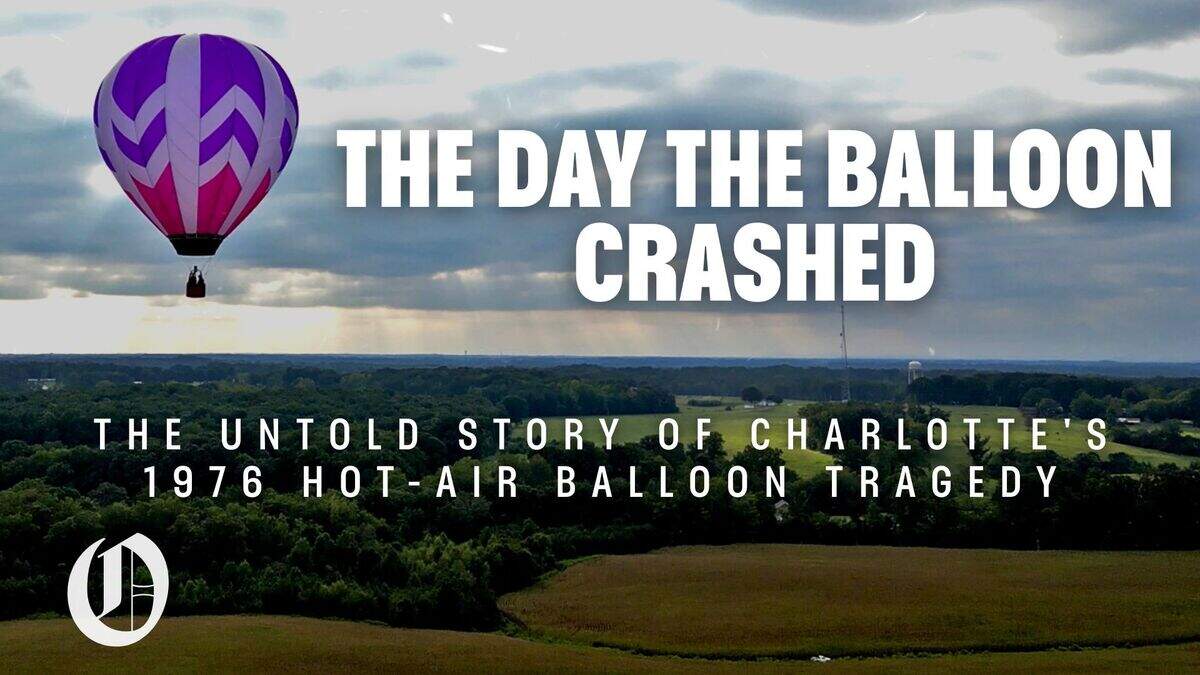
Fifty years after the “Spirit of America” fell from the sky, another balloon is drifting over the North Carolina countryside.
This time, two reporters from The Observer showed up to take the ride.
It’s one thing to reconstruct the decisions that brought Sidney and Patrick Gibson and James Vogan together in a balloon — and kept Guy Henderson and Vanessa Gallman out of it. It’s another to try to get a better understanding of that tragic afternoon while finding yourself hundreds of feet above the ground, watching a pilot assess the winds, the terrain and the choices involved in getting everyone safely back to earth.
“Nice, flat, dry, grassy field with easy access, no power lines, no trees, friendly landowner,” says Charles Page, the pilot on this September evening, to the men standing in the basket with him. “That’s what we’re looking for.”
The Iredell County countryside spreads out below: fields, trees, farm equipment, roads, houses and a fox that darts across a plowed field.
Each possible landing spot comes with its own considerations.
Then he considers the alternatives.
“Now think of all the places you wouldn’t want to land — I’ve probably been there,” says Page, who has been flying hot-air balloons since the early 1980s, logging roughly 5,000 flights.
In 1983, for instance, Page launched from the lawn of Asheville’s Biltmore Estate, counting on the wind to carry his balloon beyond the miles of forest surrounding the property. But the breeze vanished, leaving him stranded above the treetops. Rather than wait for conditions to worsen, he deliberately brought the balloon down into the forest, landing among the trees.
Page’s wife, Kristie Darling, herself a private pilot, knows that ballooning can involve such difficult moments. But when she heard about this story earlier in the summer, she hoped it wouldn’t dwell exclusively on what can go wrong.
“I would like for you to focus on the wonderfulness and not the crashes,” she said.
Up in the air, that’s exactly what Page is doing as he describes the appeal of riding in a hot-air balloon. “It’s magical. … Just the sense of —“ he pauses briefly, and lets out a contented sigh before continuing: “We’re at the will and whim of nature, of the winds. I mean, how else are you gonna be able to do this? Going down and touching the tops of the trees. I mean, all that’s just unique.
“So, it’s magical.”
Eventually, with the flight nearing its end, Page finds that nice, flat, dry, grassy field — with no power lines.
The balloon slowly floats toward it.
Everything about the descent is smooth. When the balloon touches down, it does so more gently than you’d think is possible.
The crew moves in to help. Overhead, the enormous envelope that had held the pilot and his passengers aloft begins to lose its shape. Air escapes. The fabric folds inward, sinks toward the earth and spreads across the grass.
A few minutes earlier, it had filled the sky. Now it lies on the ground.
And once it’s packed up, all three men will head home to their families.
This story was originally published October 21, 2026 at 2:00 AM with the headline “The Day the Balloon Crashed: The untold story of Charlotte’s hot-air balloon tragedy.”
Read more Fantasy 5 players win nearly $1 million in California. See where tickets sold