 By admin
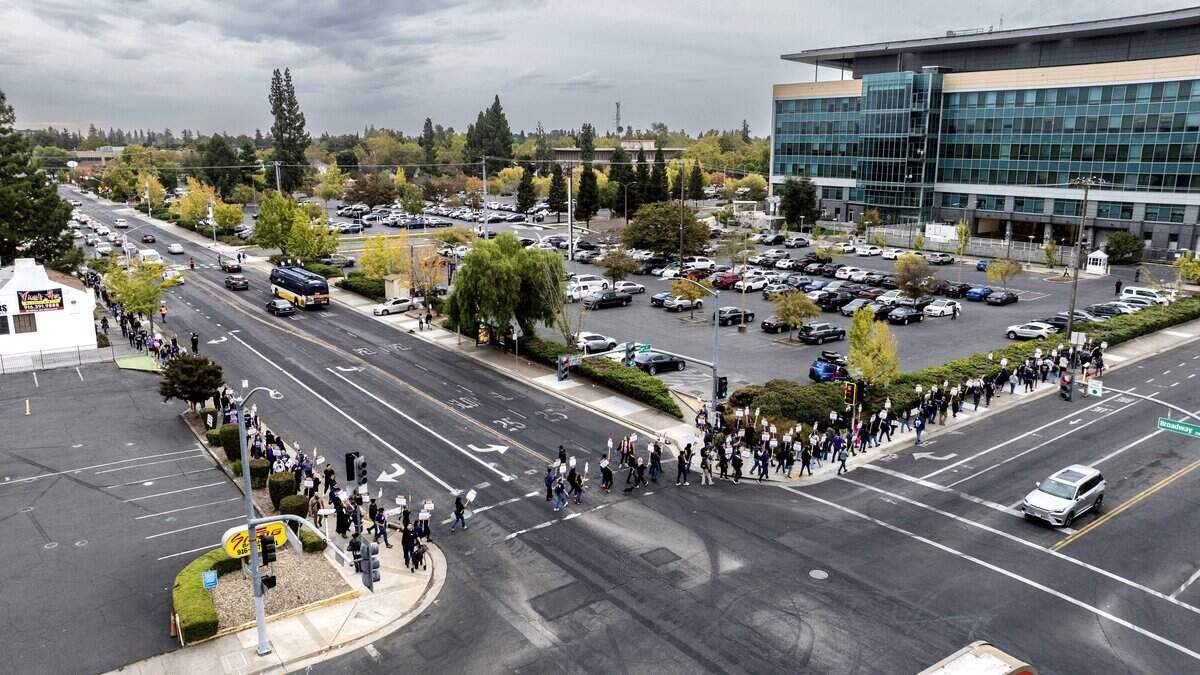
California’s largest state worker union began a one-day strike Wednesday morning, with employees represented by SEIU Local 1000 hitting the picket lines in Sacramento and elsewhere in the Golden State.
Read more Kaiser breaks ground: Folsom’s population boom fuels a wave of new medical facilities
The union has been without a contract since late June, and negotiations are continuing as employees who oppose the state’s return-to-office mandate seek more flexible telework options.
SEIU Local 1000 represents about 100,000 state workers; California employs almost 250,000 total state workers, according to the State Controller’s Office. A few thousand employees represented by SEIU Local 1000 are deemed essential to public safety and are exempt from the strike.
Here is a breakdown of which California agencies’ workers are and are not on strike during Wednesday’s labor action.
Who is included in SEIU Local 1000 strike?
California’s union-represented state workforce is made up of 21 different bargaining units. The largest California state worker union, SEIU Local 1000, represents nine of those units and includes employees of about 140 total state departments, boards, commissions and other bodies.
Read more Teen accused of killing homeless Roseville woman faces victim’s family in court
The nine main bargaining units represented by SEIU Local 1000, according to the California Legislative Analyst’s Office, are:
- Bargaining Unit 1: Administrative, Financial and Staff Services, which has roughly 65,000 workers including many within the Employment Development Department and the Department of Health and Human Services. These jobs include auditors, information technology analysts and more.
- Bargaining Unit 3: Professional Educators and Librarians, which has roughly 1,600 workers, about two-thirds of whom work for the California Department of Corrections and Rehabilitation, with the remaining third employed by the Department of Education. These include teachers and librarians.
- Bargaining Unit 4: Office and Allied, which has roughly 20,000 workers including office technicians as well as employees at Department of Motor Vehicles, CDCR, EDD, the Franchise Tax Board and the Board of Equalization.
- Bargaining Unit 11: Engineering and Scientific Technicians, which has about 2,700 workers, about two-thirds of whom work for either Caltrans or the Department of Fish and Wildlife.
- Bargaining Unit 14: Printing and Allied Trades, which has about 400 workers, mostly in the Department of General Services. These include graphic designers and printers.
- Bargaining Unit 15: Allied Services, which has about 4,500 workers, more than half of whom work for the Department of State Hospitals, Department of General Services or CDCR. Many of these are custodians, laundry workers and food services workers.
- Bargaining Unit 17: Registered Nurses, which has about 5,700 workers including those employed at state prisons and state hospitals.
- Bargaining Unit 20: Medical and Social Services, which has about 5,700 workers and includes vocational nurses, certified nursing assistants, pharmacy technicians, dental assistants and other social service specialists.
- Bargaining Unit 21: Educational Consultants and Library, which has about 700 workers, many of them consultants working on educational programs within the Department of Education.
Which SEIU Local 1000 workers are essential, exempt from strike?
About 4,400 union members are considered essential workers who may not strike, as determined by the California Public Employment Relations board.
According to the SEIU Local 1000 website, those include certain employees within CDCR, CDCR’s adult parole division, the Department of Veterans Affairs, California Correctional Health Care Services, the Department of Developmental Services, the Department of State Hospitals and Caltrans.
State workers not included in strike
More than 100,000 state workers are represented by a union other than SEIU Local 1000 and therefore were not on strike Wednesday.
Read more What happens if I lost my ballot? How you can still cast a vote in California
These include:
- Cal Fire employees;
- Law enforcement including the California Highway Patrol and correctional officers represented by the California Correctional Peace Officers Association;
- Professional scientists represented by California Association of Professional Scientists, UAW Local 1115 (whose workers went on strike in 2023);
- Engineers and maintenance workers, most of whom work for CDCR or Caltrans and are represented by the International Union of Operating Engineers;
- State-employed attorneys and hearing officers;
- State-employed physicians, surgeons, podiatrists and psychiatrists represented by the Union of American Physicians and Dentists, as well as psychiatric technicians (California Association of Psychiatric Technicians); and
- Health and social services workers represented by the American Federation of State, County, and Municipal Employees. These include psychologists, rehab therapists, social workers, prison chaplains and others, many of whom are employed by CDCR or the Department of State Hospitals.
This story was originally published October 21, 2026 at 11:51 AM.