 By admin
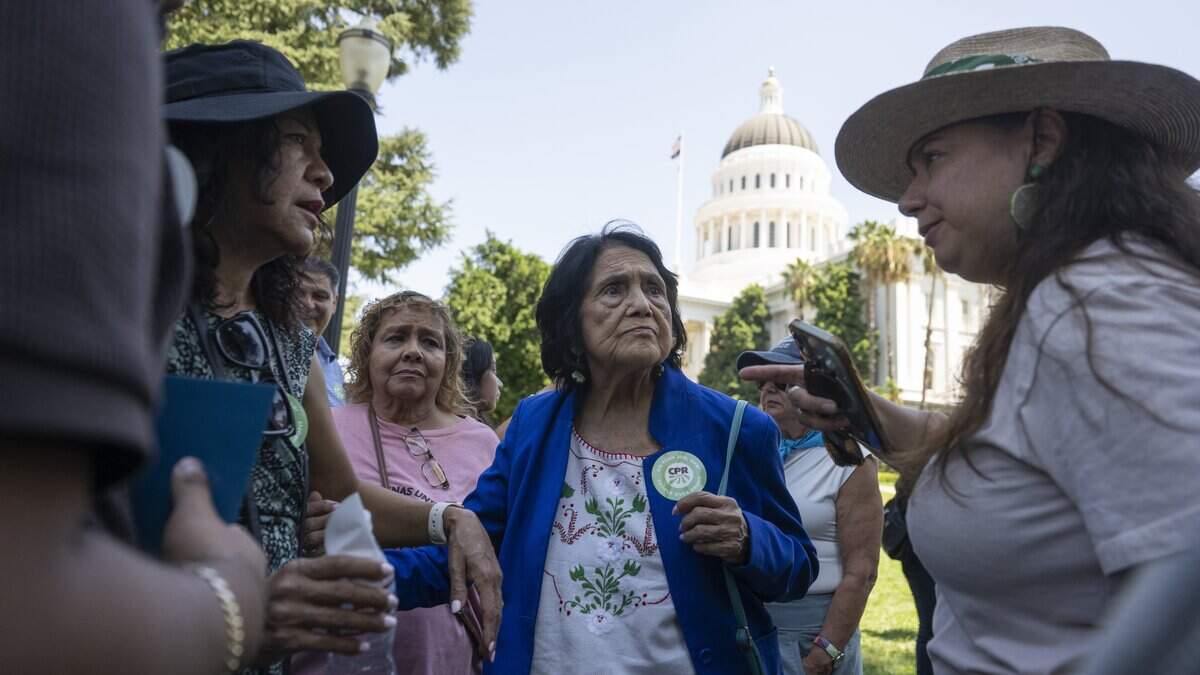
When moving to California in June to cover food and agriculture for The Sacramento Bee, one of the people I wanted to meet was Dolores Huerta. I knew she was an important figure in the history of California, and in U.S. history, because of her lifetime of devotion to the farmworker movement.
Read more Star of UC Davis Health ad ‘appalled and offended’ by changes to health benefits
Huerta, who died Wednesday at 96, helped build the United Farm Workers union into a nationally recognized organization. That work, her work, shined a light on the deplorable conditions experienced by the workers harvesting our food in California.
My first opportunity to meet her, and what turned out to be my last, came when I was invited to an August news conference in Sacramento about pesticide regulation. Huerta would be speaking at the event. Dozens of advocates and farmworkers gathered in front of the Capitol and chanted “Sí, se puede,” or “Yes, we can,” a phrase coined by Huerta.
She was the oldest person at the gathering, and also the most revered. Attendees were eager to speak to her and take photos with her. Shortly after the news conference, she was whisked away by her daughter, Juanita Chavez. Chavez’s father was Richard Chavez, Cesar Chavez’s brother.
The news conference came five months after The New York Times and Los Angeles Times reported widespread allegations of sexual harassment, sexual abuse and rape against Cesar Chavez, the former United Farm Workers leader who died in 1993. Among those who spoke to journalists was Huerta, who said Chavez raped her in 1966.
When I tried to approach Huerta, her daughter told me her mother would not be taking questions from the media. I was instructed to contact the Dolores Huerta Foundation about the possibility of an interview the next day. Her daughter warned me that my questions could not include topics on her past — “about Cesar,” she clarified.
At first, I was taken aback — no reporter likes being told what questions they can and can’t ask — but it became apparent at our later meeting that Juanita Chavez was likely just being protective of her mother.
The day after the press conference, I contacted Huerta’s foundation — and in an hour, I was sitting with Dolores Huerta.
We met at the Hyatt Regency in downtown Sacramento, where Huerta was staying for her brief visit to lobby at the Capitol.
In addition to pesticide regulation, Huerta’s recent activism in Sacramento centered on cuts to the state’s Supplemental Nutrition Assistance Program, more commonly known as SNAP, or CalFresh in California.
Read more Vic’s Ice Cream whitewashes mural, causing online backlash in Sacramento neighborhood
During the interview, Huerta described the importance of pesticide regulation, farmworker protections, organic farming practices and ending hunger, as well as her views on what she called the “dangers” of pesticides and the “very dangerous” loss of agricultural land in California. Her mind was sharp. She was friendly and accessible.
While most Americans have long since retired by age 96, it was clear that Huerta was committed to continuing her activism. She remained steadfast in her commitment to farmworker and civil rights.
“I think these are all problems that we as intelligent human beings can solve,” Huerta said at the conclusion of our interview. “But we know that to do that it (means) the solutions that we look for should not be profit driven. They should not be profit driven. It should be driven more by filling the needs that we have, not how much money can be made.”
Below are some highlights from our conversation.
Question: Do you have thoughts on the Department of Pesticide Regulation’s new enforcement regulations?
Dolores Huerta: Well, I really don’t believe that the regulations are going to stop or minimize these pesticides because I think we have to go a lot deeper on this. The whole issue and the use of pesticides has become normalized. Pesticides are poisons, and they are used to kill bugs. But that means that they can also kill humans. …But when you look at what the result is of the use of pesticides, it is that you have more and more people that are getting cancer. And it’s really tragic, because some of the prime group of people that are being affected by pesticides are the farmworkers. These are the people that are out there in the hot sun, doing the hard work of picking our foods and making sure that (the food) comes to us, the consumers. And yet, (farmworkers) and their families are the primary people that are being exposed to the dangers and the harmful effects of pesticides.
… But it’s not only the farmworkers themselves, but the consumers. They have no way of knowing that the food that they’re eating has poisons on them. I like to say, if you were to go out there and buy a poison and put it on someone’s food, and they either became sick or they died from that, that would be a felony. That would be a crime. You are harming somebody, and even maybe causing their death, which would be a murder. And yet, this is exactly what this constant use of pesticides is. And it has been proven that you can grow food without pesticides.
Q: What other issues are you focused on?
DH: Oh, a lot.
Q: You were also in Sacramento to talk about the federal cuts to SNAP?
DH: The people that grow the food, the farmworkers and people in low-income communities, are the ones that are going to be adversely affected by these cuts. We are the richest country in the world, the United States of America. And there is no excuse to have anybody go hungry — not in our country and to the extent that we can provide food for people in other countries, because we do have an abundant supply of food. We are very, very lucky. California, as you know, is one of the main sources of food for the United States and many parts of the world. So we have to think of our economy to be more of a sharing economy, not a competitive economy, especially when it comes to something as basic as food.
Q: One issue that’s been brought to my attention is the loss of small farmers and the loss of agricultural land in California. How are you seeing that in your community, and how are you seeing it affect farmworkers?
DH: I think that the loss of agricultural land is very dangerous because, again, we are one of the main providers of food to our country and to the world. I think our agricultural land has to be looked at as a very precious substance that we have and something that we have to protect — just like we have to protect our water. … And I think when it comes to housing — and we know housing is also desperately needed — we have to think of ways that we can provide housing, but do it in such a way that it doesn’t take up so much land.
Read more Suspect arrested in Citrus Heights burglaries with over $500K in stolen items
This story was originally published October 28, 2026 at 11:32 AM.