 By admin
AI-generated summary reviewed by our newsroom.
Read our AI Policy.
- Lopes Family Farms turned to duck rice after drought almost shut it in 2022.
- Duck rice uses ducks to fertilize fields and manage weeds and pests.
- Bruce and Christopher Lopes hope the new rice will save their 115-year-old family farm.
They met at midnight, a motley crew of two farmers, an uncle, a volunteer farmhand and three of the uncle’s biker friends.
Read more Magnitude 3.3 quake off Southern California coast shakes Los Angeles. ‘Nice jolt’
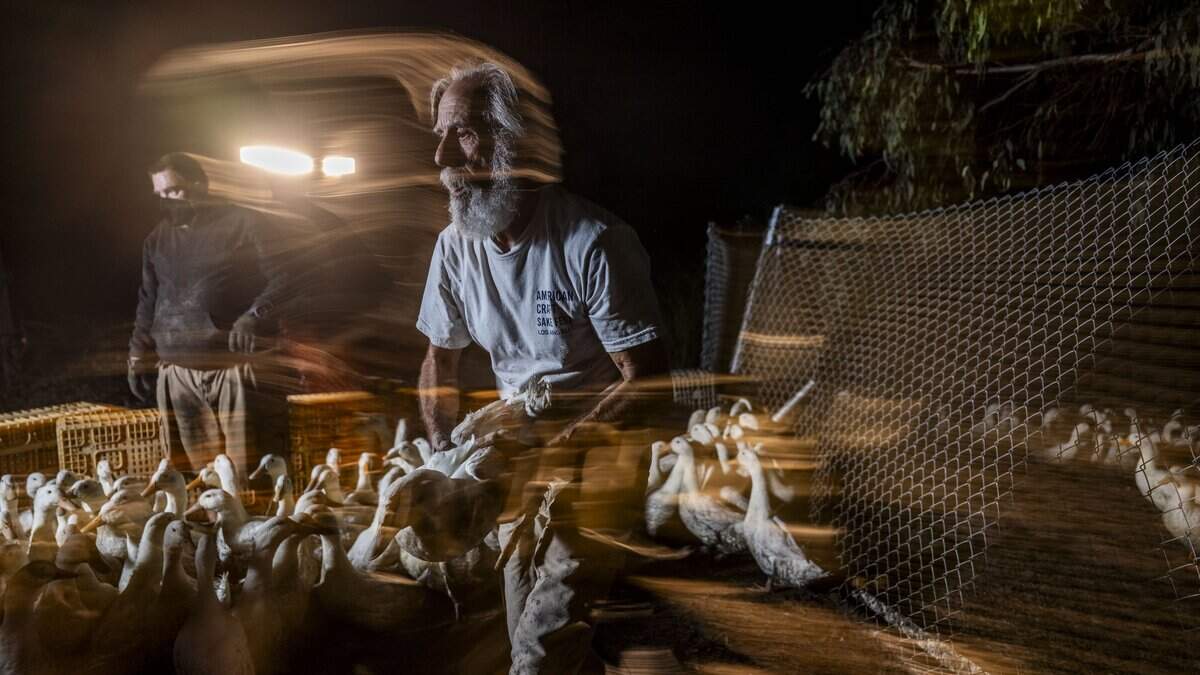
Their task: wrangle 300 ducks into cages and load them onto a truck, which would cart them off to a processing facility. The otherwise near-silent night was now disrupted by a constant din of quacking from a mass of white birds with orange beaks.
The ducks are Bruce and Christopher Lopes’ bet on the future of their 115-year-old family rice farm about 1 hour and 30 minutes north of Sacramento, in Glenn County. The farm sits off a two-lane road, its entrance marked by a mailbox made from Bruce’s grandfather’s old wagon wheel.
The farm almost shut down in 2022 as a drought lingered in the Northern Sacramento Valley. Desperate, the father and son took a Hail Mary shot to save the 203-acre farm with what they call “duck rice.” The ancient Japanese farming technique uses ducks essentially as laborers in the rice fields. The birds naturally fertilize the fields and help with weed and pest maintenance — an organic process.
Toward the end of the growing season, the ducks are pulled from the fields and can be sold for meat. The farm has seen early success with the specialized product, selling to high-profile restaurants and a sake brewery in Los Angeles.
“The writing on the wall was: We were over,” Bruce, 69, said of the drought. “The path was toward our demise.”
“There was no path,” Christopher, 38, added.
Now, a path exists again — even if it is a continuous bumpy trek.
On that summer night, the way ahead was just dark. The Lopeses would have liked to process the ducks a few weeks earlier, but the father-son duo couldn’t afford it. They had to wait for more rice sales. This type of holding pattern is run-of-the-mill for the family farm.
The Lopeses are two of the thousands of small farmers in California who find operating more difficult every day, confronting the real possibility of closing up shop. Many growers say this is the most challenging time they have ever experienced in agriculture.
Lopes Family Farms is about 1 hour and 30 minutes north of Sacramento, in Glenn County.
The 115-year-old rice farm turned to a new approach to survive.
Bruce and Christopher Lopes grow organic rice, including a variety they call “duck rice.”
The father and son use an ancient Japanese farming technique, putting ducks in the fields to naturally fertilize the rice crop and control pests and weeds.
Toward the end of the growing season, the ducks are pulled from the fields and the Lopeses sell the birds for their meat.
The threats are everywhere. Diesel prices have skyrocketed to around $7.90 a gallon, up from around $5.15 a gallon a year ago, as the war in Iran has kept the Strait of Hormuz closed. Customers can obtain cheaper goods abroad, leading to less room in the market for California-grown food. The Trump administration has cut a billion dollars in funding that once helped farmers sell their crops to food banks and schools.
Supply and labor costs have continued to rise while commodity prices have waned or stagnated. California’s regulations, farmers say and research shows, make the business more expensive. Extreme weather events have caused havoc for crop yields. Water remains a precious commodity.
The state has already lost thousands of small farms in recent years and, with them, agricultural land. Farms are classified as small by the U.S. Department of Agriculture if they have an annual gross income of less than $350,000. The majority of California farms are fewer than 50 acres and are family-owned, according to the state. Hundreds of thousands of California acres are urbanization and shifting use to solar projects.
The loss of small, family-owned farms in California spells trouble for consumers, communities and economies. California farmers supply U.S. consumers with most of their American-grown and produced food. Without those farms, the U.S. food system can be disrupted, forcing a greater reliance on imports and larger farming corporations, agricultural experts say. The state’s growers also export immense quantities of food to other countries. Japan is the number one export market for California rice, according to the California Department of Food and Agriculture.
“Small farms like the Lopeses’ are really anchors of their community,” said Paul Towers, executive director of the nonprofit Community Alliance with Family Farmers. “I think of small farms as not only creating local economic opportunity. They are the part of creating a sense of community and identity, and they really act as this kind of cultural cornerstone of what it means to be a small rural community in California.”
Even with all the financial pressures, California farmers keep going — sometimes to the point of bankruptcy. It is not new for them to be caught between political whims and Mother Nature’s urges. There’s always a new drought, import or regulation around the corner. Growers love what they do and wouldn’t still be hanging on if they didn’t, farmers and their advocates say.
But if meaningful relief does not arrive, small farms will continue to falter.
For Bruce and Christopher, third- and fourth-generation farmers, respectively, the farm is their life.
“I will do anything to save this ranch pretty much. I don’t care what it takes,” Bruce said around 3 a.m. after the ducks were wrangled. “My whole life is invested in this. …I wouldn’t give it up for nothing.”
Lopes Family Farms’ struggles
Bruce silenced his phone as it began to ring.
“Collection agency,” Bruce said, bursting into laughter with Christopher.
Bruce pulled up the voicemail after a few minutes: Someone asked if he wanted a loan. Spam.
Twenty-five minutes later, Christopher’s phone rang.
“Hello? Hello? Hello?” he said. He pretended he couldn’t hear the other person on the line. He hung up.
“One of my loan payments I can’t afford right now,” Christopher said.
The Lopeses’ farm has struggled financially for years. Many mornings, Bruce woke up slinging strings of profanity, thinking it was the farm’s last day.
The father and son grapple with an obstacle common to most California growers: sales that don’t keep pace with costs. Their usual contracts for their non-duck organic rice have dried up in recent years, leaving them searching for other channels to sell their product.
The Lopeses said they are saddled with $448,000 of debt — not including tens of thousands of dollars in credit card bills. The farmers need money for manure, cold storage, diesel, milling, shipping and various other items to maintain operations. Two banks loaned them the money, and the Lopeses also took loans from their retirement plans and life insurance policies. Christopher borrowed money against his car to purchase equipment for the farm. His car was repossessed earlier this year.
In recent years, the farm has made less than $100,000 annually, with the family taking home roughly $40,000 on a good year, the Lopeses said. Bruce splits that four ways: He has three living brothers who don’t typically work on the farm but are co-owners. Christopher rarely earns anything from his labor. They have no paid employees apart from Bruce. The Lopeses can’t afford them.
In 2022, after the drought and significantly smaller rice yields, Bruce faced a choice: go further into debt on his son’s idea to save the farm by growing duck rice or sell the farm. He chose duck rice. He spent drought insurance payouts and savings to keep the farm afloat.
He said two wells had to be built to sustain the rice crop. (As soon as the wells were built, it rained.) They sold their water to Southern California, where farmers had tree crops that would have died without it during the drought. Christopher received $25,000 from a friend to help get the business off the ground.
“I wanted to see my son farm,” Bruce said. “I wanted to pass what I have on to him. What I wanted to do was have a son who grew up and learned more than me. That’s the whole purpose of life.”
And thus began the farm spinoff from Charles Lopes and Sons — Bruce’s father’s rice business — to Lopes Family Farms.
The father and son quickly ran into trouble with the duck rice. The first planting, only one acre with 150 ducks, was a failure. They planted a variety of rice they had not grown before and flooded the field — as is done with most California rice. This variety was not meant to be flooded and, in one day, the crop was destroyed. As the Lopeses lost all their money, a collection agency came after them.
Yet, they proved their concept: The ducks did eat the weeds. The farmers committed to trying again next year, even as their cash dwindled. No more insurance payouts were coming. The debt started accumulating.
The father-son team launched a GoFundMe titled “Feed America’s Children Regenerative Rice By Saving Our Farm” in May 2024 to raise $200,000. The fundraiser brought in $2,407.
They also returned to varieties of rice that required flooded fields and found greater success, producing yields and selling their rice. The duck rice planting is up to 25 acres and 600 ducks. The Lopeses’ goal is to eventually convert all the organic rice acreage to duck rice farming.
Christopher studied the duck rice technique for years, connecting with a grower using the method in Vermont. The ancient technique was rediscovered by a Japanese farmer in the 1980s and hasn’t been widely adopted in the U.S. The process — not used anywhere else in California, according to the Lopeses — is more sustainable, as it is organic and requires less water.
“Christopher gave me hope,” the father said on a day a few weeks before the duck herding.
“…And that’s why this is the best father ever because he believed in duck rice when no one in this area would ever,” Christopher said.
Read more Crews covered 293 miles in storm seeking missing autistic teen. He was found dead in California
The two know, however, that they are not in the clear yet.
“The duck rice was our salvation and at the same time could be our downfall,” Bruce said.
“…Let’s go out with a fight,” Christopher said, the father and son fist-bumping each other.
30-hour day
Before the duck wrangling, Christopher and Bruce started their workday 20 hours earlier, in Los Angeles.
They left for the Wednesday Santa Monica Farmers Market, where they sell their rice, at 4 a.m.
That day, Christopher agonized over the ducks’ transportation, assisting the volunteer team at home to find the right equipment. The truck was secured a handful of hours before they needed it.
After the farmers market concluded in the early afternoon, Christopher and Bruce participated in an educational class about rice and dropped off other rice orders.
They took a 7 p.m. flight back to Sacramento, landing at 8:30 p.m. The two didn’t get to their car until 9:40 p.m. They drove the roughly 1 hour and 30 minutes back to the farm, arriving around 11:20 p.m. After changing clothes and some chitchat and coffee (none for Christopher), they were ready.
“All right, let’s have some fun,” Christopher said, sporting a T-shirt that said “Rice” and a button down with ducks on it underneath a thick flannel.
“This is going to be fun,” his father said. “This is going to be impossible.”
In the past, the ducks primarily lived in a shack. This year, the ducks sought adventure and spent most of their time in the fenced in duck pond area outside the structure, making the herding a more difficult affair.
Another obstacle: The sprinklers had run in the wrong direction, turning the entire duck pond area into a muddy danger zone, creating a challenge that resembled the reality show “Wipeout.”
Bruce was the pessimist of the night, doubting the crew could complete the task, noting how many hours he and his son had worked already and the slick terrain. Christopher was the optimist: “This is what we do. We figure things out.”
To the chorus of quacks and much flapping fanfare, the crew shepherded the ducks out of the pond and through a maze of cages. Two volunteers formed a human shield in the water to prevent the birds from swimming away. Bruce waddled behind the ducks while he quacked and said, “Come on, babies.”
Even as the temperature dropped to a dry low 60s, sweat dripped from the wranglers’ brows as they grabbed bird after bird, filling 85 cages and loading them into the truck. The workers plied a constant, gentler version of whack-a-mole with duck heads as the birds tried to escape their new confines. Humans and ducks alike were caked in mud from their journeys in and out of the pond. White feathers littered the ground.
“Record time,” Christopher said. The wrangling usually takes four hours. That night, it took roughly 1 hour and 40 minutes, ending at 2 a.m. Bruce and his son hugged.
After a brief respite, Christopher and two of the helpers started their 2.5-hour drive with the ducks to the Stockton processing facility at 3 a.m.
At the processor, Christopher played his annual push-and-pull game with the facility managers. The managers wanted the ducks loaded off the truck immediately, while Christopher wanted to give the ducks time to rest. Stressed ducks can lead to tougher meat, he said.
Around 6:40 a.m., roughly an hour after Christopher arrived at the facility, he backed up the truck into the unloading area. Christopher had been awake for over 24 hours and would stay that way for much of the rest of the day.
The ducks were hung by their feet, zipping by on a conveyor belt.
“Sorry. I’m sorry,” Christopher said to his flock.
“…It still makes me sad to this day,” he said.
The ducks’ final moments were filled with spread wings and chatter. And then there was stillness.
115-year-old family farm
As with many American families, the Lopeses’ story starts with immigration.
John Lopes Sr. came to America via Ellis Island from Portugal around 1898. He married Maria, also Portuguese, in Nevada, and they moved to California with Charles, Bruce’s then-young father. Around 1910, John and Maria, along with other family members, bought 500 acres of land in Princeton.
Rice was already growing on the land, and in that first year, the Lopes family sold enough rice to pay off what they owed on the property, according to family history passed on to Bruce.
The property was later divided among family members, with Bruce’s father retaining the 203-acre farm that Bruce owns with his brothers now. The Lopeses’ farm is surrounded by what the family calls the “Thousand Acre Club” — growers in the area who own much larger rice operations.
“We are like the smallest peon rice farmers in the area,” Bruce said.
Bruce began working on the farm around age 18, after his two older brothers and his father had established their rice business. About 10 years ago, Bruce’s two eldest brothers retired, and Bruce was on his own, with occasional help from his third brother, Larry.
The farm is strewn with family relics: the covered wagon that brought the Lopeses here, wooden harvesters used by late Lopes farmers that look like ants in comparison to modern-day John Deere behemoths, Bruce’s grandfather’s tractor that miraculously survived an April fire at the farm.
Bruce thought he was going to be the last Lopes grower. Then, Christopher said in 2013 that he wanted to farm. Bruce claims that his son “forgot” to inform him up until that point.
The two now run the farm together, living on the property with Christopher’s mom (and Bruce’s wife), June, four dogs, a giant tortoise, some cats and about 20 ducks that were spared so that the family could sell their eggs.
Bruce’s brothers turned out to be the biggest skeptics of duck rice, as they didn’t want to spend more money, Christopher said. Convincing them, he said, was the hardest part and remains an issue. They argued and have been through depressing moments.
“Money makes everyone more stressed out,” Christopher said.
Duck for breakfast?
Feathers flew behind the truck as Christopher left the duck processing facility at 7:40 a.m.
Christopher, his uncle and one of the volunteers drove about 10 minutes to the Duck Nook Restaurant. Although full of duck artwork and duck-named menu items, the restaurant does not serve the bird.
The Lopes Family Farms crew was the only one in the restaurant.
Christopher, rubbing his eyes, was exhausted, teetering into delirium.
“Everything hurts,” he said to no one in particular.
Christopher had another 2.5-hour drive ahead of him, and although done with 300 ducks today, the Lopeses would have to do the process all over again with the other half of their ducks the following week. They can’t afford enough cages to do it all in one go.
The ducks needed to be handled before the father-son team could move on to rice harvest.
Even though Christopher had been awake for 28 hours, his mind was churning, thinking about whether to sell the ducks whole or by parts and his love of duck pate.
His thoughts then flashed to his other job. He’s been a hospital CT technologist for more than a decade. It’s the job that pays his bills, but it’s also the job that keeps him away from the farm.
He hadn’t worked at the hospital in Chico for over a month. His employer had asked for his availability.
“My availability is nothing,” Christopher said.
Two weeks later, his phone rings. It’s his roommate in Chico. There’s a letter in the mail. It’s from the hospital.
They’ve given Christopher an ultimatum: Provide your availability within two days or you’re fired.
Read more Sac City Unified warns St. Hope over unpaid fees, threatens to evict Sac High and PS7
This story was originally published November 20, 2026 at 6:00 AM.