 By admin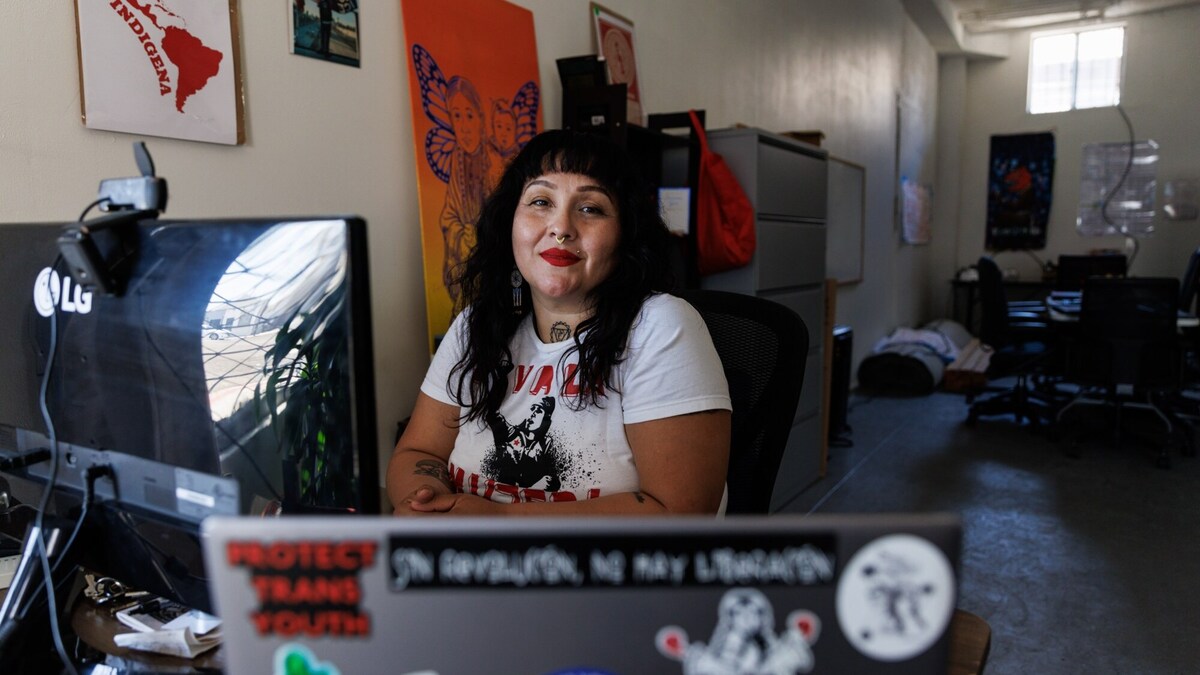
Elydé Arroyo remembers the Barrio Logan of 35 years ago, before sky-high rents pushed out many families and small businesses.
Read more Photos: Thousands attend the San Jose Obon Festival in Japantown
Arroyo spent much of her youth there but now lives in Chula Vista where the rent is more manageable. She runs her nonprofit, a pregnancy and birthing clinic called SlowBirth, from an office on Logan Avenue – her second space after she was priced out of her last.
That’s why Arroyo wants to be a part of the Tierras Indígenas Community Land Trust, a development that would bring affordable housing, a community art space and a midwifery to Barrio Logan. One of the trust’s original board members, she hopes the project will help her bring her care to pregnant and postpartum families.
The mother of two sees the effort as a way to restore her neighborhood.
“I want my children to still be able to go into Barrio Logan and be able to experience art and culture and food and still have community,” Arroyo said.
Tierras Indígenas and a few other grassroots groups in San Diego are embracing an alternative model of affordable housing by creating community land trusts, where land is owned by a nonprofit. The model not only creates permanently affordable housing but can also provide a low-cost path to homeownership for low-income families.
Community groups in historically underserved neighborhoods such as Barrio Logan, San Ysidro and City Heights are working to establish land trusts to counter gentrification and host community hubs.
Casa Familiar broke ground on its community land trust development in San Ysidro, called Avanzando, last October.
“It’s like an anti-displacement strategy, in which you are empowering the community to steward the land – but also make decisions on what happens in the land,” said Georgette Gómez, a former San Diego City Council member and now the group’s community development officer.
Under a community land trust, a nonprofit buys a piece of property for a housing development, with the help of financing like loans and public or private grants. The nonprofit then leases the land for the housing on top of it for 99 years.
Land trusts are typically a community-led effort, where residents and others invested in the neighborhood’s well-being are the ones governing the trust.
The housing is affordable because the nonprofit takes the cost of land out of the equation. And unlike traditional deed-restricted affordable housing that only has to be income- and rent-restricted for 55 years, land trusts remain permanently affordable – because they include a resale agreement that limits equity gains and requires it to stay affordable in perpetuity.
“The land is valued for its use instead of its market value,” said Josh Newton, an urban studies postdoctoral researcher at UC San Diego.
Casa Familiar’s community land trust will offer 103 affordable rental homes and plans to eventually offer a down payment assistance program to help residents buy theirs.
The development will also include climate-resilient elements such as rooftop solar and shaded outdoor areas to reduce urban heat impacts and improve air quality.
The Partnership for the Advancement of New Americans, or PANA, is developing a community investment trust – similar to a land trust, but different in that it seeks to generate equity gains for its participants. It plans to create about 150 homes and allow residents and business owners to become shareholders.
The project, which would also include community spaces and a village market tailored to support immigrants and refugees, was granted $5 million in May by the county to support its development.
Read more Volvo XC90 Vs. Subaru Ascent: Which One Is Safer?
Community land trusts have been slower to catch on in San Diego County than in other parts of the state that have more robust land trusts.
But organizers are excited about how neighbors have joined to make alternative housing options more of a reality in San Diego.
“We engaged 2,000 people total through this whole process … It’s the most amazing thing,” Rachel Lozano Castro, the director of strategic partnerships and development at PANA, said in April. “I feel really lucky that we’ve got a really cool model in San Diego, even though San Diego can’t recognize a cool thing under its nose.”
Community leaders say the need is there.
According to a from the California Housing Partnership, nearly 130,000 low-income renter households in San Diego County can’t afford their home. And while San Diego’s vacancy rates recently hit the highest in a century, rents remain stubbornly high, with an average asking rent at $2,583 a month in late June – up 0.5% in a year.
Officials are also pursuing housing alternatives. The city of San Diego recently committed $8.5 million to a fund to preserve low-rental apartments, which complements a 2025 city law that requires apartment owners to give the city first right of refusal when they decide to sell.
Over just the last decade, the number of community land trusts has tripled in California, says Lydia Lopez, the executive director of the California Community Land Trust Network. About 50 current and emerging community land trusts are in the statewide network, which provides resources to community land trusts and advocates for state funding.
In 2021, California established a fund and pledged $500 million to help community land trusts and tenants acquire property to preserve it as affordable housing – but the money never came through.
Now the California Community Land Trust Network is pushing for $200 million to fund a similar program.
“A lot of CLTs are struggling to acquire these properties, because as a nonprofit, it’s even more difficult to fundraise now,” Lopez said. She added that some foundations that historically supported this work are pulling back following the Trump administration’s efforts to dismantle diversity and equity initiatives.
But even though they agree community land trusts bring benefits, some advocates of more aggressive housing development argue the model is difficult to scale and can’t yet make much of a dent in California’s massive shortage of affordable housing.
Finding sustainable, recurring sources of funding is one challenge. Another is that it takes a lot of work – mobilizing a community to launch a land trust or co-op nonprofit and ensuring it continues to operate, without losing sight of its mission, over the course of decades.
“If you want a community-based governance of your home, that is going to require everybody to be engaged in a way that maybe not everybody is ready for yet,” said Krishna Hammond, a member of the board of YIMBY Democrats of San Diego.
The nonprofit leaders say that beyond ownership and affordable housing, they want these models to help promote community.
Casa Familiar’s Avanzando development in San Ysidro is built near the La Semilla Community Resiliency Center, intended as a refuge from extreme weather, as well as near a transit stop – infrastructure it says will help connect residents with each other and the services they need.
“The whole idea is to create a healthy, vibrant community that is safe, that is walkable, that is accessible,” Gómez said.
Read more Trump says the US should control the Strait of Hormuz and get paid for it
Copyright 2026 Tribune Content Agency. All Rights Reserved.
This story was originally published July 13, 2026 at 5:37 AM.