 By admin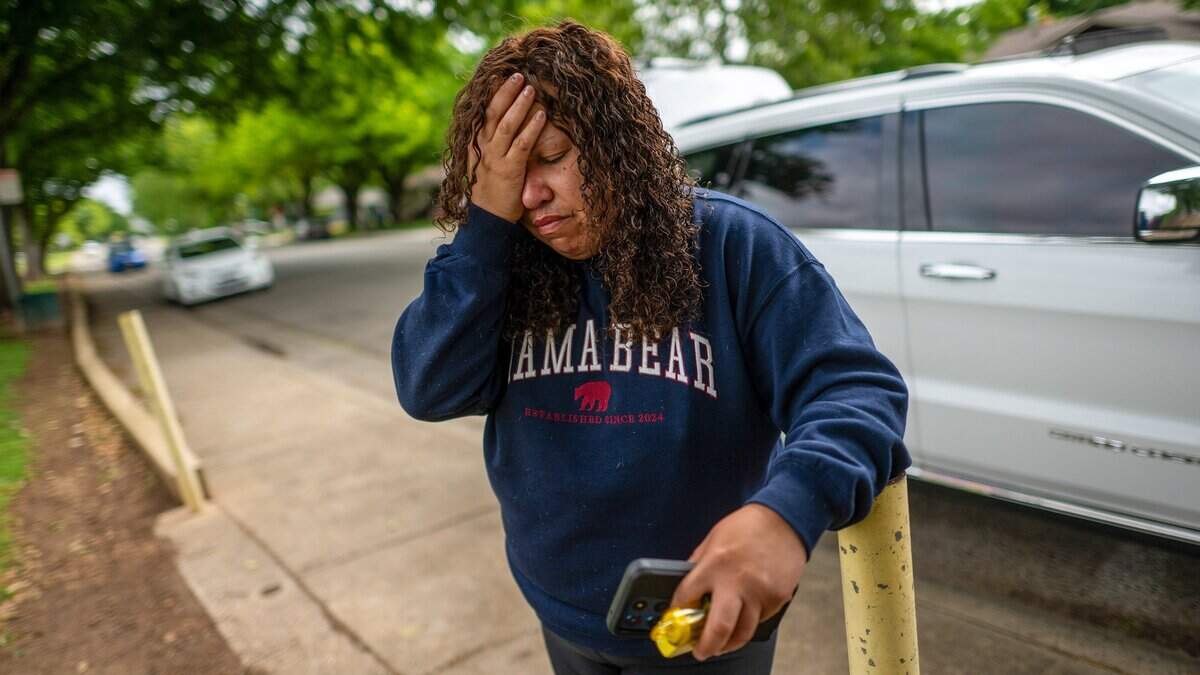
Jocelyn Wright knew the numbers barely penciled out.
Each month, the rent was $1,450, the car payment was $372.72, the insurance was $130, and her take-home pay from working full-time as a medical transporter was around $3,000 if she didn’t miss a single shift. At best, she’d have $1,047 left over to cover every other expense. Utilities, gas for the Jeep, food for herself and for her deaf pitbull.
Read more Why I authored a bill that assesses California students’ math knowledge | Opinion
Although she could barely afford it, Wright signed the paperwork and moved into the apartment in May. Although this hadn’t been her first brush with homelessness, she had been stuck living on the streets for months, so she told herself she would have to pull this off. The lease started May 14, and while the place wasn’t perfect, she felt an immediate sense of relief being indoors. Perhaps this was the beginning of something good.
But the one-bedroom apartment in Rancho Cordova might as well have been made of sand: If one thing went wrong, it could all tumble down.
Within weeks of her move-in, two things went wrong.
In mid-May, an exhausted Wright, 40, accidentally fell asleep in her parked SUV while it was running and blew out both fuel pumps. She needed the car to drive to work, and she desperately needed it as an insurance policy in case she lost the apartment and ended up homeless again. The mechanic took pity on her and said she could pay $900 upfront.
Then, the first weekend in June, Wright’s blood pressure dropped so low at the laundromat that she lost consciousness and had to be hospitalized. She missed a few days of work — and the pay that would have come with it.
June rent was already covered, but that was it. For the coming month, she’d have a choice between the rent and the car, and she picked the car. That SUV was her transportation to work and to healthcare appointments. If she lost it, she’d lose her job and then her apartment the next month anyway, and without a vehicle, she’d have to sleep in a tent.
July 1 came, and the rent was due, and Wright didn’t have the money. She was facing down an eviction while scrambling to get emergency rental assistance from local social services providers. On July 6, a Monday, nothing had come through. The three-day notice delivered on Tuesday said she had to pay or get out by the end of the day on July 10.
An ever-fraying social safety net swayed precariously beneath her. She feared that, once again, she would tumble right through it.
Few resources stand between low-income renters and homelessness in Sacramento County, and thousands of tenants weigh the same bleak options as Wright. The U.S. Department of Housing and Urban Development says the fair market price for a one-bedroom apartment in the county . At a $20-an-hour job — more than the California minimum wage — the lower end of that rent spectrum is still close to one-third of a month’s pay.
In a state with such steep housing costs, many people teeter into homelessness over relatively small sums of money. In a landmark 2023 study out of the University of San Francisco that surveyed more than 3,000 homeless Californians, 70% of respondents said they believed could have prevented them from losing their homes.
This affordability crisis is leading to a quiet eviction crisis. Records show the Sacramento County Sheriff’s Office had a list of more than 900 people and families who were on the verge of getting locked out of their homes between January and April this year. The list only counted the residents who were taken through the entire court process to force them out of their properties. It did not account for those who moved out before landlords began official eviction proceedings, or gave up and left before their cases concluded.
Although Wright’s situation was commonplace, it made no sense to her. Social services had already made an investment in her housing — a nonprofit had covered her security deposit and the first month’s rent. She’d spent barely eight weeks in the apartment. Would it all be a waste?
The three-day notice said she owed $1,450 for the rent, plus a $100 late fee, a $3.75 billing fee and $13.45 for utilities. She had some of the money, but not all of it. She asked the building manager if she could make partial payments, she said, and the manager rejected the offer. She made a GoFundMe, but no one donated.
On July 10, the deadline to pay or move out, Wright was still $400 short. Before work that morning, she was distraught — she hadn’t slept at all, and she didn’t feel safe driving her elderly clients to the doctor in a big van. A text message shows she wrote to her boss and told him she was sorry she’d failed him, but she couldn’t come in that day because it wasn’t safe. He fired her.
With that, the precarious life she had cobbled together completely collapsed.
“The thing that bothers me the most,” she said, “is that all of this would have been prevented if I just got the services I need.”
‘I don’t want to wait until I completely unravel’
Like many Californians, Wright has cycled in and out of homelessness for years. She’s struggled with addiction and complex post-traumatic stress disorder, she’s had run-ins with police and spent time behind bars. Her childhood was rough, she said, and she ended up in foster care as a teenager, eventually aging out with two children of her own. Bouts of stability and community college classes alternated with grinding poverty and methamphetamine use.
Wright has been unemployed for various stretches of her life, but this year, she rejoined the working poor — initially while she was living in her car.
Once she got into housing, she became part of a massive underclass in California barely eking out a living. The American Community Survey shows that half of renter households spent more than 30% of their income on rent in 2024. In both California as a whole and in Sacramento County, 56% of renter households are rent-burdened.
According to the Public Policy Institute of California, the state is one of the worst in the nation when it comes to the proportion of households “severely burdened” with housing costs, when renters spend more than half their paycheck to keep a roof over their heads.
While California researchers have found that relatively modest rental subsidies could likely save many tenants from homelessness, emergency assistance is hard to find. And the most coveted solutions don’t come close to meeting the demand. Spots in public housing or the Housing Choice Voucher program — usually called Section 8 — come with onerous requirements and waitlists that take years.
Seeing no other option, Wright kept trying to navigate that labyrinthine social services system. This year, she hoped that by force of will, she might qualify for housing assistance in the California capital.
“Somebody out there has to care, right?” she said. “I’m still out here like this, and I need help. I’m trying to do all the things right that I can do to get myself on the right track so that I can live before I die. That’s it.”
In the spring, she seemed to make some progress. First, Wright found a job. An employment verification document shows she started at the medical transport company in April, earning $20 an hour. Documents show she quickly leased an SUV; it wasn’t a great deal because of her bad credit, but she could live in it with her dog and a new puppy she took in. With a cheap gym membership, she had a place to shower so she could be presentable at work even as she went “home” to the car. She slept fitfully, but showed up to her early-morning shifts.
The job offered a sense of purpose: People depended on her to take them to their medical appointments.
Wright had also re-enrolled in services through a behavioral health-focused provider called Turning Point Community Programs and was assigned a case manager. They clicked.
Then, almost miraculously, she independently found the barely-affordable apartment in Rancho Cordova with a landlord who overlooked her credit score. Turning Point helped her cover the security deposit and the first month’s rent in May, and she signed the lease.
Read more No majors for Scottie Scheffler in 2026 after late push at Open
She filled the home with free furniture from a generous stranger on Nextdoor. With a red pushpin, she hung up a photo of her big dog, Blue — the color of his eyes — and set up multiple beds for him. She made fresh food in the kitchen. Wright was just a contract worker, with no guaranteed salary. But her boss seemed understanding, and he sometimes gave her advances on her paychecks. The kindness came with a drawback, though: It meant she always owed him money from her next paycheck.
Sitting at the desk she set up in her little apartment, Wright read aloud a letter she recently sent to her case manager at Turning Point pleading for greater supportive services. She has mental health and substance use disorder diagnoses, and to her, it seemed like her efforts to claw out a stable life had undermined her quest for institutional resources.
She hoped to enroll in “full service partnership” or FSP, a high level of case management in California that’s administered at the county level. She had qualified for the program in the past, and was almost placed in housing.
But after an assessment this year, she was told she wasn’t a good candidate for an FSP. The criteria show that she didn’t qualify in part because she’d stayed out of jail for too long and hadn’t had a recent forced hospitalization for being suicidal or for endangering others.
Those criteria are designed to channel the most robust resources toward the people with the most severe needs. But Wright also thought that they were backwards. To the best of her abilities, she had managed to create a little stability. Now it appeared that those efforts were being held against her.
“If someone has to lose everything, end up back in jail, or be hospitalized before they qualify, then the program isn’t preventing crises — it’s waiting for them,” she wrote to her case manager. “I don’t want to wait until I completely unravel before someone decides I’m finally ‘sick enough’ to deserve help.”
Few emergency eviction services
Alexis Bernard, the chief development officer at Turning Point, declined to answer any questions about what — if any — eviction prevention resources are available for its clients. She said she could not describe the nonprofit’s programming because they “take confidentiality and privacy obligations very seriously.” But, in general, she said that people in distress can call 211.
Previous Bee reporting has shown that at 211, operators help people navigate a social services system strained almost to the point of uselessness in the case of emergencies.
“Everyone is told to call 211,” said Crystal Sanchez, president of the Sacramento Homeless Union. The number, she said, “generally leads to nothing.”
When Wright called 211 this month, she said she was told to call back when the landlord served her with an unlawful detainer notice, which would signal the start of a court eviction process. If the landlord’s threat became a legal eviction case, she could try again to ask for help.
Bernard added that people being evicted can call local legal aid organizations — which are oversubscribed and focused on legal defense, not emergency rental assistance — or that they can contact tenant advocacy groups.
On Friday, Wright tried the Sacramento Renters Helpline and told the operator that she needed emergency aid because she’d received a three-day notice.
The operator said, “OK, have you contacted 211?”
Wright said yes, she had already called 211. The operator explained politely that the renters helpline had no additional resources. Wright thanked her and hung up.
Would using meth help her get housing?
Had Wright qualified for an FSP earlier this year, she might have had an easier time accessing emergency rental assistance.
Kim Nava, a spokesperson for Sacramento County, wrote in an email that for people enrolled in one of three local programs, including FSP and “Community Outreach Recovery Empowerment,” the lower-level type of program Wright is in, “being at risk of homelessness is sufficient for providers to consider financial assistance.” Through county programs, she said, there’s no need to prove a landlord has already filed a formal eviction case.
Nava explained that the county has a reserve of flexible housing funds to help stave off homelessness, but that “access to these funds is not automatic or unlimited.”
The access did not seem to apply to Wright. She called her Turning Point case manager Friday, and he suggested that she contact her medical provider’s office to prod them into sending a referral for “Enhanced Care Management” through her Medi-Cal program, which might help her get some rental assistance in the future, but not immediately. She had a second assessment for an FSP on Tuesday, and — since her life had gotten markedly worse and she was no longer employed — maybe she’d qualify this time.
She asked her case manager if it would be helpful for her to be jailed or to end up in a psychiatric ward before the next assessment.
He urged her not to do anything illegal or dangerous, but then reminded her that she would be drug tested on Tuesday. She asked him, if she had relapsed and tested positive for drugs, could that help her qualify for the FSP? He said yes.
To her, it seemed absurd. She hoped that she could get rental assistance for around six months and enroll in a high-quality drug and mental health program. She wanted to feel better, to escape the cycle of relapse, crisis and poverty.
“In order to get your life situated,” she said, “it needs to be based on a foundation of stability.” That wasn’t possible with a looming eviction.
Still, amid all the uncertainty in her life, Wright was trying to stay afloat. She’d scheduled a job interview on Monday, the same day her landlord could file an eviction case in court. The potential gig was full-time with benefits, and it paid $25 an hour. Her paychecks would add up to $52,000 a year, which didn’t sound too bad.
In Sacramento County, however, that salary level is considered low-income. If she managed to stay in her current cheap apartment, she would still be spending more than a third of her pay on housing.
And if she does have to move, she could end up even worse off. The U.S. Department of Housing and Urban Development says that in 2026, the fair market rent for a one-bedroom in her current ZIP code is $1,830.
So if she got the new job, a fairly priced apartment would eat almost half of her paycheck.
Read more Brooke Henderson announces engagement to Twins prospect
The Bee’s Theresa Clift contributed reporting.