 By admin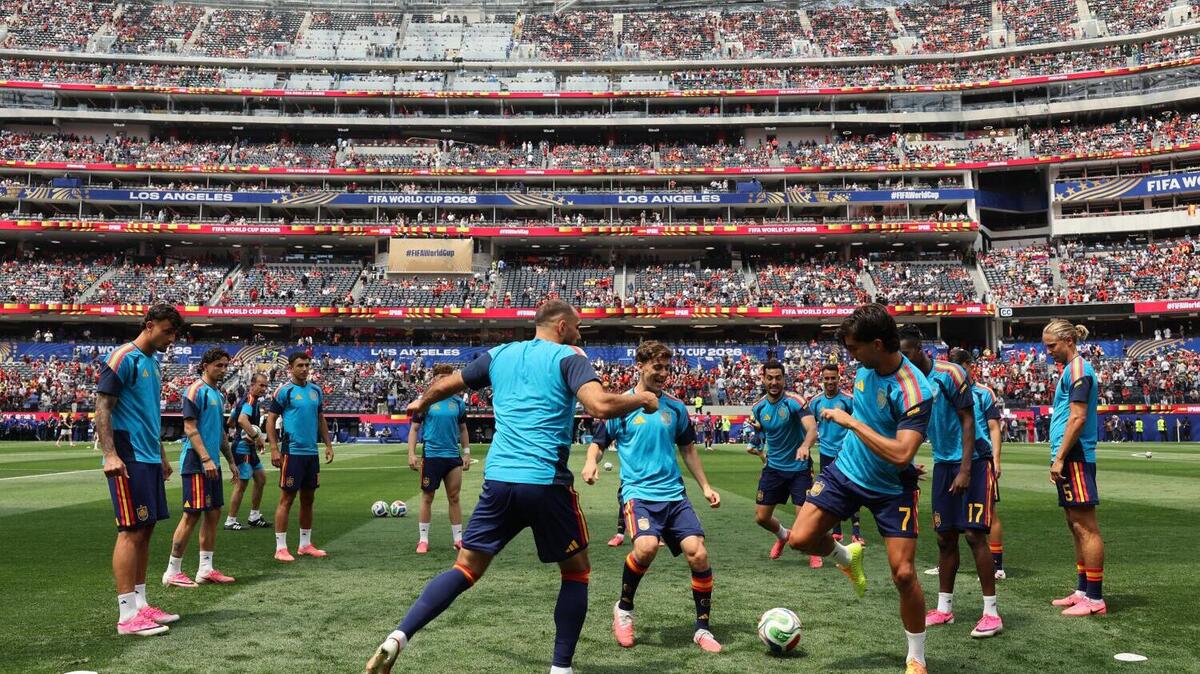
Like most good stories, this one requires planning. Organizers with the L.A. Sports and Entertainment Commission spent nearly nine years preparing to bring the FIFA World Cup to L.A. The most popular sporting event in the world was just the start of a mega-event trilogy that turns the page to Super Bowl LXI at SoFi Stadium and will culminate with the largest Olympics ever in 2028.
Read more Tre Tucker Explains Raiders’ Unique Wide Receiver Room
“We are on the international stage for three years,” said Kathryn Schloessman, president and chief executive officer of L.A. Sports and Entertainment Commission, or LASEC, said. “What story are we telling and how are we doing that?”
The World Cup was a riveting first chapter. The 39-day tournament brought more than 560,000 fans to SoFi Stadium for eight matches, 250,000 fans to 10 official fan zones and a projected $892 million in economic impact across L.A. County, according to LASEC.
The expanded World Cup, with 48 teams and 104 matches over 16 venues in three countries, is only a logistical qualifying match compared to the 2028 Olympic and Paralympic Games. The first Olympics in L.A. in 44 years will welcome 11,198 athletes across 51 sports from more than 200 countries competing over 20 days. The 2028 Paralympics will come to L.A. for the first time with a 23-para sport schedule that will begin competition before the opening ceremony for the first time
Despite the difference in scale, LA28 chief operating officer John Harper called the successful World Cup’s local matches “an immense learning opportunity for us in a lot of ways.”
Attending World Cup matches as a fan and behind-the-scenes observer, Harper was impressed by the transportation services provided by L.A. Metro. The agency said it provided more than 212,000 rides directly to and from SoFi Stadium and 15 parking and transit hubs in L.A. and Orange counties through an enhanced service. Harper was encouraged by the interagency work between different public partners that helped the eight matches go off without a major hitch.
But the biggest lesson was in the spirit of the fans who packed watch parties, streets and bars.
“It really demonstrated the power of sport,” Harper said. “Not only the energy in the stadium, but the energy in the city and L.A. being such a diverse city, you really saw the world come to life on the streets of L.A.”
The World Cup exceeded expectations, Schloessman said, delivering economic effects, local supplier opportunity and community engagement. LASEC hosted fan areas at 10 different locations, highlighted by the tournament-opening festival at the Coliseum. The City of L.A. hosted seven free “Kick It In the Park” watch parties. Sports bars and restaurants overflowed with customers who drank beer taps dry.
“It was just this six-week interlude of time when people liked each other and people were having fun together,” Schloessman said.
LA28 hopes to create a similar, harmonious energy during the Games with sports parks at major sports zones. Areas where multiple venues are clustered together, such as L.A. Live, Exposition Park, Long Beach, Inglewood and Carson, will have dedicated areas for pin trading, sport trials, entertainment zones and sponsorship activations.
While LA28 will be responsible for hosting official live sites for the Games, local communities can organize their own Games-time activities. LASEC worked with local organizations and businesses leading up to the World Cup to promote opportunities, including watch parties, meetups or themed decorations while still adhering to strict rules regarding FIFA broadcasts and logos. LA28 will provide similar guidance leading up to the Olympic and Paralympics Games.
“It is our responsibility, with the organizers, with the authorities, to create an Olympic experience for as many people as possible,” said Pierre Ducrey, International Olympic Committee sports director, who was impressed by the atmosphere of a FIFA fan event in Kansas City where he attended a match featuring his native Switzerland facing off against Argentina. “Whether they have a ticket to be in the stadium or they don’t, we want to create special moments for them that they can remember.”
Read more Bay Area high school football 2026: Top storylines as practices begin
LA28 sold more than 4 million tickets in its first ticket drop, and after last week’s presale, the second drop will resume Aug. 10. With 14 million tickets available, the 2028 Games could break the sales record set by Paris 2024, which sold 12 million tickets between the Olympics and Paralympics.
The biggest World Cup ever was also the most attended, but some of the tournament’s best parties came outside of stadiums.
Santa Monica put screens on every block of the Third Street Promenade for World Cup watch parties where patrons were allowed to carry alcoholic beverages within a specific area of the open-air mall. More than 40,000 people walked through a fan hub on the Santa Monica Pier. The city closed down more than a mile of downtown Santa Monica during the World Cup final for a block party that attracted 20,000 people.
And, Santa Monica Mayor Caroline Torosis proudly emphasized, it was free.
“I think major global events have an extractive history,” Torosis said. “We are trying to change that. We are also trying to use it as an opportunity to showcase the city itself. So how do we benefit our local community but also reintroduce Santa Monica to the region?”
Santa Monica balked at the chance to host competitions for the 2028 Games. Talks to host beach volleyball near the iconic pier broke down in 2025, six months after a study indicated that being a venue city could result in a net loss of $1.45 million, while not hosting the competition could still generate $10.65 million in profit because of the city’s status as a popular tourist destination.
Santa Monica already has deals in place to host hospitality houses for several countries in 2028, including France and Switzerland. Broadcast partners will set up studios on the city’s iconic pier. With plans for watch parties and other accessible celebrations for fans, Torosis envisions Santa Monica being “the place to be” during the Games.
“We are prepared for the influx of people that are going to be in the city,” Torosis said. “I think that FIFA was a great dry run.”
Inglewood was at the center of the World Cup with eight matches at SoFi Stadium. The city got an economic boost from an estimated 625,000 fans, including thousands who traveled to support their national teams without a match ticket, Inglewood Mayor James T. Butts Jr. said.
Fans from all over the world, sporting their country’s colors, flooded Market Street for the city-hosted Wood Cup festival to begin the tournament. Packed prematch marches stunned organizers who were unfamiliar with the tradition. While SoFi Stadium’s name was changed to “Los Angeles Stadium” per FIFA’s strict sponsorship rules, broadcasters still emphasized they were in Inglewood.
“It really gave a boost to community pride that Inglewood is now an international city,” Butts said.
Inglewood will remain the setting for the mega-event story. SoFi Stadium, in addition to hosting a second Super Bowl in five years, is the scene for the 2028 Olympic opening ceremony – which will be shared with the Coliseum – as well as the Olympic swimming and the Paralympic opening ceremony. Neighboring Intuit Dome will host the Olympic basketball tournament.
The consistent stream of global events doesn’t faze Butts. In a city that will have hosted an NBA All-Star Game, eight World Cup matches and another Super Bowl in less than a calendar year, the Olympic chapter is already written.
Read more Why Wrexham Have Added Surprise Friendly After Competitive Season Starts
“We do it time and time again,” Butts said. “This is what we do.”
This story originally appeared in Los Angeles Times.
Copyright 2026 Tribune Content Agency. All Rights Reserved.
This story was originally published August 3, 2026 at 4:30 AM.