 By admin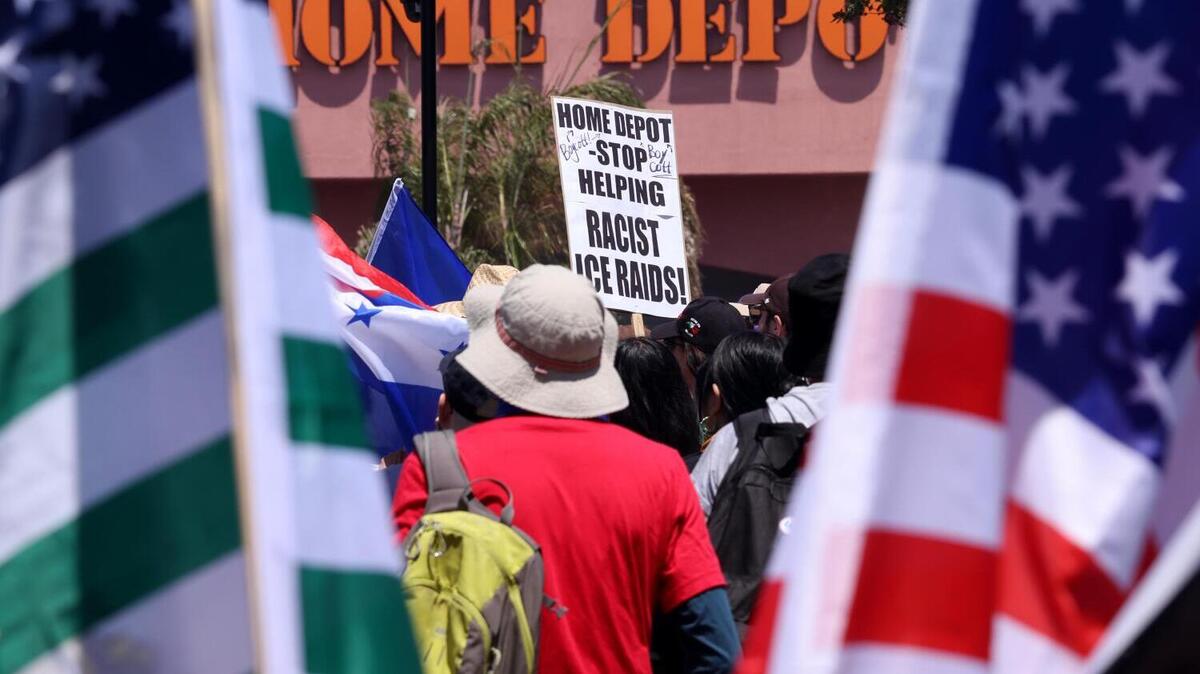
After immigration raids swept across Southern California Home Depot parking lots last summer, advocates hoped they could work with the retailer to address the fear that had taken hold among day laborers who gathered outside the stores looking for work.
Read more California courts must provide records to people who can’t afford court reporters
But a September 2025 meeting between Los Angeles Mayor Karen Bass, National Day Laborer Organizing Network representatives and Home Depot executives instead convinced NDLON that voluntary cooperation had reached a dead end, general counsel Chris Newman said.
Newman said Home Depot had declined to provide a list of locations where raids occurred and refused to acknowledge immigration enforcement actions were taking place at its stores.
“If you’re not even willing to acknowledge where these raids are happening, how can we talk about a shared strategy to mitigate a human rights crisis that is clearly happening at their stores?” Newman said. “People have been killed. And so the rest of the meeting, obviously, was quite awkward.”
That stalemate would eventually move from Los Angeles City Hall to the state Capitol, where the legislative process proved more conducive to negotiation. At the center of the debate was how much responsibility private retailers should bear when federal immigration enforcement takes place on their property.
Nearly a year later, lawmakers are considering a compromise that has substantially narrowed that divide.
In an attempt to deliver on President Donald Trump’s promise of record-level deportations last summer, U.S. Immigration and Customs Enforcement shifted tactics. Stephen Miller, a senior White House official, instructed the agency to target places where migrants often congregate, including Home Depot.
Instead of operations aimed at specific individuals, federal agents increasingly conducted sweeps outside of Home Depot storefronts — where day laborers have long gathered to be hired for work. Several of the raids grew violent, and one ended in the death of 52-year-old Roberto Carlos Montoya Valdez, who was struck by a vehicle in August 2025 while fleeing immigration enforcement in Los Angeles.
Home Depot remained largely silent about the enforcement activity occurring on its properties. It said only that it did not receive advance notice of raids and could not interfere with law enforcement. Newman believes the company’s silence on the raids was a political calculation.
“My guess is that they continue to be more afraid of being denounced on the Sean Hannity show, or by Tucker Carlson or Steve Bannon, than they are of the denunciation of protesters outside their stores,” Newman said. “In part, because they borderline have a monopoly on small residential retail services.”
Newman said with the company seemingly unwilling to collaborate, NDLON approached state Sen. Sasha Pérez, D-Alhambra, to explore whether legislation could accomplish what voluntary discussions had not.
Pérez worked with the organization to introduce SB 1103, a bill that has since undergone months of negotiation in the Capitol. If passed, it would require large retail stores to preserve and provide documentation of immigration enforcement activity occurring on their premises when requested by the California attorney general or county governments.
Read more State rejects Sac City appeal, warns it may take direct oversight of SCUSD in future
After Valdez was killed fleeing a Home Depot in her district, Pérez said his family had reached out to the retailer for video surveillance footage. It did not provide the footage at the time. Without it, she said, Valdez’s family was left with unanswered questions about his death and the broader community did not feel justice had been served.
“The number of people that have been impacted as a result, the number of people that have been harmed as a result of these immigration raids, that have been killed as a result of these immigration raids, it’s all important,” Pérez said. “There is value to us monitoring what has happened here.”
The initial version of the bill, which Pérez named the REPAIR Act of 2026, placed much of the reporting burden on retailers themselves. Large home-improvement chains would have been required to send documentation of immigration enforcement activity to the California attorney general within 24 hours and publish daily reports detailing raids at their stores.
In committee, however, legislators debated whether private companies should be responsible for monitoring federal law enforcement. Lawmakers eliminated the daily reporting requirement and shift responsibility for tracking and publicizing enforcement activity to local and state agencies.
“I think the amendments were fair. I feel really good about where the bill is,” Pérez said. “It would be the first in the nation to pass and gives us a way to better track these events.”
Rachel Michelin, CEO of the California Retailers Association, which represents retailers including Home Depot, praised Pérez for listening to the industry’s concerns and working with retailers to amend the bill.
The association remains opposed, however. Michelin said its remaining concerns include a provision allowing designated county agencies to request records from retailers, which she worries could be misused.
Home Depot referred requests for comment on the bill to the California Retailers Association, but did not answer follow-up questions about whether it shares the association’s position.
Nearly a year after their meeting, Newman said neither Home Depot nor Mayor Bass has responded to NDLON’s requests for further discussion. The organization wishes the legislation went further, he said, but for now, it is focused on getting something to the governor’s desk.
“We’re not asking for the moon and the stars from Home Depot,” Newman said. “To the contrary, we’re asking them to do more than they are currently doing, which is nothing. Nothing at all.”
Read more Lakers Fans Will Immediately Circle These Two Games on the 2026-27 NBA Schedule
This story was originally published August 11, 2026 at 5:00 AM.