 By admin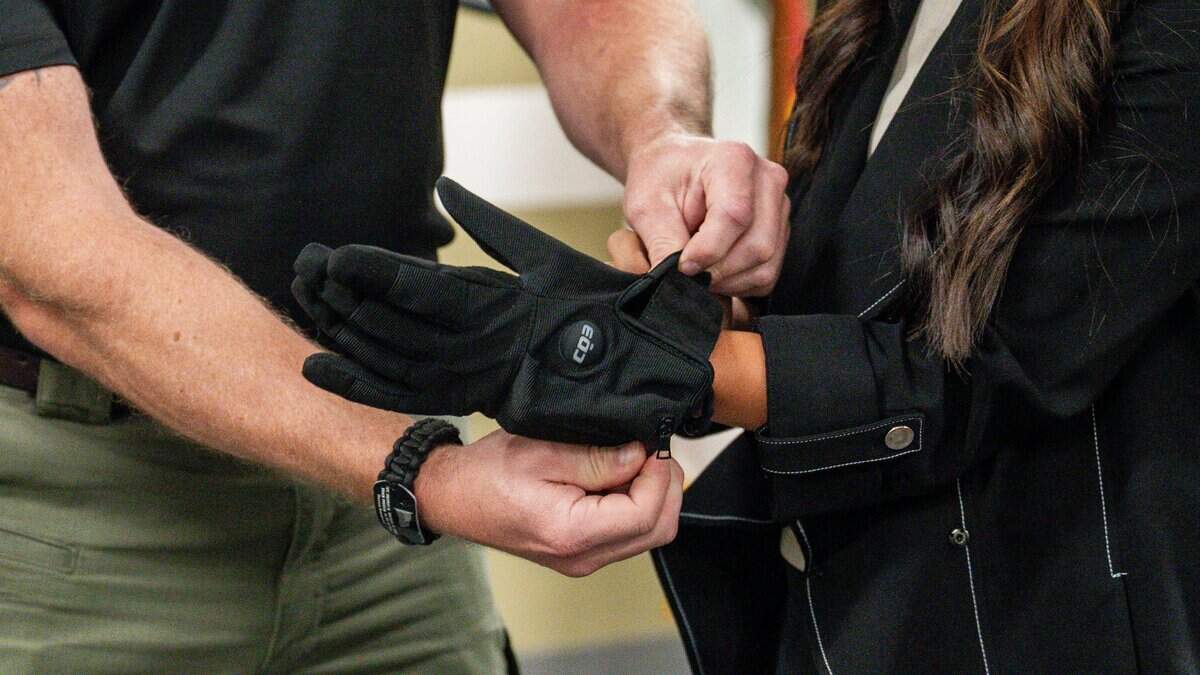
The Legislature passed a bill prohibiting law enforcement officers from using wearable electroshock devices Monday, sending the measure to Gov. Gavin Newsom’s desk.
Read more To buoy local journalism, Legislature passes bill to create newsroom tax credits
Assembly Bill 2760 would extend the prohibition on electroshock gloves to both state and federal law enforcement agents operating in California. If the bill is signed into law, California would be the first state in the U.S. to enact such a ban.
The legislation would also prohibit the use of state funds to purchase electroshock gloves and mandate that the California Department of Justice conduct a safety and community impact of the technology.
Assemblymember LaShae Sharp-Collins, D-San Diego, the bill’s author, said the gloves allow officers to administer multiple electric shocks in one encounter, potentially resulting in deadly outcomes.
“Imagine your family, your friends and loved ones or even yourself being incapacitated by federal, state or local law enforcement who do not have the necessary training to ensure that you don’t suffer from adverse health effects due to being shocked,” said Sharp-Collins in an Aug. 26 Senate committee hearing.
Sharp-Collins introduced the legislation earlier this month by replacing the language of an old bill. The strategy, called a “gut-and-amend,” allowed Sharp-Collins to move the ban on electroshock gloves quickly through the legislative process.
The bill’s proponents and architects have said that despite the measure’s rapid progression, its timely implementation is necessary; law enforcement officers and one California school district are already in possession of the gloves, Sharp-Collins said in a Monday Assembly hearing.
“AB 2760 draws a clear line: that public safety technology must be proven safe and accountable before it is deployed, not after someone is killed or seriously injured,” Sharp-Collins said. “Our commitment is to protect our communities, especially the most vulnerable, and that is what 2760 is about.”
The measure also responds to concerns that Immigration and Customs Enforcement officers may have access to the gloves if they become more widely available in California. The bill’s introduction came just after the U.S. Department of Homeland Security announced that ICE was planning to purchase a multi-million dollar contract with Compliant Technologies, a Kentucky-based company that produces the gloves.
Read more 3 bills to regulate immigration detention approved by Legislature, sent to Newsom
Since, ICE has awarded a $16.7 million contract to the company to purchase 6,000 pairs of electroshock gloves called Generated Low Output Voltage Emitters, according to reporting by the Associated Press. As the first legislation to respond to the deal, AB 2760 has attained national attention.
In an to DHS Secretary Markwayne Mullin, U.S. Sen. Alex Padilla, D-Calif., urged the cessation of ICE’s contract with Compliant Technologies.
“ICE is answerable to the American public whose trust in the agency has eroded: over half of Americans have little to no confidence in the agency and over half believe it uses excessive force,” the letter reads. “To that end, DHS and ICE must immediately halt the procurement, deployment, and use of electrical shock G.L.O.V.E. weapons.”
Opponents of the measure say it would limit the ability of law enforcement officials to effectively maintain public safety, criticizing the expedited drafting and amendment process that allowed the bill to pass the legislature during the current session.
“This is something that is absolutely insane,” said Assemblymember Carl DeMaio, R-San Diego, during the hearing. “We’ve had 11 days of discussion on something as significant as being the first state in the nation to ban these taser gloves.”
However, supporters of the bill maintain that it provides necessary protections against undue force from law enforcement officers. To address concerns from those worried the bill’s provisions are too restrictive, lawmakers amended the bill to sunset on Jan. 1, 2030, giving law enforcement officials time to learn about the technology and be trained on how to safely use it.
“I think we strive for a world of true de-escalation, of true unwinding of conflict,” said Assemblymember Alex Lee, D-San Jose, a co-author of the bill. “That is why we embrace stronger cultural skills and stronger mental health skills, not arming our law enforcement with more tools in the torture toolbox. … They do not need another way to brutally hurt or potentially hurt someone.”
Read more To buoy local journalism, Legislature passes bill to create newsroom tax credits