 By admin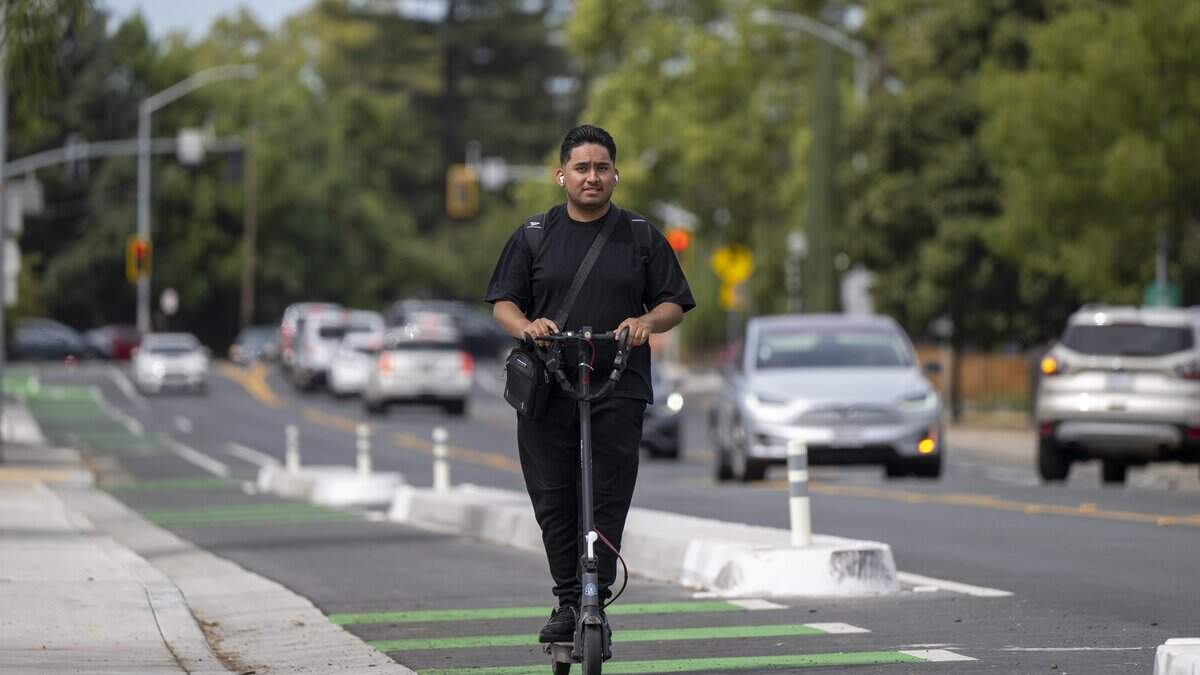
For decades, Franklin Boulevard’s four traffic lanes carried motorists past restaurants, auto shops and other businesses in the North City Farms section of south Sacramento.
Read more Super El Niño is looming. Here’s what new data means for snow season across the west
Now, a roughly 1.2-mile stretch looks — and functions — much differently.
After more than a year of construction, Sacramento has largely completed a roughly $20 million overhaul of Franklin Boulevard between Sutterville Road and 32nd Avenue, replacing two through lanes with protected bike lanes, wider sidewalks, new streetlights, trees and signals for a pedestrian crossings.
The redesign represented one of the most significant changes to the corridor in decades and was intended in part to make Franklin Boulevard safer for people walking and biking. For business owners who endured construction and watched the transformation from their storefronts, the first few weeks with the finished street have brought mostly positive reviews — along with an adjustment period.
Some said traffic appears slower and the street feels safer and more inviting. Others have watched drivers strike new concrete medians, mistakenly enter bike lanes or struggle to figure out where to park.
“I would say it’s going to take a while for people to get acclimated,” said Victor Batovac, whose family has operated Ellio’s German Auto on Franklin Boulevard since 1991. “But overall … I think it’s a very positive thing.”
A major redesign of Franklin Boulevard
For more than a year, construction crews widened sidewalks, installed protected bike lanes and streetlights, planted at least 60 trees and added pedestrian crossings between Sutterville Road and 32nd Avenue.
The most consequential change may be what disappeared.
The city eliminated two through lanes, leaving one lane in each direction and a center turn lane. The “road diet” was intended to reduce vehicle speeds while creating more space for bicyclists and pedestrians.
Before the project, Franklin Boulevard had not undergone a major infrastructure improvement in about 40 years, said Mike Bokan, executive director of the Franklin Boulevard Business Association. The previous major work occurred in the mid- to late 1980s, when power lines were placed underground.
The push for another overhaul stretched across years of community advocacy. The project received about $443,000 from the Sacramento Area Council of Governments in 2016 for community outreach, Bokan said, before Sacramento established the Franklin Boulevard Complete Street project the following year.
The roughly $20 million project ultimately used city, county, regional and federal funding, according to the city.
“In my lifetime, I’ve never seen this much change in the district over the course of a 10-year period,” Bokan said.
The changes extend beyond the street project, he said, pointing to new murals and a multimillion-dollar modernization of Ethel Phillips Elementary School.
“The hope was that in the end, we’ve improved our lighting, we’ve improved our walkability, we’ve improved our mobility, we’ve brought a safer environment to Franklin Boulevard, and that’s conducive not only to business but to the community as well,” Bokan said. “I think we’ve delivered on that.”
Businesses notice moderated traffic
At Ellio’s German Auto, Victor Batovac remembers drivers “flying” past the shop at 3928 Franklin Blvd.
Batovac co-owns the business with his sister, Emma. Their father opened it at the same location 35 years ago.
“Basically people treated the street like an alternative to (Highway 99), you know what I mean,” Batovac said. “They weren’t really here patronizing the businesses.”
The speed limit hasn’t changed, but the Batovacs said traffic appears to be moving slower.
“In that aspect, it feels safer,” Emma Batovac said.
Caballo Blanco Restaurante co-owner Ruben Unzueta has noticed a change, too. His business has operated at Franklin and Fruitridge boulevards for more than 60 years.
Unzueta said he particularly likes the new streetlights and has noticed more people walking and riding bicycles.
Read more Sacramento City Council to consider allowing zoo expansion in Land Park
“I feel by adding the new improvements that they did, that’s going to help for people to get used to walking,” he said. “It just seems like more life, really, instead of so many vehicles.”
Unzueta had watched a similar road diet take place on Freeport Boulevard near C.K. McClatchy High School, where he once expected fewer lanes to worsen congestion during school drop-off.
“It actually flowed smoother,” Unzueta said.
He said he is seeing the same thing on Franklin Boulevard.
Mike Furiani Jr., owner of Furiani Marble & Granite, moved to a new location on Franklin Boulevard in May. So far, he said he has not seen any traffic jams.
“There’s never any congestion on this street,” Furiani said. “Not at 6 o’clock in the morning when we get here. Not during the day, with more coming and going. And not even… when it gets busy on the weekend.”
Safety was more than an aesthetic concern on Franklin Boulevard.
The corridor has been the site of fatal crashes and was identified in 2018 as part of Sacramento’s high-injury network — the . In February, pedestrian Josefina Guzman, 45, was struck and killed near 22nd Avenue, within the boundaries of the complete street project.
Bokan, whose family has operated a business along Franklin Boulevard since 1947, remembers vehicles jumping curbs and crashing into buildings.
He and Unzueta said they have noticed fewer crashes recently. Bokan said he has observed only two since spring.
It is too soon, however, to determine from those observations whether the redesigned street has reduced crashes.
Drivers adjust to the new Franklin Boulevard
One effect of the redesign is already easy to spot: tire marks.
New concrete medians along Franklin Boulevard, between the traffic and bike lanes, bear evidence of drivers who haven’t quite mastered the new configuration.
“I can tell you a lot of people don’t like the islands because I see a lot of tire marks on them,” Furiani said.
For the first few months after moving his family business to Franklin Boulevard, Furiani said he regularly heard screeching tires and the thud of vehicles hitting the concrete.
He had his own moment of confusion shortly after arriving.
“Before they actually painted the bikes and stuff like that, we just moved here, and I pulled into the lane,” he said, describing pulling into the bike lane. “I was like, this is really tight.”
When bicyclists passed a few weeks later, he realized his mistake.
Another concern for Furiani is getting out of a vehicle parked on the street with traffic approaching.
“There’s not a lot of traffic, but if you just aren’t paying attention, you open up your door, somebody will take off your door,” he said.
The city acknowledged the adjustment period.
“There has been an adjustment for vehicles in figuring out where to park with respect to the new protected bike lanes and how fast is too fast alongside the concrete medians — the concrete medians have been hit throughout the length of the project,” city spokesperson Gabby Miller said. “But one of the key goals of the project was to reduce vehicle speeds while protecting and providing safe facilities for pedestrians and bicyclists.”
The city does not plan to alter the improvements already installed, Miller said, though officials will consider feedback as they finish the remaining work, including completing a walkthrough list from the Department of Utilities and accounting for the installed signage and striping.
Both Victor and Emma Batovac said they also appreciated the street’s appearance compared with before construction.
Read more West Sacramento to answer community questions about trash contract at open house
“It was kind of an old, dilapidated street,” he said.
“It’s nice to see it look cleaner,” she added.