 By admin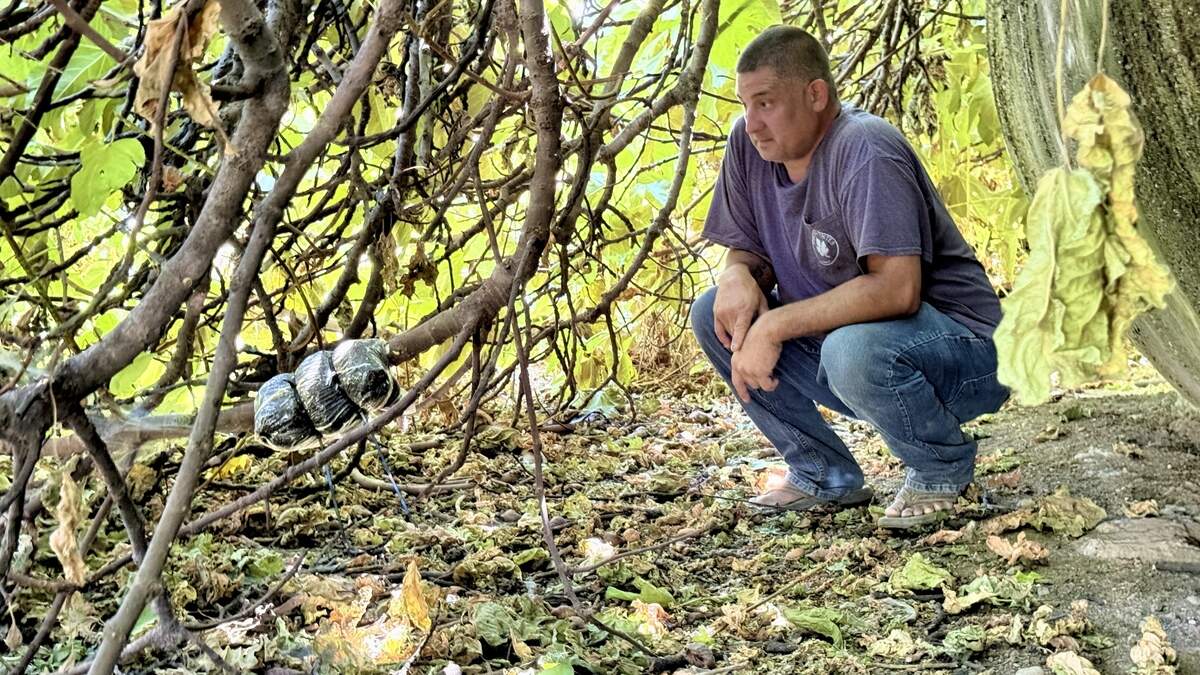
David and Priscilla Burke don’t find wild fig trees. The trees find them.
David Burke works in construction, and found his first fig tree on the job. It was the beginning of a lifelong obsession, and led to the creation of their business The Fig Hunter in 2021.
Read more Where are wildfires burning right now in California? Map shows major blazes
“I was working on a project down in the Bay Area, and there was a fig tree on that project, so I brought home some figs. And then that summer was the summer of figs because I was pulling over, looking and seeing trees, and creating a map. I would bring figs home, and if Priscilla liked them, we read that we can simply stick sticks in the dirt,” he said.
Trees that have been planted by people do not interest him. Burke looks in unlikely spots to find trees that have grown from seeds left by wildlife. They sprout in culverts, beside buildings, through cracks in pavement. Each wild fig is a unique variety.
Like citrus, apples and many other fruits, figs grown from seed do not grow true to form, which means they are genetically distinct from their parent trees. The resulting fruit may be similar to the parent fruit, or utterly different.
For starters, there’s a 50 percent chance the seed will be male. Male fig trees produce small, dry fruit known as caprifigs. While not good for eating, caprifigs are a critical part of the reproductive cycle of figs, as it’s where the fig wasp nests.
By and large, the figs you already know and buy at the market are self-fertile, requiring no intervention to produce fruit. These include popular varieties such as Black Mission, Brown Turkey and Kadota. However, figs in the wild do need pollination in order to produce fruit. The fig wasps carry pollen from the caprifigs to female blossoms, pollinating them.
Even if a wild fig turns out to be female, the fruit may be unremarkable. Moreover, the same tree’s fruit may be lackluster in one location and exceptional in another.
Figs have deep roots in California. Initially introduced by Spanish missionaries, they had a heyday after the Gold Rush when then-governor Leland Stanford began investing in them as a cash crop. . Looking to compete with imported figs from Turkey, he kept half his imported Smyrna fig trees in the Bay Area, gave a quarter to nurseryman William West in Stockton, and the remainder he planted at his ranch in Vina, California.
Once the Burkes have identified a wild fig tree, they take cuttings to cultivate at their Red Bluff home. Initially they give it a number, sequentially in the order it’s been discovered, and pin its location on a map. Once the tree bears fruit, if it’s good enough to continue propagating, they’ll name it. The names usually reference the location of the tree, and maybe a flavor note.
For example, one of their breeds is 547, or Shasta Cranberry. It was found in Shasta County, in an area that was devastated in the Carr Fire in 2018. The mother tree burned to the ground, but it came back from rootstock.
Read more Roseville considers new incentive to spur downtown development
“The reason why it’s named Shasta Cranberry is because it’s a Shasta County find, and it reminds me a lot of cranberries as far as the tart berry flavor,” Priscilla Burke said.
Another is 455 Amen’s Citron. They found the tree on local farmer Brett Amen’s property. It’s massive and sprawling to the point that it has completely swallowed a huge water tank. The leaves span nearly a foot across, and the figs weigh in at up to a quarter pound. The name refers to that farmer and the fruit’s bright citric notes.
Once they’ve deemed a variety as viable, the couple begins by sprouting cuttings in pots.
“Propagation of figs is super, super simple. It’s six inches of cutting, three or more nodes, and as many of those nodes as you can get in contact with soil, the better chances of success you have because the natural rooting hormone is located in each one of those nodes,” Priscilla Burke said, pointing to small bumps on a branch.
Another method is called air layering, or marcotting. By packing dirt around a branch still attached to a tree, the branch will grow roots. It can then be cut and potted. The bark can also be stripped from the branch, called girdling, which encourages faster root growth.
The Burkes have been terraforming their property, preparing to plant the cuttings, of which there are many. About 50 pallets containing 12 pots apiece line a ridge near their house.
The Burkes sell trees via their website, and sell fresh fruit at the farmers market and via a local specialty butcher, A & R Custom Butchering, Retail Meats and Deli in Red Bluff. They’ve also planted a dedicated stand of one variety for local restaurant Krystyna’s Polish American Cuisine. But David Burke’s primary desire is to get more figs in the hands of people.
This led to the creation of their non-profit, One Seed at a Time, whose goal is to donate and plant 5,000 fig trees on behalf of the community. As he sees it, growing more fruit can be a way to tackle one of the biggest issues in the area, hunger.
“One in five families within our county live below the federal poverty level, closer to West Virginia. Eighty-five percent of the families that go to our daughter’s school district, our Title One school, get federal programs. Last year, when there was the SNAP debacle, kids were actually coming to school hungry. I don’t see it as just our issue. This is an across the board issue,” Burke said.
Read more Sacramento City, unions launch $95 parcel tax campaign for special education