 By admin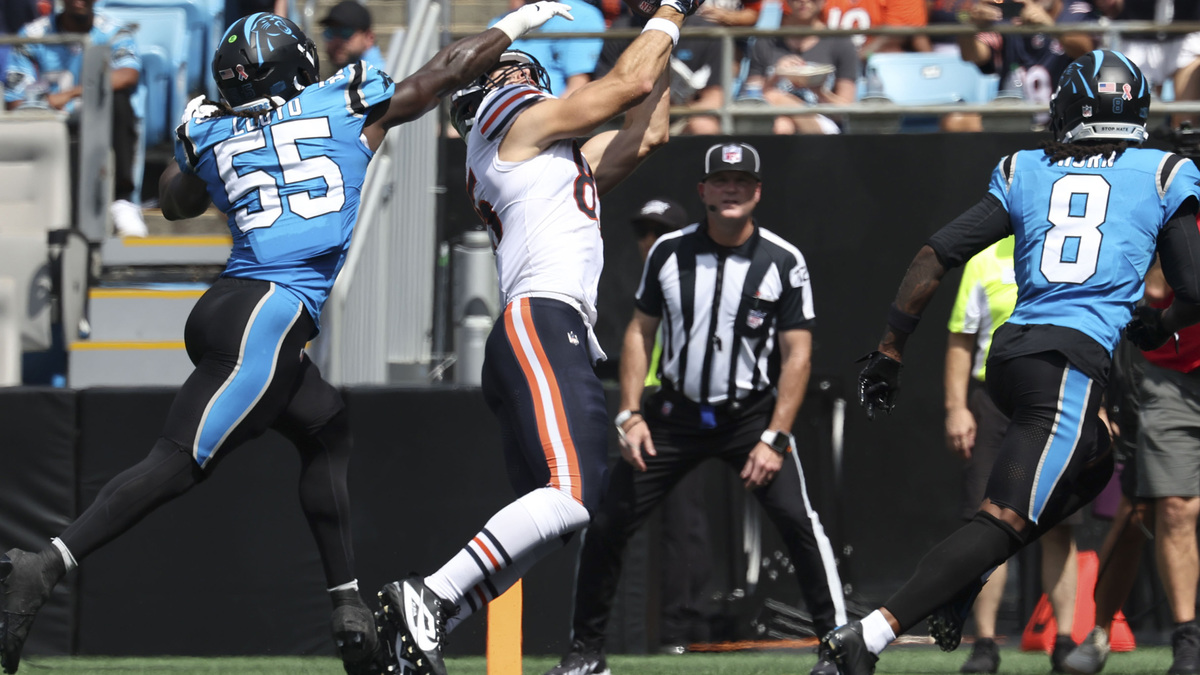
CHICAGO – The Chicago Bears are 1-0, but quarterback Caleb Williams is going to face a very different challenge in Week 2. Minnesota Vikings defensive coordinator Brian Flores is always an enigma.
Read more Josh Tolentino: Ravens look ready for deep run with top corners
The Vikings finished second among 32 defenses in Week 1 with a 50% QB pressure rate, according to NFL Pro. The Vikings had four sacks in their season-opening win over the Green Bay Packers. They blitzed an absurd 78.3% of the time in the game. Last season, the Vikings led the NFL with a 46.1% blitz rate.
Williams is 1-3 against the Vikings in his career. The game the Bears won last year was a struggle too. They scored just one touchdown and won on a last-second Cairo Santos field goal at U.S. Bank Stadium.
The good thing for the Bears is that Williams just saw a 51.3% blitz rate Sunday against the Panthers, and he wound up with a 137.5 quarterback rating against the blitz. Williams was 9 for 14 against the blitz for 142 yards and two touchdown passes.
The thing about Flores’ defense, though, is that he disguises his blitzers so well. It’s difficult to predict who is blitzing on any given down. If Bears coach Ben Johnson wants to have the highest-scoring team ever, his offense is going to have to score against good defenses. They’ll see a good one in Sunday.
Here’s what other stats, numbers and figures stand out this week.
What does a historic offense look like?
If Johnson wants to catch the 2013 Denver Broncos, a 59-point opener helps. That Broncos team set the high mark with 606 points (37.9 per game). The 2007 New England Patriots held the record before that with 589 points (36.8 per game).
Also in the top five are the 2018 Kansas City Chiefs (565 points, 35.3 per game), Johnson’s 2024 Detroit Lions (564 points, 33.2 per game) and the 2011 Packers (560 points, 35 per game). The 2024 Lions were the only team in that group that benefited from a 17th regular-season game.
After scoring 59 against the Panthers, the Bears need to average 34.3 points over the final 16 games to set a new high mark with 607 points.
“That will always be the goal,” Johnson said after the Week 1 win. “We want to be the highest scoring, we want to have the most wins, we want to win Super Bowls. That’s what we do. We didn’t get into this profession trying to be mediocre, average.”
So what makes a historic offense? Looking at those highest-scoring offenses, all of which have happened relatively recently (since 2007), all five of those offenses ranked in the top three in the NFL in passing yards per game. All five ranked either first or second in passing yards per attempt. Four of the five teams had an MVP quarterback, with the 2024 Lions being the lone exception.
Four of those five teams had two 1,000-yard receivers (or a tight end in the case of Travis Kelce). In 2011, Packers receiver Greg Jennings finished 51 yards shy of joining teammate Jordy Nelson over the 1,000 mark. The Bears haven’t had two 1,000-yard receivers since 2013, when Alshon Jeffery and Brandon Marshall did it. The only other instance in Bears history came in 1995, when Curtis Conway and Jeff Graham both reached 1,000 yards.
Of those five teams, only Johnson’s 2024 Lions ranked in the top 10 in rushing yards per game. They were by far the most balanced of those five elite offenses, ranking sixth in the run. The 2018 Chiefs, 2013 Broncos and 2007 Patriots were merely average in terms of rushing yards per game, while the 2011 Packers were downright bad, ranking 27th. In fact, none of the top 11 highest-scoring offenses of all time led the NFL in rushing in their respective seasons.
Perhaps most notable, though, is that none of the five teams won the Super Bowl. In fact, of the 25 highest-scoring offenses ever, only three won a championship. Those would be the 1999 St. Louis Rams (15th highest-scoring ever), the 1961 Houston Oilers (23rd highest) in the AFL and the 2009 Saints (25th highest).
The journey to 4,000 yards
Williams threw for 269 yards and two touchdowns in Week 1. He needs 3,731 yards to become the first Bears quarterback to throw for 4,000 yards, meaning he needs to average 233.2 yards over the next 16 games to get there.
On both of his touchdown runs, Williams topped 20 mph, according to Next Gen Stats. His 29-yard TD run maxed out at 20.8 mph. Both touchdown runs were among the top-10 fastest ball carriers in Week 1.
The journey to 3,000 yards
The Bears ran for 291 yards against the Panthers. If the Bears are going to be the best offense ever, that undoubtedly includes putting up some big numbers in the ground game.
Only seven teams have rushed for 3,000 yards in a season during the Super Bowl era, per Stathead. That includes the Bears franchise record 3,014 yards in 2022, when quarterback Justin Fields was running wild.
After the Week 1 performance, the Bears need to average 169.3 rushing yards over the final 16 games in order to reach 3,000. For reference, the Buffalo Bills led the NFL last season with 159.6 rushing yards per game.
Five of the seven teams to reach 3,000 rushing yards in the Super Bowl era have done it since 2019. The 2019 Ravens hold the record with 3,296 yards in 16 games in 2019. The Ravens and the Philadelphia Eagles both surpassed 3,000 yards in 2024. The 2020 Ravens and the 2022 Bears are the other recent teams to do it.
It’s worth noting that in 2025 the NFL officially incorporated statistics from the long defunct All-America Football Conference, which folded in 1949, similar to how it incorporated past AFL stats after the AFL-NFL merger. The NFL technically now recognizes the 1948 San Francisco 49ers from the AAFC as the highest-rushing team of all time with 3,663 yards that season. The 49ers did that in a 14-game season, averaging an astounding 261.6 yards per game. That record might never be broken.
The 49ers, Baltimore Colts and Cleveland Browns joined the NFL from the AAFC in 1950. The first iteration of the Bills also began in the AAFC but folded in 1949.
Exceeding expectations
Per Next Gen Stats, the Bears had three of the top seven most remarkable rushes in Week 1. Based on where the players were on the field when he took the ball, Kyle Monangai was expected to run for 6 yards on the play that became his 61-yard touchdown run.
Some exceptional blocking from everybody made that play possible.
“He actually ran through a good amount of like trash, I would say,” said Bears receiver Jahdae Walker, who helped interfere with the defenders chasing Monangai at the end of the play. “(Kalif Raymond) had a great block, Luther (Burden III) had a great block and I was just the last little guy left.”
Additionally, D’Andre Swift’s runs of 32 and 28 yards were among Next Gen Stats’ top seven remarkable runs in Week 1. On the 32-yard run, Swift executed a spin move to escape a would-be tackler and get the Bears into the red zone. Next Gen Stats’ model suggested Swift was expected to pick up just 6 yards.
Swift had the second-best rushing EPA (expected points added) in Week 1, behind only Kenneth Walker III of the Kansas City Chiefs. Swift on Wednesday was named NFC Offensive Player of the Week.
Copyright 2026 Tribune Content Agency. All Rights Reserved.