 By admin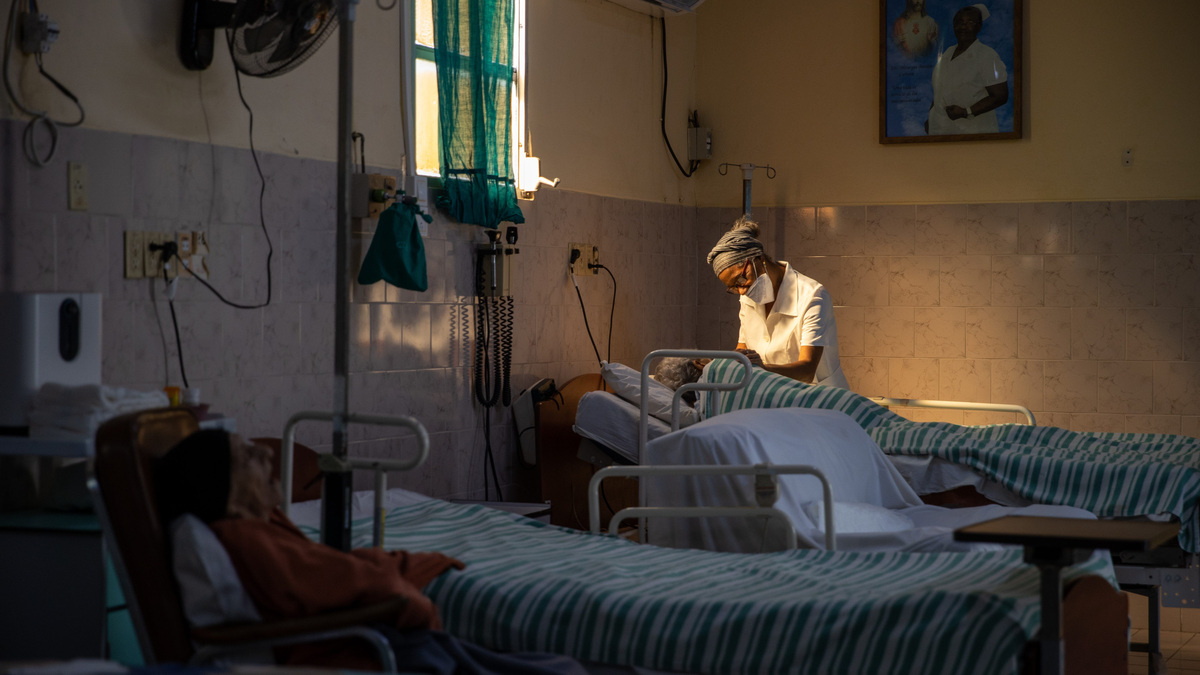
HAVANA – Sister Cecilia María Fuentes Ávila marched through the sun-drenched grounds of the nursing home, greeting the fragile older women others had forgotten.
Read more Week in photos: Kings + Aftershock + crash court hearing and more
Some, like 79-year-old Yvonne Martínez Padrón, had lived at the facility for more than a decade – divorced and destitute, with nowhere else to turn, she was grateful to be here. Others were bedridden and unable to meet her eye.
Outside in the sprawling property of the San Francisco de Paula Home for Elderly Women in the La Vibora neighborhood of Havana, green and yellow crotons and two-story palms lined walkways connecting one building to the next. Mango trees dropped their ripe fruit to the ground.
“Buenos días,” Fuentes cheerfully told a group of older women sitting in a shaded walkway. A few responded with smiles. Another, slumped in a wheelchair, stared vacantly into the distance.
All 102 women, ages 70 to 91, will likely live out their final years here.
More than 1.4 million Cubans have fled the island in recent years, leaving behind thousands of older adults – and Cuba is struggling with what to do with them.
Ten months of U.S. sanctions, a fuel blockade and years of Cuba neglecting its infrastructure have led to prolonged blackouts and shortages of food, water and medicine. The generation that grew up with the Revolution’s promise of world-class, state-run health care is now abandoned – by its country and its family – and simply struggling to survive.
The Catholic Church has stepped in as a de-facto safety net. Many of these older Cubans end up at the home, which is overseen by the church and run by Fuentes.
“It’s like a downward spiral,” Fuentes, 63, said in an interview with USA TODAY at the facility. “A decline that hasn’t hit bottom yet but is becoming more difficult by the day.”
Chlorine, fence posts and dementia medication
Fuentes wakes at around 6 a.m. each morning.
Before she takes her first sip of sweetened black Cuban espresso, her mind is already galloping with the challenges of the day:
Workers need chlorine to clean urine-soaked sheets, but nearby shops don’t carry any.
If there’s no power, will they have to fire up the solar power system to run the freezers filled with food or the washing machines to clean soiled sheets.
Did the resident who screamed through the night take her dementia medication – Is there any medication?
Do the cooks have enough branches or wooden fence posts to fuel the open flame in the makeshift outdoor kitchen?
By 7 a.m., Fuentes is dressed in her taupe religious habit and veil, making rounds and solving problems.
The property is lined with squat concrete buildings and dotted with queen palms and mango trees. Eighty workers, including 17 nurses, three administrators and two doctors, tend to the older residents, who live here for free.
On most days, Fuentes relies on grit and the shelter’s meager funds to hunt down supplies and keep the shelter running. On others, she prays for guidance. Each day, conditions worsen.
‘Like a Pandora’s box’
Cuba is struggling under one of the most profound exoduses in the island’s history.
As more leave each day, their older relatives are left behind – a mounting crisis the government can’t handle.
More than 26% of Cuba’s population today is 60 or older, making it one of the oldest populations in Latin America and the Caribbean, according to Cuba’s National Office of Statistics and Information, or ONEI. By 2040, that figure is expected to jump to 36%.
“The problem lies not in that accelerated aging,” ONEI’s Elaine Acosta told Martí Noticias, “but rather in how ill-prepared Cuban society is to face the challenges posed by such a defining shift in population.”
Enter: the Catholic Church and nuns like Fuentes.
On a recent morning, Fuentes made her way through the grounds, checking on staff and residents. Statuettes of St. Francis of Paola and La Virgen de La Caridad del Cobre, Cuba’s patron saint, stood sentry in hallways. Crucifixes hung over doorways.
In the shaded walkways, some elderly residents slumped in wheelchairs, mumbling alone or staring off vacantly; others pushed walkers in tiny shuffles.
Fuentes greeted each one. Those who could, smiled and waved back. One woman stopped to show Fuentes the squat exercises she’d been practicing.
Five of the home’s six residential wings house the most frail: the bedridden, those with dementia, others who need help moving around. The last wing is devoted to those who can still get around on their own, Fuentes said. Most are 80 or older.
The women usually sleep two to a room in small quarters with single beds covered in threadbare flowered bedsheets, two small dressers, walkers and, in some units, bedside commodes. In one wing, the pungent smell of urine permeated the common area.
Families who leave their relatives here often are struggling to survive themselves or plotting to leave the island, said Gladys Pazos, one of two staff doctors.
As Cubans flee, they sell their homes – and often leave behind their mothers, grandmothers and aunts, she said. Some are brought here by concerned neighbors, some of whom had to bust down doors to retrieve incapacitated women left behind.
“It’s like a Pandora’s box,” Pazos said. “All sorts of bad things are being unleashed.”
‘We deal with life and death every day’
With Cuba’s power grid in freefall, the government installed a small solar panel system on the home’s hospital wing, Fuentes said. That allowed ventilators, air conditioners and dialysis machines to keep churning overnight.
All other residents sleep without air conditioning.
On this day, Fuentes checked in on the hospital wing. A wall-mounted air conditioner hummed quietly over five beds. One woman gently swayed in a rocking chair, eyes closed, blanket pulled up to her chin. A nurse attended to another resident in bed. Above them, a framed photo of a nurse in white uniform watched over them: Mirurgia Barrero Carrión, a former nurse who died attending to residents during the coronavirus outbreak.
The women who arrive at the home are often in the final year of their lives, Fuentes said. They arrive incontinent, with high blood pressure, schizophrenia, dementia, respiratory failure, coronary heart disease, encephalopathy and diabetes.
Some live just a few weeks; others stay much longer. One woman has been here for 17 years; another lived here until she was 107, Fuentes said.
Read more Marvin Harrison Misses Cardinals Team Meeting Ahead of Trade
Through August, 36 women had died this year at the home.
“We deal with life and death every day,” Fuentes said, “with pain every day.”
A call to serve
Fuentes is short and stocky, with salt-and-pepper hair she keeps tucked under her veil. She holds a steady gaze while speaking and has a slightly conspiratorial smile, like she’s pulled off something unexpected (which she does often).
Fuentes, originally from Las Tunas, felt a calling to join the convent, in part, after caring for her grandmother until she died. Fuentes felt the first pulls to a life in the clergy as a teen and entered the church at 33. Missions to Puerto Rico, Costa Rica and Nicaragua followed, before she returned to Cuba.
When church officials asked her in 2013 to run the San Francisco de Paula home in La Vibora, she relished the opportunity.
“My reason for being here is a calling from the Lord,” she said. “Jesus loves and shows mercy through service, specifically charitable service.”
As electricity began to falter at the home, the kitchen staff built a wood-burning outdoor kitchen with concrete stoves and large stockpots. Nearby walls are blackened by woodsmoke.
A cart near the kitchen was stacked with branches and weathered fence planks for kindling. Each day, staffers forage for more wood to keep the fire burning.
Stockpots bubbled with soup, rice or picadillo, a traditional Cuban ground beef dish. Beans are served twice a week, Fuentes said. If they can find it, they’ll serve bread at breakfast with a glass of milk or tea. Pasta is served occasionally; chicken’s rare.
Even when they have money, they find store shelves empty.
“You might go to the store,” Fuentes said, “but there’s nothing to buy,”
Medical gowns for bed pads
More concerning is the scarcity of medicine across the island.
Antibiotics, anti-diarrhea medicine and blood pressure medication are always in short supply.
Someone gifted the staff a glucometer, but they’ve run out of test strips to check blood sugar levels, Fuentes said. Stores in the area don’t sell them.
Sometimes they have to get creative: During a recent diarrhea outbreak, and with no medication to treat it, Fuentes gave the sick women salty water to keep them hydrated.
“Sometimes people want a solution but have to settle for one that isn’t the best option,” she said.
Fuentes accepts donations from Caritas Cuba, a nonprofit associated with the Catholic Church. She visits the United States regularly to raise money from families and parishes. With those funds, she’s been able to buy 48 solar panels for the property, which mostly go to keeping the infirmary, kitchen and laundry room operating. They need more.
Most days, she needs to choose which buildings or rooms get plugged into the solar system, while the city around them remains in the dark, she said.
Recently, as they endured a 48-hour blackout, they were unable to power the laundry room to wash soiled bed pads that go under bedsheets. Staff members used disposable gowns leftover from the pandemic instead.
“It’s a complicated situation here,” Fuentes said.
‘One suffers. But you endure.’
Despite the challenges, most of the women seemed happy to be here.
Martínez, the divorcee, was living in the far eastern city of Santiago de Cuba with no surviving children. In 2015, as her finances dwindled, she approached her local Catholic church in Santiago for help. They sent her to Fuentes’ facility in Havana.
She said she likes the stability of a roof over her head and the assurance that she’ll be cared for. Her room consisted of a single bed, a small plug-in fan, a rocker and a tiny basket of plastic flowers atop a small television. Hanging on a wall was a framed portrait of La Virgen de la Caridad del Cobre.
The blackouts and heat are rough, Martínez said. But overall she considers herself lucky.
“One suffers,” she said. “But you endure. It’s God’s will.”
As Fuentes made her rounds, families gathered under shaded corners of the property – it was visiting day.
Gonzalo Sánchez sat under the cover of a palm tree with his mother, Gloria Negret González, 84. He held a guanábana-flavored yogurt drink up to her mouth as she sipped from a straw and stared silently into the distance.
Sánchez, 53, lives in Arroyo Naranjo, a neighboring municipality about 10 miles southwest of La Vibora. As Negret’s condition began deteriorating and she needed more help, Sánchez was faced with a painful choice: care for his mother or keep his job as an electrician. He couldn’t do both, he said.
The blackouts and lack of running water and medicine made it all the more difficult to keep her at home, Sánchez said. He heard from a friend about this home, came and interviewed with Fuentes, and moved his mother in.
“They’re doing me a tremendous favor,” Sánchez said.
Any family wishing to bring a relative to the home needs to be interviewed, Fuentes said. They’ll accept most women, except those with severe mental disorders, she said. They are currently on a waiting list, but spots open regularly, she said.
The women here have access to some things many of their relatives don’t. Fuentes has seen some of the women set aside some of their meals or scoop up fallen mangos to give to family members on visiting days.
‘Jesus is here in Cuba’
It’s been emotionally draining seeing so many Cubans flee the island and leave behind so many older relatives, Fuentes said. As blackouts extend and hope diminishes for those left behind, it’s hard at times to keep everyone’s spirits up.
There are nights when they don’t have power, when she wakes up in the sweltering heat only to discover there’s not enough running water for a bath.
She finds joy in the small things: bringing a pitcher of cold water to dinner, finding the missing part to fix a busted washing machine so everyone can sleep in clean sheets.
Even as the city around her slowly empties, Fuentes’ calling is here, she said.
“The church is here in Cuba. Jesus is among us here in Cuba,” she said. “And I trust that He walks with us, suffers with us and waits for us.”
She greeted a few more women, checked on the kitchen, then headed back to the receptionist area. There were more families to interview, hoping to bring their abuelitas inside.
To donate to the San Francisco de Paula Home for Elderly Women, contact: [email protected].
Jervis is a national correspondent based in Austin, Texas. He reported this story from Havana. Follow him on X: @MrRJervis, or Instagram: @rjervis5905.
This article originally appeared on USA TODAY: As Cubans flee crisis, these nuns care for elders left behind
Read more Historic Gavin Williams Development Emerges After Winning ALDS Over White Sox
Reporting by Rick Jervis, USA TODAY / USA TODAY
USA TODAY Network via Reuters Connect
Copyright Reuters or USA Today Network via Reuters Connect
This story was originally published October 11, 2026 at 2:06 AM.