 By admin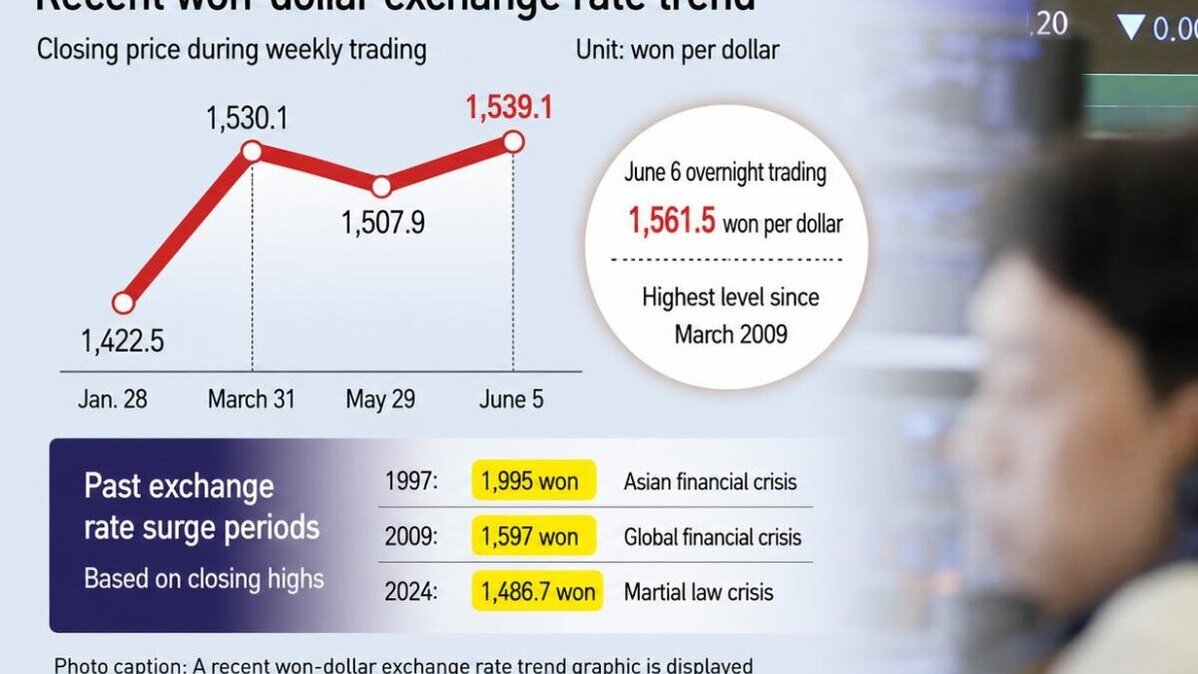
June 7 (Asia Today) — The South Korean won has weakened sharply against the U.S. dollar, approaching levels last seen during the global financial crisis, as foreign investors sell Korean stocks and uncertainty grows over the prolonged Middle East war.
Read more Trump says he will press Israel to hold back after Iran retaliates for Beirut attack
According to the Seoul foreign exchange market, the won-dollar exchange rate rose to 1,549.1 won per dollar at about 10:27 a.m. Thursday before ending daytime trading at 1,539.1 won. In overnight trading early Friday, the rate reached 1,561.5 won per dollar.
That was the highest intraday level in 17 years and three months, since March 2009 during the global financial crisis, when the rate reached 1,597.0 won per dollar. Korean market reports also showed the won briefly passing the 1,560 level in overnight trading.
Several domestic and external factors are driving the exchange rate higher. Analysts point first to continued foreign selling in the Kospi, which has weakened the won. Foreign investors have been net sellers of Korean stocks for 20 consecutive trading days, with their total sales this year approaching 120 trillion won (US $77 billion.)
The selling has increased demand for dollars, adding upward pressure to the exchange rate.
A stronger-than-expected U.S. labor market also supported the dollar by raising the possibility that the Federal Reserve could take a more hawkish policy stance. The Wall Street Journal Dollar Index rose during the week after stronger U.S. jobs data, while Treasury yields also moved higher.
The prolonged Middle East war has also increased demand for safe-haven assets, putting additional pressure on the won. South Korea’s May inflation reached 3.1%, the highest level in more than two years, largely because of higher petroleum product prices tied to the Middle East conflict.
As the exchange rate rises, attention is also turning to a possible interest rate increase by the Bank of Korea.
Bank of Korea Gov. Hyun Song Shin said late last month that the central bank would need to consider raising the benchmark interest rate, citing exchange rate volatility, housing prices in the Seoul metropolitan area and household debt risks.
Read more Residents near Roseville, Rocklin and Lincoln may see smoke from training this week
Some analysts said the direction of the exchange rate will depend on whether foreign investors continue selling Korean stocks and how U.S. monetary policy develops.
The Korea Trade Insurance Corp. said in its June monthly exchange rate outlook that continued foreign net selling of Korean stocks would be a key factor. It also said dollar strength could continue if a hawkish policy stance is reaffirmed at the first Federal Open Market Committee meeting under Federal Reserve Chair Kevin Warsh.
Deputy Prime Minister and Finance and Economy Minister Koo Yun-cheol held an emergency market monitoring meeting with related agencies Sunday to discuss responses to the foreign exchange market.
The government said it would improve transparency in offshore non-deliverable forward derivative transactions, judging that one-sided movements in the NDF market can affect the foreign exchange market.
Authorities also plan to review suspected speculative activity and market-disrupting behavior that may be taking advantage of won weakness through inspections by the Bank of Korea and the Financial Supervisory Service.
“The market could see renewed volatility depending on developments in the Middle East war and U.S. price trends,” Koo said. “We will monitor market conditions with high vigilance around the clock and swiftly implement measures prepared in cooperation with related agencies.”
— Reported by Asia Today; translated by UPI
© Asia Today. Unauthorized reproduction or redistribution prohibited.
Original Korean report: https://www.asiatoday.co.kr/kn/view.php?key=20260607010002173
Read more Sierra Nevada Conservancy awards $4.6M for wildfire projects
Copyright 2026 UPI News Corporation. All Rights Reserved.
This story was originally published June 7, 2026 at 4:13 PM.