 By admin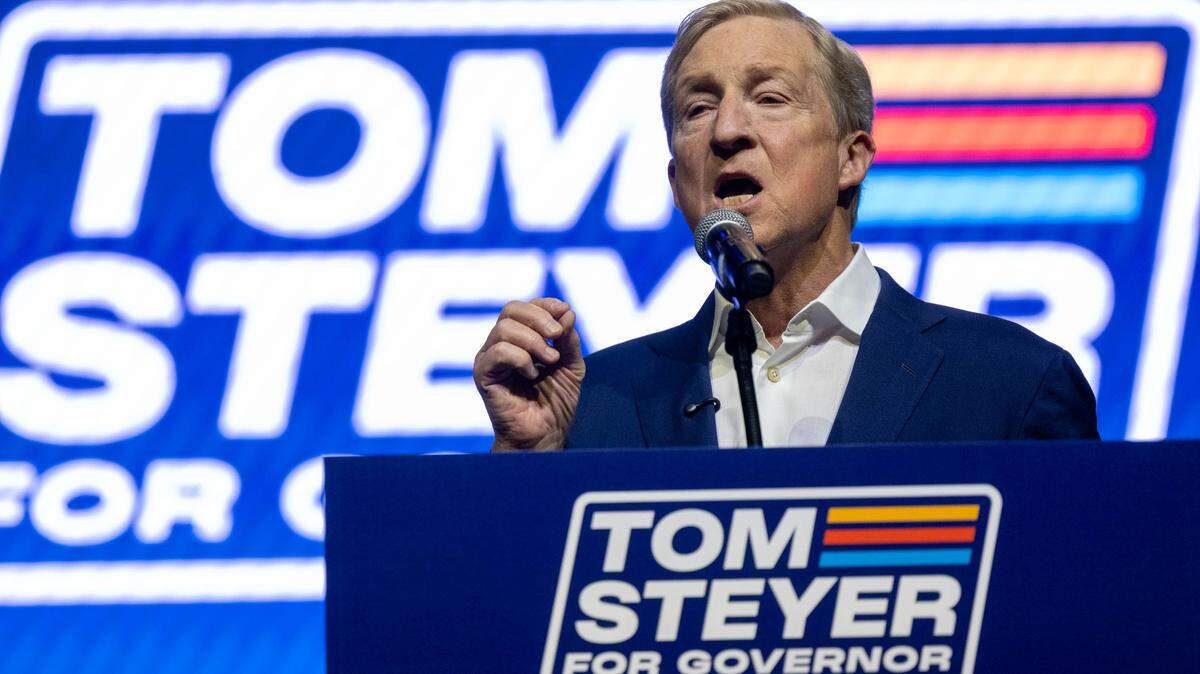
Democrat Tom Steyer plowed a record $215 million of his own money in the race to become California’s next governor and came up short.
Read more If anyone should win without a party label in California, it’s Kevin Kiley | Opinion
The former hedge fund manager joins the campaign graveyard of self-funded business world converts who have tried and failed to win over California voters to become governor, from Democrat Al Checchi to Republican Meg Whitman.
None spent as much in a primary as Steyer — or came as close to winning.
Local election officials are still tabulating results, but the current tallies show the environmental activist came within a few percentage points of surpassing Republican Steve Hilton in what’s already the most expensive governor’s race in U.S. history.
Steyer didn’t have a major gaffe or scandal that torpedoed his campaign. But interviews with Steyer supporters and outside observers suggest some common themes.
Steyer’s wealth may have hurt as much as it helped
Steyer’s campaign had to resolve a tension between his progressive platform and the “billionaire” label that often prefaced his name. The wealth that enabled his candidacy also made him an awkward populist messenger.
“One of his greatest strengths was also one of his greatest weaknesses,” said Amar Shergill, a Steyer supporter and former chair of the California Democratic Party’s progressive caucus.
Steyer acknowledged as much himself in a concession statement Tuesday, saying it was “hard to blame” people who “just couldn’t stomach voting for a billionaire.”
Where past self-funded candidates have often been unapologetic about their wealth and C-suite experience, Steyer branded himself a “class traitor” bent on disrupting the world where he’d made his fortune.
Rivals relentlessly attacked Steyer for some of the sources of his wealth, from private prisons to fossil fuels. Steyer said he regretted those decisions and tried to pivot the conversation to his top Democratic rival, Xavier Becerra, whose candidacy got a boost from corporate interests like Chevron and Meta.
Steyer’s wealth and past investments were a dealbreaker for some progressives, according to Irene Kao, executive director of Courage California, a progressive group that endorsed Steyer. Other voters she spoke to wanted to see a candidate more aligned with their background and life experience rather than another wealthy, white man from the Bay Area.
“He is very much in the line of who we’ve had for governor,” Kao said.
Then there was the question of why Steyer, who’d run for president in 2020 but never held public office before, skipped conventional political stepping stones. Steyer pointed to his experience championing ballot measures and political advocacy on environmental and social justice issues. Those connections helped win him backing from major unions, but still couldn’t rival Becerra’s extensive resume serving in Congress, attorney general and in former President Joe Biden’s cabinet.
Steyer was also up against a rising backlash to the ultrawealthy, the likes of which hasn’t been seen in the U.S. since the aftermath of the Gilded Age, according to Jefferey Winters, author of “The Blind Spot: How Oligarchs Dominate Our Democracy.” Winters, a political science professor at Northwestern University, said Steyer’s anti-elite rhetoric didn’t entirely shield him from those realities.
“Deploying money power to influence politics is what oligarchs do, even when they are doing it for progressive policies,” Winters said in an email. “Americans are very suspicious now of that kind of power in their democracy.”
Steyer’s spending wasn’t the full story. He faced well-funded attacks from interest groups like the California Chamber of Commerce and PG&E, many of which also boosted a pro-Becerra committee.
Bob Shrum, a longtime Democratic strategist and political science professor at the University of Southern California, is unconvinced that Steyer’s wealth doomed his candidacy. Shrum advised Checchi, a former airline executive, in his failed 1998 bid — a campaign that’s often been compared to Steyer’s. But he said the outcome in that race had more to do with intraparty attacks in the primary than Checchi’s wealth. Shrum argued the door wasn’t closed on self-funded candidates, whom he said got outsized scrutiny from the press compared to candidates who took contributions from special interest groups.
“We take case studies of three or four people and we make a political rule out of that,” Shrum said. “I think that’s just foolish.”
The relentless advertising can only go so far
Steyer’s well-funded campaign allowed him to target ads in a way few other candidates could. He used that wealth to first introduce himself to voters and later, attack rivals.
Read more Elk Grove player wins five-figure Mega Millions prize as jackpot hits $413 million
The funding gave his campaign extra reach for harder to reach voters. It allowed the campaign to advertise on Spanish language radio stations in Fresno and San Diego in March, when some campaigns were still struggling to get on TV at all.
But Steyer may have hit a ceiling in the amount his ads could influence voter behavior. Ken Goldstein, a former political media executive and professor at the University of San Francisco, said a good advertising campaign might move the needle 3 or 4 percentage points.
“It clearly diminishes at the margin,” Goldstein said. Still, he said, “races are won and lost at the margin.”
Steyer’s decision to lean heavily into negative advertising may also have weighed on voters’ minds. Goldstein said negative ads are more unpredictable in multi-candidate fields, where it can be hard to know who will rise if one candidate falls.
Courage California’s Kao said the negative ads may have reflected poorly on Steyer, whose favorability ratings were nearly 10 percentage points lower than Becerra’s in a final UC Berkeley poll in late May.
“I think it started to really turn people off,” Kao said.
The wide, unsettled Democratic field may have hurt Steyer
For months, California Democratic Party Chair Rusty Hicks openly fretted that Democrats’ wide pool of primary candidates risked splitting the vote. Hypothetically it could have allowed two Republicans, Steve Hilton and Chad Bianco, to advance to the general election.
Many other observers — including Hilton and Bianco — publicly doubted that would happen. The scenario became even less likely after President Donald Trump endorsed Hilton, with polls showing GOP voters consolidating behind the British Fox News commentator.
But there are signs that word never made it to some Democratic voters; in one May survey, more than three-quarters of Democrats said they were concerned about getting locked out of the primary.
Shrum said Becerra benefited from voters who feared a lockout and wanted to back the Democratic frontrunner. According to most polls in the last month of the race, that was Becerra, who was also a known quantity from his decades in public office.
“I think people wanted someone safe, reliable, and they wanted to make sure a Democrat got in the runoff,” Shrum said.
The results suggest that had progressives rallied behind a single candidate, they might have made the general election. Still, despite frustration by some Steyer supporters online, there’s no guarantee the roughly 4% of voters who backed former Rep. Katie Porter, the other top progressive in the race, would’ve gone to Steyer; the UC Berkeley poll found Becerra, not Steyer, was the second choice pick for the plurality of Porter’s supporters.
Kao said Becerra may have been perceived as more progressive by voters than by groups like Courage California; the group got that feedback from some voters after it endorsed Steyer.
“Even if he doesn’t have a whole lot of concrete policies that necessarily suggest that he’s progressive across the board, the perception was that he was progressive,” Kao said.
While Kao and former progressive caucus leader Shergill say they’re concerned about Becerra’s lightly defined policy platform and backing from corporate donors, Steyers has urged his supporters to back his former rival against Hilton. And in his concession statement, Steyer suggested he’ll remain politically active.
“I wasn’t born a billionaire, I won’t die a billionaire. And I’ll spend the rest of my life working alongside you to dismantle a system that only benefits billionaires,” Steyer said.
Read more Capitol Corridor schedules special trains to Bay Area for FIFA World Cup