 By admin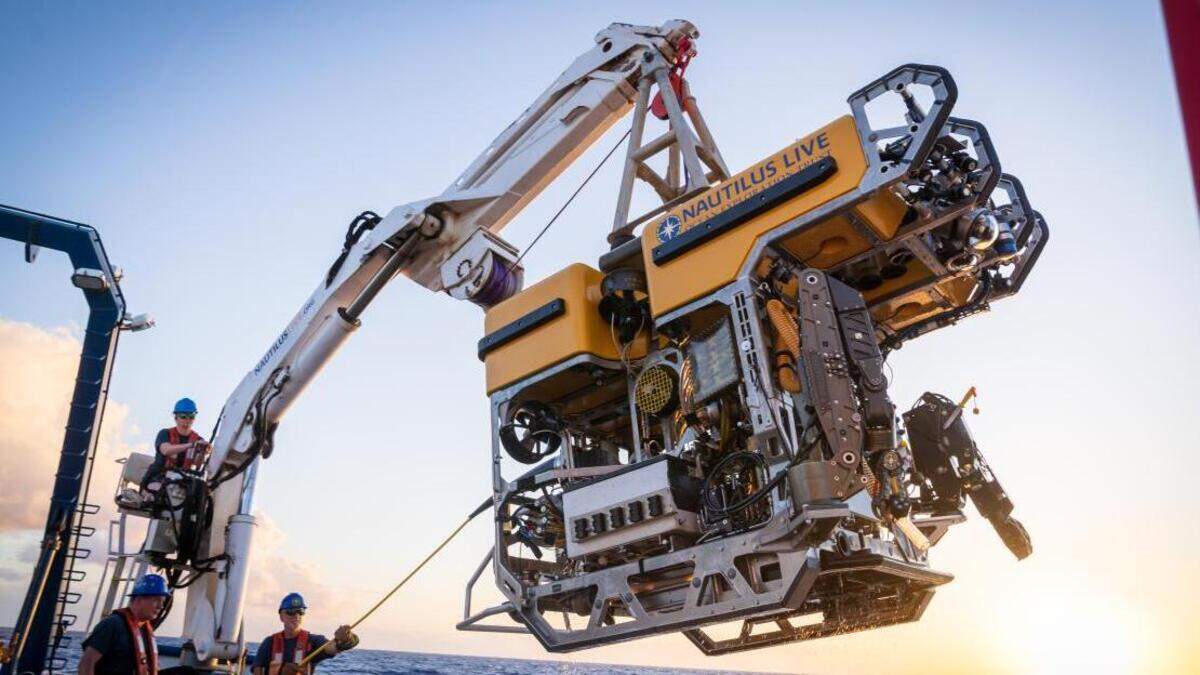
Two UC Davis alumni set sail Saturday on a 22-day expedition to the Mariana Islands aboard the Nautilus, a deep-sea exploration vessel operated by the Ocean Exploration Trust, the nonprofit organization announced.
Read more Drag, dogs and diesel: CA State Fair second Saturday was jam-packed with events
“Getting more hands-on experience and getting the opportunity to do something that’s pretty rare and pretty hard to do this early in my career,” said Peter Webster, who graduated from UC Davis in June with a Bachelor of Science in Mechanical Engineering. “I think that’s pretty special.”
Webster joined the Nautilus as a remotely operated vehicle, or ROV, engineering intern alongside fellow UC Davis alumnus Alice Chou, the ship’s lead science communication fellow.
“Having the experience of seeing something that’s never really been seen before with an amazing group of people, and having the ability to share that out beyond the confines of this ship, I think is really special,” said Chou, who obtained her Bachelor of Science in Neurobiology, Physiology, and Behavior from UC Davis in 2013, and has since received her PhD in biology from the University of Maryland, Baltimore County.
Exploring one of Earth’s least-studied regions
The voyage departed from Apra Harbor on Guam and will spend three weeks exploring deep Pacific waters east of the Northern Mariana Islands and the Mariana Trench, in one of the least-studied parts of U.S. territorial waters. The expedition is using the ship’s ROVs, the Hercules, mapping systems and an autonomous underwater vehicle called the Sentry to survey the seafloor.
“The ocean area around the Marianas is twice the size of California. It’s an absolutely massive area of ocean,” said Megan Cook, communications lead aboard the ship. The crew is exploring U.S. waters surrounding the Commonwealth of the Northern Mariana Islands, focusing on ancient seamounts and the abyssal plain east of the Mariana Trench, the deepest ocean trench on Earth.
The region — including the abyssal plain and deep seafloor — are among the least studied in the world. Much of the seafloor east of the Mariana Trench remains unmapped and uncharacterized despite decades of research. Scientists hope the expedition will help fill those gaps by documenting habitats, biodiversity and geological features.
“Fewer than 10 times human eyes have been to the types of habitats we’ll be visiting,” said Cook, who has been on 25 previous Nautilus expeditions and nearly 50 expeditions during her career.
Both Chou and Webster said their undergraduate experiences at UC Davis helped prepare them for the expedition.
UC Davis experience prepared crew members
At Davis, Webster co-founded an autonomous underwater vehicle team called Cyclone RoboSub which competes in the annual summer RoboSub Competition. More recently, the team has deployed its vehicles for projects including algae monitoring in Lake Tahoe with UC Davis researchers.
Webster also conducted bathymetry, or underwater mapping, work at Lake Tahoe, giving him experience working on boats and with marine technology, he said. During his final summer before graduating, he worked with agricultural robots on a farm.
“Field experience combined with robotics led me here, along with a lot of education and working with communities,” he said. On the Nautilus, he is piloting ROVs from the ship’s control room. The expedition marks his first extended voyage at sea.
For Chou, it was working at the university’s Bodega Marine Laboratory that helped prepare her for doctoral research involving crustacean microbiology. That experience eventually led her to the Ocean Exploration Trust, where this is her third expedition aboard the Nautilus.
She also works full time as education manager at the Mystic River Watershed Association in Arlington, Massachusetts, designing watershed and climate science programs for students and community members.
The 52-member crew includes geologists, biologists, mapping and technology specialists, cultural experts from the Mariana Islands and student interns.
One reason for the range of expertise aboard the vessel is to prepare for the unexpected.
Read more Week in photos: Athletics + State Fair + K Street trial + grape harvest
“The ocean is full of surprises,” Cook said. “There’s no way for us to know precisely what we’ll find before we go.”
Mission data will be available publicly
The journey is sponsored by the NOAA Ocean Exploration Cooperative Institute, a program in National Oceanic and Atmospheric Administration dedicated to exploring regions of the United States underwater.
The crew will map the seafloor, document marine life and collect data to better understand the geology and biodiversity of the region. Researchers also will record ocean conditions including temperature, salinity and pressure. All data collected during the expedition will be made publicly available.
Cook said extended expeditions allow researchers to gather data more efficiently than shorter missions.
“Many of the places that we don’t know much about the ocean, they’re not places you could put on, like, a snorkel mask and be close to shore and see,” she said. “Many of them are deep, many of them are far offshore.”
The ship’s ROVs and the AUV Sentry can collect data at depths of up to 6,000 meters — about 19,700 feet, or roughly 60 football fields.
Science and teamwork drive expedition
For Webster, getting to know fellow crew members is one of the most exciting parts of the trip.
“You keep sitting down with someone new, and then kind of, like, learning about who they are, and their background, and what they’re interested in, and why they’re here, and that’s pretty exciting,” Webster said.
For Chou, it’s working together to make discoveries that’s most fulfilling.
“It’s one thing to be a scientist who’s like, ‘oh my god, I’ve never seen this before, I am the first person to discover this.’ But here, you do it as a team,” she said.
The ship’s crew, though, aren’t expecting just smooth sailing.
“The ocean is a very humbling place to work,” Cook said. “It’s a harsh environment to send electronic machines into a salty, deep, rough ocean.”
For the ROV team Webster joined, equipment failures are a routine part of the job.
“That’s why we’re here, is to fix things as things go wrong, and that’s just kind of, like, part of the fun, part of the challenge,” he said.
For Chou, the anticipated difficulties of the voyage are more straightforward. “The first thing that came to my mind was seasickness.”
The team’s journey is being livestreamed 24 hours a day throughout the voyage. A large part of Chou’s role will be to communicate with the audience and answer questions about the ship’s mission. As of Sunday, the ship was about 340 miles east of Guam in the western Pacific, roughly 1,500 miles south of Japan.
“We really are at a stage where we know shockingly little about big parts of our planet, and this is a really exciting opportunity to visit those spots, learn and share,” Cook said.
Read more Dodgers Announce When Kiké Hernandez, Edwin Diaz Will Officially Return