 By admin
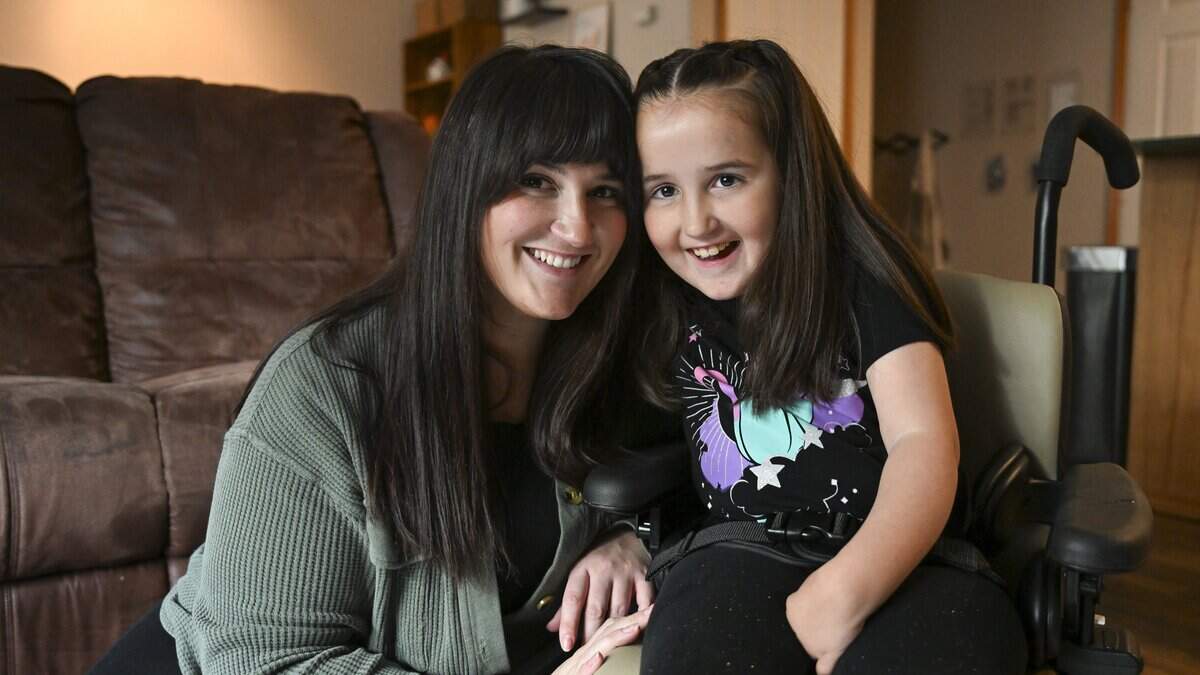
Kinley Harriman was 10 days old when she had a stroke.
It was the summer of 2017 when her mother, Kayla Harriman, rushed her to Mary Bridge Children’s Hospital, where staff prepared to perform heart surgery. Just before Kinley went to the operating table, an ultrasound revealed something completely different: An ultra-rare brain condition called Vein of Galen Malformation (VOGM).
Read more Sacramento mom sentenced to 15 years to life in baby daughter’s scalding death
Kinley — who lives in Bonney Lake, Washington state, with Kayla, her stepfather and two younger brothers — was the one person out of every 3 million with VOGM, according to a 2023 study from Duke University. Boston Children’s Hospital says the condition happens when arteries in the brain connect to veins instead of capillaries. The capillaries normally act as a buffer, slowing down blood flow; but with VOGM, bypassing the capillaries causes high-pressure blood to rush straight into the veins.
VOGM is nearly 100% fatal if left untreated, according to the Journal of Neurosurgery — often leading to heart failure and severe brain injuries.
Because the condition is so rare, specialized treatment is scarce, often forcing families out of state for complex surgeries — including the Harrimans, who flew across the country six times to see specialists at Boston Children’s Hospital.
Kinley is now 9 years old and has cerebral palsy, a secondary condition stemming directly from VOGM, and is mostly non-verbal — but she has reached a level of stability her family once feared impossible.
With Kinley steady, Kayla is channeling her energy into advocacy. Following VOGM Awareness Month in October, she is organizing “Claus for a Cause,” a public holiday market and photo event on Nov. 14 from 9 a.m. to 4 p.m. in Federal Way to raise funds for the VOGM Support Network. The event will be from 9 a.m. to 4 p.m. at Brooklane Church.
“I want people to know VOGM exists,” Kayla said. “I want families who receive this diagnosis to know they aren’t alone.”
‘We have never seen this’
Kinley was at Mary Bridge Children’s Hospital in Tacoma, about to undergo heart surgery, when a nurse paused.
“When the nurses come in and do vitals, the nurse was like, ‘Something is weird about her,’” Kayla told The News Tribune.
They ordered an ultrasound, which revealed Kinley’s VOGM, Kayla said — and the doctors were shocked.
“They were like, ‘We have never seen this. We need to call a doctor in Australia. This is serious. This is very, very rare,’” Kayla said.
They transferred Kinley to Seattle Children’s Hospital, where doctors gave Kayla an explanation: a temporary fetal blood vessel that normally closes early in pregnancy had stayed open in Kinley’s brain.
Kayla described the medical mechanism like a water balloon under a wide-open tap: as high-pressure blood rushes in, it overfills the main vein and forces open a web of smaller “feeder veins” that bleed off into other areas.
“That’s what caused her cardiac failure,” Kayla said. “[Her body was] trying to keep this malformation in her brain full, but then there’s just a bunch of feeder veins, they call them, losing the blood and losing it in other places, so her heart is working overtime to keep that malformation full in the brain.”
Doctors at Seattle Children’s Hospital told Kayla that Kinley would have to undergo several brain surgeries.
“When I asked if they had ever seen this before, they pretty much said, ‘No,’ and they had only seen this in textbooks,” Kayla told The News Tribune. “… That (was) a big shock. You think, Seattle Children’s, world-class, top-of-the-line for the whole country, and then to kind of be told that they’ve never actually, physically seen that — that was a big pump on the brakes of, ‘OK, wait, I’m not going to just hand my child over and assume and hope for the best.’”
That’s when Kayla connected with Dr. Darren Orbach at Boston Children’s Hospital, one of the few facilities that specializes in treating VOGM. Kinley’s first brain surgery was in January 2018, and she received three more after that, roughly one every three months.
In one of the surgeries, they put a catheter in her groin, then used “coils,” which are tiny pieces of metal they stuck into the malformation, prompting scar tissue to build up in the area and block the vein.
Kayla said they used a GoFundMe to raise a couple of thousand dollars to fund the cross-country flights, but that it was still “a big financial strain.”
“It was very difficult in the beginning, because she would go and do these surgeries, and they were minimally invasive, and so they would do it, she would stay in the hospital for that night, and then the next day, they technically cleared us to fly home,” Kayla said. “And every single time, we stayed out there for two or three days because I just could not comprehend how she just had these big brain surgeries, and then they wanted us to fly home.”
In February 2019, when she was almost 2 years old, Kinley had a seizure. Kayla said they took her to Seattle Children’s, where they put her in a medically-induced coma to stop the seizure.
“They did some scans and everything, and they said: ‘We really need to start cleaning up more of those feeds,’” Kayla said.
Kinley ultimately had eight surgeries before her fourth birthday — and in December 2020, her final surgery saved her life.
‘I didn’t know if I was going to be flying back with my daughter’
In 2020, Kinley started to decline.
“I called her my 25-pound newborn,” Kayla said. “She was this 3-year-old body, but she couldn’t lift her head up. She wasn’t eating. She had to go on a feeding tube. She couldn’t sit up herself.”
Doctors ran an MRI scan. On an MRI, healthy brain tissue looks gray — but when Kinley came back, her entire brain was white and “foamy-looking,” indicating brain damage.
Boston Children’s Hospital laid out the grim reality for Kayla: Kinley needed an aggressive surgery to close off all the feeder veins, and she needed it soon.
“[They said,] ‘She has a 50-50 chance of walking out of there or dying on the operating table,’” Kayla said. “‘If you don’t, [she has] a 100% chance of dying.”
So, in the thick of a pandemic winter, Kayla took Kinley and her 1-month-old brother, masked up and flew to Boston for what would be Kinley’s final surgery. While waiting, pandemic restrictions made it so that Kayla was by herself in the hospital, while family members who flew out were stuck in their hotels, awaiting Kinley’s fate.
“I kind of blacked out for that whole season of her life,” Kayla said. “I didn’t know if I was going to be flying back with my daughter on the seat with me or not.”
Kinley survived the surgery.
While the operation saved her life and cured the malformation, the damage left long-term impacts, Kayla said. Before 2020, Kinley was able to sit by herself on the floor and turn herself in a circle — skills she hasn’t regained.
Read more Nationwide ground stop causes California airport chaos. What travelers need to know
But she’s alive.
‘There’s probably a lot more children who have this’
Kinley, who is now 9 years old, has cerebral palsy, a neurological condition that impacts her movement and muscle coordination. Kayla said the cerebral palsy stems from the stroke that happened when she was 10 days old.
She uses a wheelchair at school and home, and has an activity chair that allows her to sit at the table and eat dinner with her family.
Each week is a blur of therapy appointments for Kinley: physical, occupational and speech. Physical therapy helps her strengthen her muscles and work on things like standing. Occupational therapy helps her focus on improving her daily living with skills such as using a pair of scissors, eating, drinking and regulating her emotions.
As for speech, Kinley is mostly non-verbal. When The News Tribune visited the mother-daughter duo on Oct. 22, Kinley would often say “Mom,” and then gesture with her hands, which Kayla quipped was like a daily game of charades.
“She actually just recently got her talking device [in speech therapy], and so we’re still kind of in the like, working and learning how to use it, but it’s been very great,” Kayla said. “She’s formed sentences.”
Kinley takes daily vitamins for her muscles, and up until July of 2026, required a feeding tube in order to eat.
Kayla said one of the hardest things to grapple with is constantly managing logistics.
“Going to a restaurant, or a house, or really anywhere, constantly having to think of like, ‘How is she getting there? How are we accessing this? Is there going to be a place where she can sit, where she can participate as well? Am I going to have to carry her up a flight of stairs and have someone else carry after me?’” Kayla said. “Whatever we’re doing, we’re having to think, like, 10 steps ahead of, how Kinley is going to get there, is it safe for her? What is she going to eat? Is there a cup that she can drink from? …Feeding tubes and feeding schedules, and is her pump going to go off in the middle of church while the thing is going on? [For vacations], do we have enough medicine or do I have to talk to the pharmacist and explain why we need her medicine filled early?”
Mark Wainwright, the division head of pediatric neurology at Seattle Children’s Hospital, told The News Tribune that VOGM occurs in 1 birth per 60,000.
He said he does not know for sure how many cases happen in Washington state annually, but that Seattle Children’s sees between one to three infant cases per year, which lines up with the 1 per 60,000 births estimate.
“That data would result in about one or two newborns per year and that goes along with our clinical experience,” Wainwright said.
Kayla said one of the hardest things about VOGM is that it is often misdiagnosed — such as with Kinley, when she was about to go through heart surgery.
“There’s probably a lot more children who have this who have, unfortunately, passed away, but been misdiagnosed,” Kayla said, referencing a child born with VOGM in Washington state in 2019 who later passed away.
As for Kinley, she has been seizure-free since 2020, Kayla said, which has been very helpful in her recovery from VOGM and managing her cerebral palsy.
“Other than that, she is a healthy little girl,” Kayla said. “She just has some physical limitations.”
‘I don’t necessarily think that she thinks she’s missing out on anything’
Despite her rough start, Kinley has a joy-filled life.
She loves school. For the past four years, she has attended Crestwood Elementary School in Bonney Lake, where she has made many friends.
“Kinley is like a star at school,” Kayla said. “Everybody knows her here. The janitor knows her. She’s the opposite of me, I’m like, ‘I don’t want anyone to know me,’ and she’s like, ‘Hi, hi,’ to everybody, every single person that she knows.”
Every spring, Kinley also plays baseball in a challenger league for children with disabilities. There are helpers on the field that make it possible for Kinley to go from base to base in her wheelchair.
At home, Kinley loves to help cook, and she loves her brothers, 8-year-old Kade and 6-year-old Crew. Her wheelchair allows her to get close to the floor and play with the two boys regularly.
“Kinley is just funny, she is truly, so funny. She’s just as loving, and she just loves to be around people,” Kayla said. “She doesn’t care that she’s — I don’t necessarily think that she thinks she’s missing out on anything.”
When Kinley had her feeding tube removed earlier this year, Kayla told The News Tribune it felt like a long exhale after a string of hectic and chaotic years.
“With having littles — her brothers and herself — and just being in the position that we were in, I didn’t necessarily have time to take a breath for myself. My focus was her, and it was always her,” Kayla said.
The VOGM Support Network had asked Kayla for help here and there over the years, but she didn’t have the bandwidth because she was so consumed with Kinley, she said. Now, this is the first year when she feels she can help, with the upcoming “Claus for a Cause” event in Federal Way.
“We’re projected to bring in about $10,000 from the vendors and the photoshoot and stuff like that. I’m very excited. That will be a very big chunk of money that will go to the nonprofit and help fund other kids,” Kayla said.
Kayla was 20 years old when she gave birth to Kinley, and she said the journey has changed her on a fundamental level.
“I was just a full-blown advocate and stepping in, and every single time that I look back on that, I just don’t feel like I missed out, because I was right where I needed to be for that timeframe,” Kayla said. “And that’s something that she really instilled in, like, our whole family, is that nothing in life is that serious when you have a kid with a serious medical condition, and you’re having to think if she’s getting through the surgery. Nothing outside of that is that serious … there’s so much better things to spend your time and energy on.”
Their family is closer now than ever before — something that became more apparent for Kayla during this year of reflecting.
“I’m able to kind of process what happened and just, not necessarily process it being sad about where we’re at, or the cards that we were dealt,” Kayla said. “But more, kind of, reflecting on that we did it, and that we’re here.”
This story was originally published November 14, 2026 at 5:45 AM with the headline “A baby was headed for heart surgery. Then an ultrasound found something else.”
Read more What to do if the FAA’s nationwide ground stop delays or cancels your flight