 By admin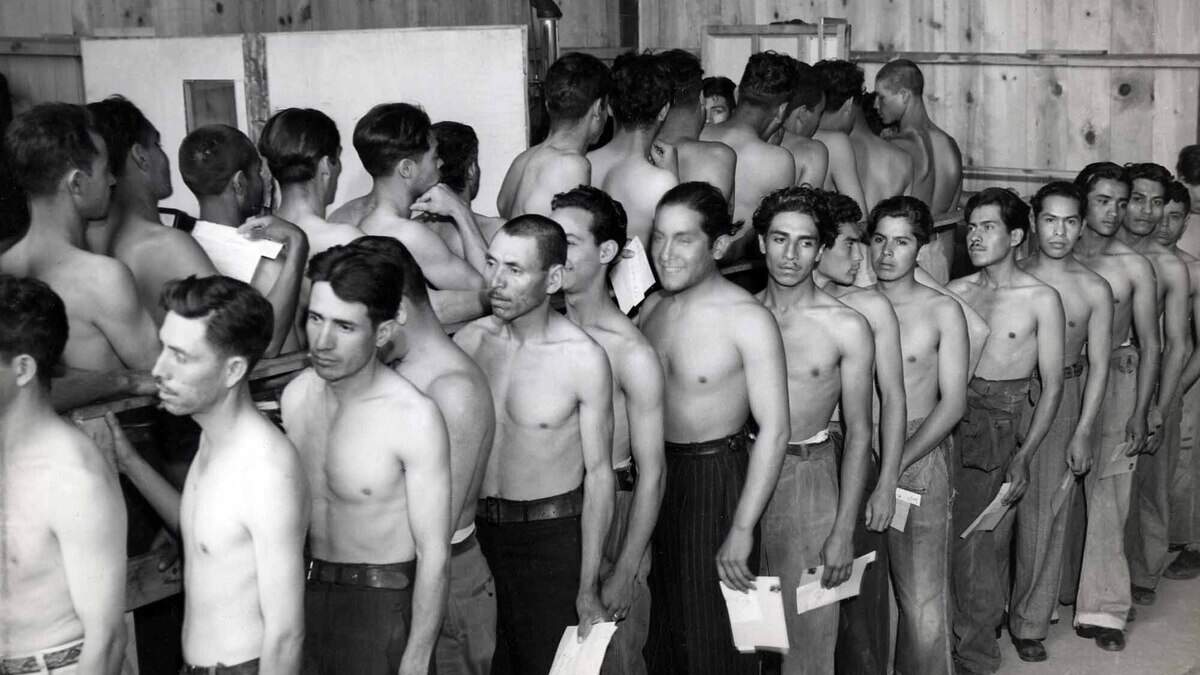
On July 18, 1955, federal agents arrived at the Los Angeles home of 7-year-old Victor Ochoa and his family. The agents informed the family they had to leave the U.S. for Mexico. For Ochoa, his typical American upbringing— he visited Disneyland for its grand opening just the day before— ended.
Read more Every NFL team’s most underrated rookie for upcoming season
When he and his family arrived in Tijuana, the street vendors Ochoa saw reminded him of scenes from the movies. Ochoa remembered his mother cried when he told her.
“It was sad for her to see us return to Mexico. For a kid like me, to me, it was a complete adventure,” Ochoa said.
Ochoa’s story is just one of several featured as part of the California Museum’s latest exhibition, “Help Wanted/ Leave Now: Operation Wetback & the Revolving Door of Mass Deportation.”
The museum’s immersive experience walks visitors through the events of the largest mass deportation carried out by the federal government in its history and its human consequences.
The exhibit combines archival images and videos, along with real-life accounts from Ochoa and more recent deportees such as registered nurse Vilma Palacios.
Under the Eisenhower-era operation that used an ethnic slur as its title, more than one million people were deported between June 1954 and early 1955. Migrant workers were herded onto buses, boats and planes and sent to Mexico. Most were undocumented, but some, like Ochoa, were U.S. citizens.
Many of them came to the U.S. as part of the U.S.-Mexican Farm Labor Program, also known as Operation Bracero, coined for the Spanish word for manual labor. According to History.com, the program brought Mexican immigrants to the U.S. on a temporary legal basis, guaranteeing them wages and humane treatment.
The screening process for the Bracero Program was invasive — workers were forced to undergo physicals to test their strength and were sprayed with pesticide upon arrival. A large portion of the exhibit is dedicated to the inhumane conditions many of the workers were subjected to. The exhibit is also an attempt to humanize the workers as individuals with families.
“You see some of those faces, they look really young. Some of them look sixteen,” said Pablo Espinoza, California Museum Board Member and member of the exhibit’s advisory council.
Part of the exhibit is interactive, including a recreation of a Mexican-American family home and the garlic that would perfume the foods of a typical meal.
Women and children are pictured working in the fields. One photo features Mexican women working on the railroad during World War II.
“Yesterday I was able to see in the pictures, as you all will also, there are young mothers with their toddlers and their babies in their laps,” Espinoza said. “There’s a wonderful quote, and I’m paraphrasing, that says ‘we wanted workers, and we got human beings.’”
Read more Arman Tsarukyan confirms promised title shot with UFC 331 win
For some left behind, the experience had debilitating effects on their health and wellbeing, said exhibit advisory board member Juan Garcia, Mexican-American historian and author of a book on the topic.
“My mother ultimately developed agoraphobia because she had entered without documents when she was 18, and she was always so fearful that she would be discovered and removed from her family,” Garcia said.
Ochoa returned to the U.S. in 1967 to continue his education. He eventually became a well-known painter and activist, commissioned to paint murals for the Black Panthers, Cesar Chavez and the Farmworkers Union.
“So you know, I’ve sort of dedicated my life to responding to these issues,” Ochoa said.
Registered nurse Palacios had just graduated from Louisiana State University in June 2025 when she was detained by federal agents. She had immigrated to the U.S. from Honduras with her parents 17 years prior.
Palacios spent six months in detention where she faced severe mistreatment before she made the difficult decision to return to Honduras, she said.
She will always be grateful to the U.S. for providing her with an education and a home. “But now it’s not the country where everyone would be so excited to migrate to,” Palacios said.
Espinoza, who is from Ecuador, said the stories featured in the exhibition also contain hope.
He said he was inspired by Gonzalo Alvarado Sr., who despite his deportation in the 50s, still holds love for the U.S.
Espinoza paraphrased Alvarado who said his life would not have been the same if he had stayed in Mexico.
The California Museum show was made possible through members of the exhibit counsel including labor leader and civil rights activist Dolores Huerta. It will run through Jan. 10, before it is turned into a traveling exhibit. Tickets for general admission are $10. Children under the age of five are admitted for free, while children aged six through 17 are admitted for $8.
This story was originally published August 17, 2026 at 3:12 PM.
CORRECTION: A previous version of this story misidentified the museum affiliation for Juan Garcia and Dolores Huerta. They are both members of the exhibit’s advisory council.
Read more Williams sisters, teaming for first time since ’22, lose in Cincy opener