 By admin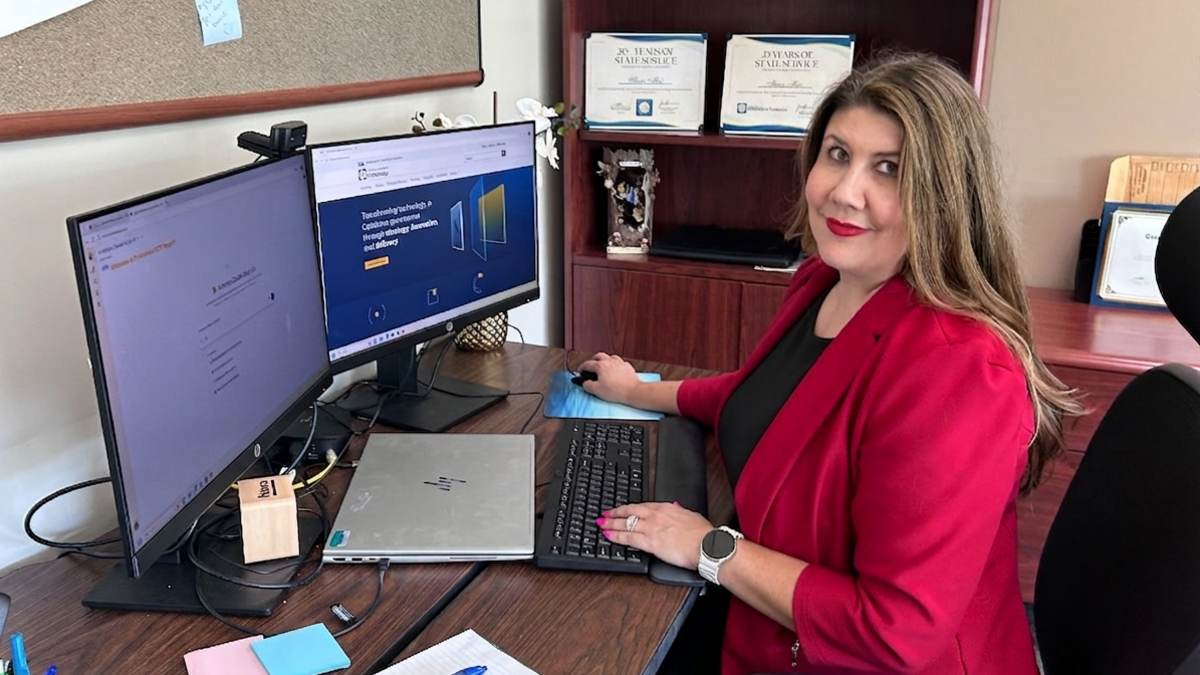
A text box breaks the otherwise white screen on Lucy Andrews’ computer monitor, posing the question: “How can I help you today?”
Read more Late summer ‘surge’ of COVID-19 cases expected for Sacramento County
This is Poppy, a new generative artificial intelligence tool deployed last month to California state workers in hopes of increasing efficiency while safeguarding sensitive data.
For Andrews, a senior environmental scientist at the Department of Water Resources, the tool helps execute simple administrative tasks, giving her time to focus on researching salmon, a fish species that can struggle to reproduce in California’s warmer waterways.
“These kinds of workflows are often pretty uninteresting, often take an incredible amount of time and can be automated with large language models to a degree as long as there are still people checking the results,” Andrews said.
The tool is the result of an executive order signed three years ago by Gov. Gavin Newsom to bolster generative AI use in state work. Newsom maintains such tools intend to improve government services and not cut jobs.
Half of the order’s eight initial projects didn’t make it past the pilot stage, according to previous Sacramento Bee reporting, including a call center tool that listened to the California Department of Tax and Fee Administration’s call center inquiries and transcribed their conversations while offering answers to questions.
Poppy is a little different, and last week Newsom’s office listed it as a win for government efficiency. It connects users to generative AI platforms like Anthropic’s Claude, Google’s Gemini and OpenAI’s ChatGPT. However, data fed to the tools are kept within the state’s possession, giving an additional layer of security.
“You bring in your own data, but you don’t want to contribute your data to the model, Poppy allows you to interact with it without giving that information to (an external company),” Andrews said.
Because California already has agreements with AI vendors, new contracts weren’t required. General costs related to AI products can vary by usage, according to the Department of Technology, meaning the price tag could increase with widespread adoption.
Poppy was developed within the CTE’s existing budget and went into pilot in September 2025 before its official launch last month. More than 2,700 people across about 70 departments used the program during the pilot.
Today, more than a month into the program’s initial launch, Poppy has about 1,000 users across 24 departments — that’s 0.42% of the state’s workforce.
The product’s slow adoption isn’t necessarily a reflection of its quality, according to CTE Deputy Director of Platform Services Shera Mui. Each department must sign up for Poppy, generally costing agencies $7,500 to $35,000. An $8 per-user fee is also an option. Nor is the slow rollout a reflection of the number of state workers using chatbot-style AI tools because the Microsoft Teams platform that state workers use has Copilot.
“There’s a lot of competition in the market,” Mui said.
What does Poppy do?
Poppy can be used for a wide range of tasks. Simpler items may include proofreading text and summarizing documents, while more complex prompts include writing computer code and analyzing data.
Read more Michelin-starred chef launches ‘culinary destination’ in SLO wine country
When workers ask Poppy for help, they can decide which generative AI system, such as Google Gemini or Anthropic’s Claude, they want to use and which model size is preferred.
“There are some very large models that you would use perhaps to do really intense coding work, and then there are much smaller models that can do much more simple (administrative) work,” Andrews said.
By electing the smaller models when appropriate, Mui said, having options can save the state money and reduce environmental effects.
Andrews used Poppy to track research completed by DWR scientists to see what topics they probed and where their work was published.
“Thousands of papers would take a really long time individually if somebody were going through and categorizing … but a large language model — reading the paper abstracts, and with the right prompt and context — can do that work very quickly on our behalf,” Andrews said.
While Poppy helped Andrews save time, she said generative AI is changing quickly, making it difficult for some to understand what exactly it can do.
Training on generative AI is provided by CTE and individual agencies, according to Mui, who said a benefit of Poppy’s slow rollout is ensuring proper policies and training for responsible use.
“As departments individually decide where they’re going with AI, they have to do their training,” Mui said. “They have to do their education before they ever have their hands on the tool.”
But once the state workforce is properly trained, it might be difficult to assess Poppy’s success. There isn’t a specific benchmark for CTE to determine if the new product was worthwhile. Instead, Mui said feedback from other departments is considered.
“Metrics like, ‘Hey, I save three hours and 45 minutes doing this now that I didn’t (have) before,’ those are departmental-level metrics that they’re also watching to justify subscribing and paying for this service,” Mui said.
While DWR is assessing Poppy, Deputy Director of Communications Ryan Endean said a specific productivity benchmark hasn’t been established.
Read more DJ Pauly D of ‘Jersey Shore’ fame to host ‘outdoor block party’ at Sacramento club