 By admin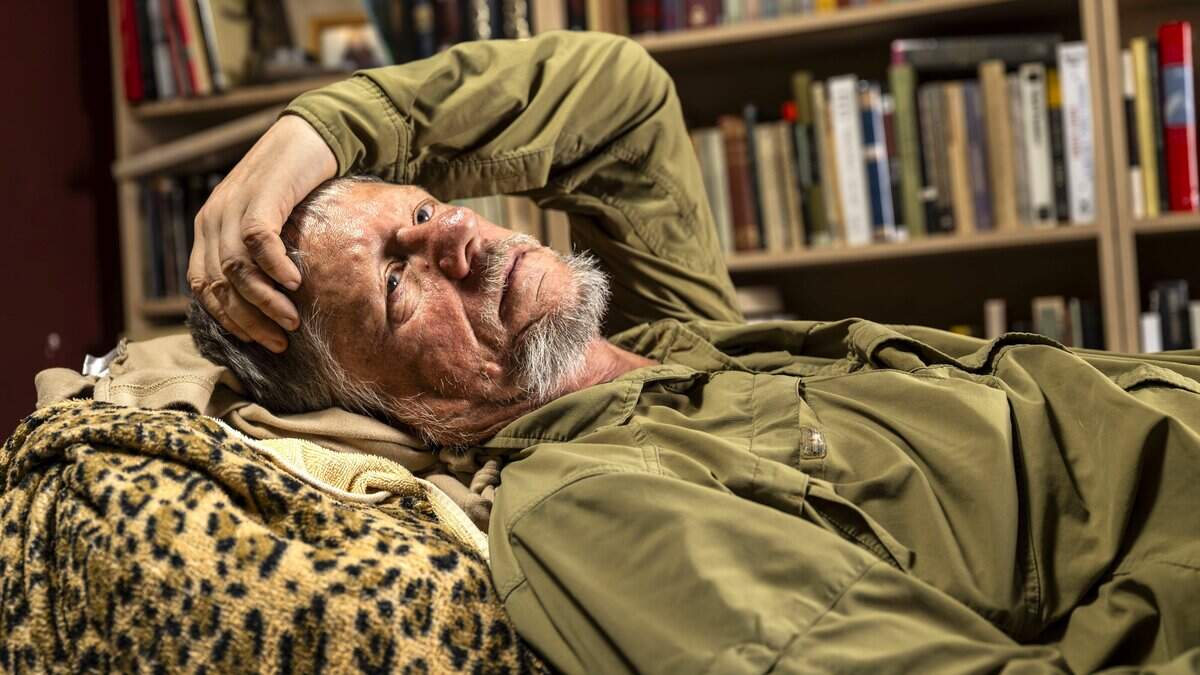
The fortified building that William T. Vollmann has long used as a workspace is its own universe, even if he spends less time there than he once did.
Read more Famed writer William Vollmann is dying. Sacramento’s still a big part of his life
Vollmann, a National Book Award-winning writer, used to spend 16 hours a day here writing, but no longer can. He’s 67 now and faces terminal cancer. His workspace, a barbed-wire lined facility near downtown, still contains an estimated 4,000 to 5,000 books. There are also hundreds of his own charcoal drawings and oil paintings, most of which are of Dolores, his female alter ego.
He spends many days in bed now. Even picking up the phone can be tiring.
“I just think, I can’t compete with who I was, and I just have to spend more time trying to be a better person and kinder to my friends and to strangers,” Vollmann said.
Vollmann, 67, is dying. But as he’s done so much of his life, he’s continuing to live on his terms, creating meaningful work and doing it in Sacramento.
His latest book, “A Table For Fortune,” will be released Tuesday. Four days after that, Vollmann is scheduled to give a sold-out reading and talk at the Crocker Art Museum with writer Devyn Defoe.
Vollmann continues to be part of a community that has long provided him a home base while he’s forged an unlikely career, churning out door stopper-level novels about the CIA, sex workers, climate catastrophe and colonial wars against Native Americans as the literary industry contracts amid fears about the “end of reading.”
Sacramento ‘was like the most boring, conservative place’
The earliest news stories about Vollmann’s writing career, dating from the late 1980s after he published “You Bright and Risen Angels,” describe him as a San Francisco writer.
Vollmann came to Sacramento in the early 1990s after his wife Janice Ryu, a radiation oncologist for Sutter Health, completed a medical residency in New York.
Sacramento was the closest city to San Francisco that Ryu could find work in her field. They settled in Land Park.
“The first few years I was here, I just hated it,” Vollmann said. “It was like the most boring, conservative place.”
In time, he grew to enjoy Sacramento for its coffee and beer offerings, the fact he could ride freight trains and explore the Sacramento River Delta. He stood in line for Christmas pies from Freeport Bakery. He met neighbors like longtime Land Park real estate agent Sue Olson, who said she had run into Vollmann on walks or visits to Chocolate Fish Coffee Roasters.
“If I see him when I’m walking and or if I see him at the coffee house, he always makes a point to come over and say hi and he’s very friendly,” Olson said.
His work as a reporter, which subsidizes his writing career, has taken him to Afghanistan, Bosnia, Ukraine, Kosovo, and most recently, Kuwait, for an upcoming magazine story about drones and the war in Iran.
For all of Vollmann’s willingness to explore, his candor has limits.
He acknowledged his daughter Lisa’s death at 23 in 2022 from alcoholism and bulimia. Her voice is still the outbound greeting on his and Ryu’s answering machine, which warns that the family is unavailable due to being overtaken by an infestation of firebreathing ants. Vollmann, who eschews cell phones, email and social media, still has a landline.
“I told my wife I thought it was kind of morbid, ‘Why don’t you get rid of it?’” Vollmann said. “She said no. I said, ‘All right, it’s up to her.’ Now, it’s been four years. She wants to keep it for the rest of her life. Why not? It gives her comfort.”
His studio contains reminders of Lisa, including a few paintings, an Easter card addressed to Vollmann from her pet lizard Greenie and an old report card that notes her excellence in subjects like language arts and French.
Lisa enjoyed showing friends around the studio, pointing to hanging photos of Vollmann dressed as Dolores.
“She’d say, ‘Do you know who that is?’” Vollmann recalled, “And then she’d laugh.”
But he was reluctant to talk much about what his daughter was like as an adult.
“The last couple years when she was actively destroying herself, she wasn’t really close to anybody,” Vollmann said. “She’d rip off her friends. She was homeless for a while. And so I think she probably is better off dead. That’s what she wanted.”
Vollmann was also circumspect about his cancer diagnosis. He answered a question about if there was a chance of remission by quoting a line from a 1966 song, “That’s When I’ll Come Back to You” by Jim Kweskin and the Jug Band.
“Well, how does that song go? ‘When boxcars are flying around and blue turns to brown, that’s when I’ll come back to you,’” Vollmann said. “It’s something like that.”
Months of research before writing
Critics and articles about Vollmann note how long and commercially inaccessible his books are, which they liken to contemporaries like Thomas Pynchon in terms of subject matter and prose.
“Vollmann has been sometimes considered part of a new wave of metafictional writers, including David Foster Wallace, Richard Powers and Susan Daitch; he is also sometimes grouped with quite a different movement known as ‘transgressive fiction,’ including writers like Catherine Texier, Joel Rose and Dennis Cooper,” Madison Smartt Bell wrote in a 1994 New York Times profile.
Bell added, “In fact, while he has appropriated styles and techniques from both groups, he belongs fully to neither; the complexity of his work defies pigeonholing.”
Before turning to writing, Vollmann spends tens of thousands of dollars and often devotes months to researching his subjects. He smoked crack and slept with sex workers for research while writing a quartet of books about prostitution that ends with “The Royal Family,” his 2000 novel about a private detective from Sacramento searching for the “Queen of Whores” in San Francisco’s Tenderloin neighborhood.
Vollmann estimated that he spent between $70,000 and $80,000 producing “A Table For Fortune,” far surpassing his $10,000 advance. He said his publisher, Viking Books, dropped him after he refused to change the fonts, which he used to depict classified intelligence documents, or to whittle the 4,000-word manuscript to a more concise 600 or 700 pages.
Across four volumes spanning 1968-2019, the book blends a deeply researched history of U.S. foreign policy with the saga of the family of a CIA analyst. The boxed set, more than 3,000 pages long, has a retail price of $199.99.
“I went through it and I said, ‘I cut it, but I’m really sorry but unfortunately, it’s like 400 pages longer now,’” Vollmann recalled telling his editor. “So he was not happy, and they fired me. I felt bad because it was the same year that Lisa died and this and that. Then I thought, ‘So what?’”
When prompted for his thoughts about the state of his industry today, specifically on the seeming inevitability of artificial intelligence, he’s less emphatic than expected for a writer who famously shuns the Internet and relies on an encrypted laptop when traveling.
“I say more power to them if they don’t care what they think,” Vollmann said of bots like ChatGPT. “They’re thinking what someone else has made them think. I can’t necessarily respect what they think and then at the same time, I don’t have any right to make them think the way I do. The world doesn’t owe me a living, and I’ve been so lucky.”
Until his condition worsened in recent years, Vollmann slept in the studio for days at a time, to drive off people who would try and break in, like a would-be copper thief he once chased off the roof.
“It used to be, I’d just go out and deal with them, with or without my gun,” he said. He pointed to a boarded up window where someone once tried to break in.
Read more Your guide to Sacramento County’s Measure M, a parcel tax for Sac City schools
In the bedroom of the studio, he installed an industrial meat locker as a closet.
“When I bought the place, I had some electricians come and put in a light. They said, ‘What do you want a light in here for?’” he said. “I said, ‘Sir, I’d like to watch the faces of my victims.’”
Now, Vollmann has relinquished many of his firearms and allows homeless people to stay on the property in exchange for keeping an eye on the place.
Vollmann said between the pain pills and chemotherapy treatments, neither his memory nor his stamina are what they once were.
“It’s one of the most miserable things about my existence. These sudden holes in my memory, and it’s very, very disconcerting and humiliating,” he said.
Vollmann said when he realized his time was short, he could be braver, likening his condition to elderly female ants.
“As the ants get older, they can’t lay eggs anymore, so they’re less valuable to the colony,” Vollmann said. “So they start foraging farther and farther away for food because if something happens to them, who cares?”
Life in Sacramento today
Bob Lytle didn’t know who Vollmann was when he first visited Lytle’s coffee cart near 16th and N streets.
Vollmann gave fake names, such as James Bond. He lacked a smartphone or debit card and Lytle’s business didn’t take cash, so Vollmann worked out an arrangement: He would pay $100 and have a running tab.
Lytle has since opened Burnside Coffee Bar at 902 K St. Every time Vollmann comes in, Lytle said, he orders the “El Scorcho,” a Mexican mocha with sugar, hot honey and pepper.
In time, one of Lytle’s employees figured out who Vollmann was. His books now sit on a coffee table in the shop.
Lytle said that, in a sense, Vollmann is Sacramento.
“He’s weird, he’s quirky, he’s got his own kind of thing going,” Lytle said. “He doesn’t really care what anybody else thinks about him. He’s just living his life the way he wants to live it.”
Vollmann has also been a customer at Temple Coffee on 9th Street. He also stops closer to his home at 5 Sips Coffee & Tea.
“There’s a little dog at the 5 Sips place,” Vollmann said. “She just loves me and I think she can smell my cancer.”
Vollmann, who had a long-running feud with the city over allowing homeless people to sleep on his property and has written about sleeping rough to expose the bureaucracy of Sacramento’s encampment policy, empathizes with marginalized people.
“You know the MMPI, the Minnesota Multiphasic Personality Inventory?” Vollmann said. “Yeah, so I took that in psychology and I was very proud to see that I am the absolute lowest possible percentile for tolerance of authority and I think I got that from my dad.”
Earlier this year, Vollmann traveled to Cuba on assignment for Granta Magazine with his friend, Sacramento attorney Mark Merin.
“He’s very good at really getting into people’s psyche,” Merin said. “When we met somebody, we would not just interview that person, but also get to their homes, meet their parents, their grandchildren. So it was a very in-depth, intense week.”
Plans came together quickly for the event at the Crocker with Vollmann and Defoe.
“It’s been quite a whirlwind,” said Lily Rushing, a program assistant for the Crocker. “The Crocker usually plans our events at the very least six months in advance. But it’s not hard to say yes when … it’s Devyn and William.”
Defoe, a Beers Books seller and Sacramento native, said she discovered Vollmann in 2018, when she read his Harper’s Magazine essay about homelessness in Sacramento.
“He’s not someone I necessarily grew up reading,” she said.
Defoe recently published her first novel, a quasi-noir set in Sacramento called “Burnside.” The book follows the unnamed narrator, a college student working at a used bookstore, and her roommate September as the two endure perpetual wildfires and precarious housing and employment while on a quest to find the titular character, a homeless man with whom September has a disconcerting run-in.
“He’s been a hero of mine for a while now,” Defoe said of Vollmann. “He’s been very helpful and supportive of me, helping me navigate the drop of the book.”
“Sacramento is so isolated for writers,” she said, comparing it to larger literary scenes in the Bay Area and Los Angeles. “The isolation of Sacramento can be a good quality, to bunker down and write, but when you’re on the business side, it can be a hindrance.”
She read “The Royal Family” the year before she began writing “Burnside.”
“There are some thematic interests there,” Defoe said of her love of Vollmann’s work. “Some of it is subject matter, others it’s his writing style. Everything sounds so uniquely him. Knowing him, his persona is infected in his writing style. It’s very conversational and so funny.”
Vollmann said he’d never given a reading in Sacramento and that he wanted to bring a crowd for Defoe. Fans of his from all over the world attending.
“I’m excited for him to see how loved he is,” Defoe said.
Depending on how one defines the term, Vollmann might be Sacramento’s greatest writer.
Writers with greater levels of fame have spent time in the region. Mark Twain wrote for the Sacramento Union in the 1860s. Joan Didion grew up in the area and graduated from McClatchy High School in 1952, but spent much of her adult life elsewhere. Oscar-nominated director and screenplay writer Greta Gerwig has also made her life outside the city.
But perhaps no writer as celebrated as Vollmann has spent more of their adult life here. Not that he really cares at the end of the day for the accolades.
“Twenty years from now or 200 years from now, at some point whatever I did is going to be forgotten anyway,” Vollmann said. “So why not just do what I want to do?”
Read more Your guide to Sacramento County school bond measures for Natomas, Center and Galt