 By admin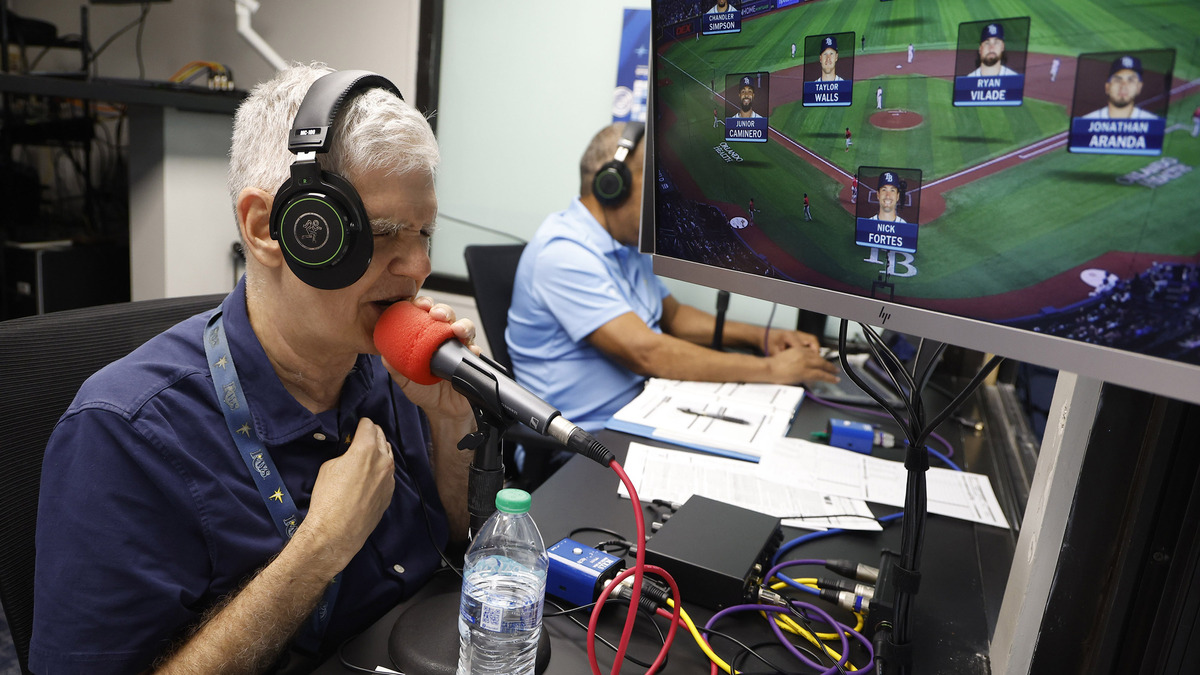
TAMPA, Fla. – Enrique Oliu’s skill is most apparent when he describes a play that, to the average observer, occurs silently.
Read more Twins’ bullpen ‘grandfather’ mentored next wave. And he’s not ready to be done.
A lightly hit ground ball to the third baseman is a routine, under-the-radar play. The ball leaves the bat softly, and there’s typically little reason to cheer.
But Oliu, born blind, knows what sounds signal how the play is unfolding. Through his headphones, the Tampa Bay Rays Spanish-language radio broadcaster has access to audio from microphones on the field that help him locate where the ball has been hit. He listens for heightened reactions from fans seated along different parts of the field. He knows how many outs and baserunners there are, if any, and what the sensible play would be.
When the play arrives, he puts it all together. The sound of the ball on the ground, the silence as the throw travels across the diamond, the slight thump as it lands in the first baseman’s glove, the ensuing cheers, rattling cowbells and stadium sound effects.
It isn’t a flawless process. It’s hard to adjust if, say, the shortstop decides to step in front of the third baseman. Occasionally, as all announcers do, he makes a mistake. But as Ray Bryan, a Rays radio producer who has watched Oliu work for more than a decade, points out:
“It makes you think, if he can do that, anybody can do anything.”
How it all ‘really started happening’
Orestes Destrade remembers the disbelief in the dugout.
In the fall of 1980, Destrade and Lorenzo Fernandez, Cuban baseball players and childhood friends, were freshmen at Florida College, two of the few Latino students enrolled at the small Christian school by a bend in the Hillsborough River.
They quickly befriended an 18-year-old Nicaraguan who had graduated from the Florida School for the Deaf and the Blind in St. Augustine. They first met him, Destrade said, in his dorm room, while Oliu was air-guitaring to the music of Mexican rock star Carlos Santana. They bonded with him over baseball, and not long after, brought him to a practice. There, Oliu revealed his ear for the game.
“I’m sitting next to him, and somebody was hitting batting practice,” Destrade said. “The ball was hit, and he’d go, ‘ground ball.’
“I go, ‘Yeah, ground ball,'” he said, some incredulity still lingering four decades later.
Then there was a fly ball, and Oliu was correct again. He continued to call swings accurately for the entire session, solely off the sound of the contact. A craft that, even as a kid, he was constantly seeking to practice.
“I was always bothering people,” Oliu said. “And because they were nice, they’d let me into the booth and spend a few innings with them, or the whole game.”
Two teachers in St. Augustine – Marvin Sanford and Tuck Tensley – helped Oliu, who can only perceive light, understand the games he heard on the radio. They taught him sports theory in the classroom and took him through the motions on the field during physical education classes.
Oliu started working as a public address announcer for the college after his introduction to the baseball team, which is when it all “really started happening.” He went on to earn his bachelor’s degree in communication from the University of South Florida and continued to pursue opportunities behind a microphone.
“I was hooked on doing radio,” Oliu said. “I’m still hooked.”
At first, he volunteered at a station while working full time as an interpreter at the Hillsborough County Public Defender’s Office. He hosted an hourlong talk show and covered tennis, boxing and Michael Jordan’s matchups against the Orlando Magic.
He was hired by the Rays in 1998, when Destrade, who went on to play professional baseball, recommended Oliu to Vince Naimoli, the Rays’ inaugural owner. Naimoli was a bit befuddled when Destrade proposed hiring a blind announcer but ultimately approved. Nearly 30 years later, Oliu is one of two broadcasters who have been with the team for its entire existence.
“He made me look really good,” Destrade said. “He’s colorful. He’s just wonderful.”
And he never left his day job. He’s never wanted to. Oliu is in his 34th year at the public defender’s office, where he says he enjoys guiding immigrants through the judicial process. He still works 40 hours a week, 7:30 a.m. to 4:30 p.m., before it is time to head to Tropicana Field.
The trio at the Trop
It is a Friday in September, a few minutes past 7 p.m. in St. Petersburg, and Tropicana Field is abuzz.
The Rays are about to play the Boston Red Sox with pivotal playoff seeding at stake. The Major League Baseball season started in March, but the remaining games matter most. There is a collective hum of chatter as fans fill the stands, and plenty of pregame festivities. Two ceremonial first pitches elicit no more than faint applause, while a young child’s declaration of “Play ball” proves more endearing. The Red Sox spill out onto the field, setting off competition between cheers and jeers. When the Rays emerge from their dugout, a foghorn blares.
Seated inside the home team’s Spanish radio booth, Oliu’s posture is eager. He’s moved his seat as far forward as the booth’s desk allows, his stomach nearly pressing against it. Oliu, 64, wears an animated smile while holding his microphone with both hands.
Moments before the game begins, the booth is still in motion. Oliu’s wife, Deb Perry, sits beside him, reviewing statistics and rustling papers. Ricardo Taveras, his radio partner, is brewing a coffee in the back of the booth, the machine rattling like a faulty engine. Oliu monologues in the meantime, reciting the team’s lineups and explaining the game’s significance before seamlessly welcoming Taveras to the broadcast.
“Gracias, mi querido,” Taveras says as he takes his seat, hot coffee in hand. The game’s first pitch is a ball, north of the strike zone by about a foot.
Read more Where do the Cubs go after falling short in the playoffs again? ‘We let it slip away.’
Their connection, chemistry built over decades of calling Rays baseball together, is evident in the banter they share in between pitches. Taveras tells Oliu he’d like to take him on a cruise through the Caribbean, and at another point, sings him a Bad Bunny lyric. Early on in the game, Oliu reveals his best Bostonian impression, referring to the Red Sox’s stadium as “Fenway Pahhhk,” a drawl distinguishable even in Spanish.
The trio shares a desk about 6 feet long at the front of the radio box. Taveras sits to the left, wearing a headset and tracking the game with a traditional scorecard. He’s the play-by-play announcer, responsible for delivering the running narration, calling nearly every pitch. Perry sits on the right, advertisement scripts and sheets full of factoids spread out in front of her. She reads them to her husband in English, and he instantly repeats them on the air in Spanish. Oliu, positioned in between his teammates, wears a headset, too, leaving his right ear uncovered so he can hear Perry. He’s the color commentator, tasked with complementing Taveras’ narration with analysis and antics.
“Many people,” Taveras says, “tell me they can’t believe he’s blind.”
Andy Freed, a Rays English-language radio broadcaster since 2005, said he enjoys spending a few minutes watching the Spanish radio team from the back of their booth while he’s on a break from his own production.
“I’ll just kinda listen to the back-and-forth of it, and it’s beautiful,” he said. “It’s really a beautiful combination of voices.”
Some calls are easier than others. The previous week, Junior Caminero, the Rays’ star slugger, stepped to the plate in the bottom of the ninth inning with a chance to send his team to the playoffs. He smashed the first pitch he saw 417 feet, the sound of his swing inciting a frenzy before the ball landed in the left-field seats.
“I just know I heard an explosion off the bat, and I said, ‘This is over,'” Oliu says. “‘The Rays are going to the playoffs.'”
Perry helps him with the specifics on a sheet of paper he cannot see, but there is plenty Oliu does on his own. He has some advertisements memorized, and his knowledge of baseball is encyclopedic. By now, much of it has become second nature.
“Even though he doesn’t see it, he knows it, he feels it,” Destrade said. “Especially this Rays team that he’s followed for half his life.”
‘To share this with her is tremendous’
Perry didn’t know she was going on a date. A mutual friend asked if she’d meet Oliu at a Tampa Bay Lightning game and initially, that’s all she thought it was: a hockey game. But she found herself captivated in conversation, and they stayed out until 3 a.m. that night. They were married two years later.
“When he cares for somebody,” she said, “he really cares for you.”
Perry is often by Oliu’s side. She drives him to both of his jobs and aids his ambitions as an announcer, helping him study in the spring and sitting with him for dozens of games a year. She doesn’t go to every game – typically only the home games – but when she is in attendance, she’s as much a member of the team as Oliu and Taveras.
“To be able to share this with her is tremendous,” Oliu said.
They call her the radio team’s sergeant, alluding to her two decades of service in the Air Force. She was raised in a baseball-loving family, and she estimates at least half of their life revolves around the sport. The rest, she says, is kept vibrant by her husband’s seemingly incessant energy and enduring fascinations with sports, music, movies and books.
‘There are people everywhere to reach’
Trent Ferguson, who was born blind and is an alumnus of the same St. Augustine school as Oliu, holds a trip to Tropicana Field when he was 13 years old as one of his most formative memories.
He remembers meeting Dewayne Staats, the team’s television voice since its start, and radio broadcaster Dave Wills, who was posthumously inducted into the team’s hall of fame in 2024. Ferguson, capable of matching the tenor of their signature catchphrases with impressions born out of admiration, considers them both heroes. But it was meeting Oliu that left the strongest impression.
“Seeing Enrique had a different level of impact,” said Ferguson, now 28. “I knew that there was a place for me somewhere within the sports realm.”
They exchanged phone numbers, and Oliu has embraced him as an apprentice ever since. They speak on the phone monthly, at minimum. Oliu has stayed by his side through struggles, including the death of Ferguson’s stepfather, and successes, most notably securing his own radio show.
Ferguson, a native of the Avon Park/Sebring area about 100 miles east of Tampa, hosts an afternoon program on a small local station called “Outta Sight Sports.” The pun, displaying a sense of humor similar to his mentor’s, is intended.
Oliu offers Ferguson as an example of what is most precious to him about his position: forging a path someone else might be able to follow.
“What’s important for people to know is that I made it, not because I am special, but because any person can, in any path or any phase of life,” he said. “There are still people who say, ‘No, how is that possible?’ So to me, there is still work to do. There is still a lot to teach. There are people everywhere to reach.”
—
A week after Caminero’s cathartic home run, the American League-leading Rays lose, 4-2. They finish 0 for 13 with runners in scoring position after leaving the bases loaded in the bottom of the ninth. There are no more than murmurs in the stands as the stadium empties, and no celebratory interview for any Rays broadcast.
The Spanish-language booth is back in motion, as it was before the game. Taveras stands up and leaves Oliu to eulogize the loss. Oliu speaks from memory for at least five more minutes, showing that his mind is, as his wife put it, like a “steel trap.” He recounts the pivotal plays and missed opportunities, explains the implications of the results around Major League Baseball and even remembers the evening’s exact attendance.
“Tomorrow will be another day,” he tells listeners, wearing his headphones over both ears.
Read more Cam Ward Caught on Titans’ Livestream Talking About Walking Out Before His Presser
____
Copyright 2026 Tribune Content Agency. All Rights Reserved.
This story was originally published October 5, 2026 at 2:38 AM.