 By admin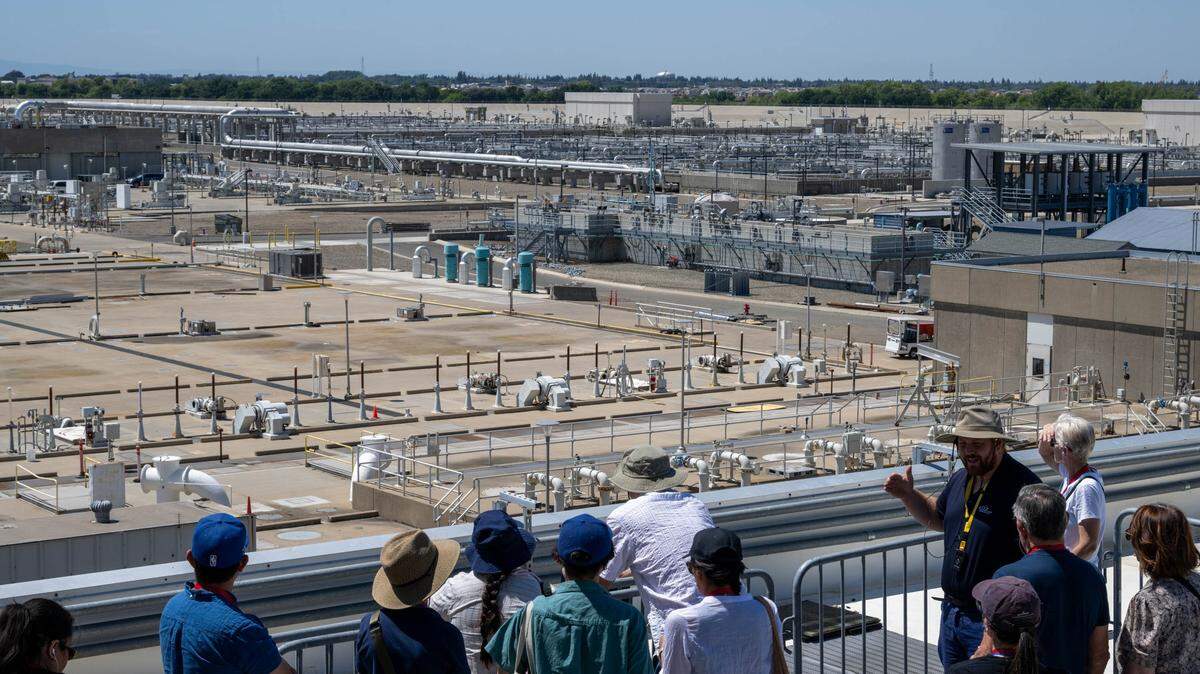
Have you ever wondered where exactly your wastewater goes?
The water from your dirty dishes, the water that goes down the shower drain, and yes, the water for every flush.
Read more Updated results: Cofer, Kennedy lead in Sacramento County Supervisors races
All that water is treated by the Sacramento Area Sewer District (SacSewer) at its wastewater treatment plant known as the EchoWater Resource Recovery Facility.
Located in Sacramento County, near Elk Grove, the facility is the second largest sewage treatment plant in the U.S. and the region’s largest sewage collection, treatment and resource recovery utility, according to its website.
This site is the only wastewater facility in Sacramento County and serves every city and multiple unincorporated areas, including Locke, Walnut Grove, Freeport, Franklin, and Hood, said Christoph Dobson, the general manager of SacSewer.
Serving more than one million Sacramento County residents, the EchoWater plant is the equivalent of 18 football fields in size, Dobson said.
On average, the EchoWater plant treats an average of 151 million gallons of sewage per day. It’s responsible for removing solid waste and organic matter from sewage and discharging clean, recycled water. Part of the process, called Biological Nutrient Removal, uses bacteria to remove 99% of the ammonia from the sewer water.
Sonny Lunde, the director of EchoWater Operations, supervises all aspects of the facility describing it as “a moderate to large swimming pool coming at us every four seconds, and it’s a lot of flow coming at us during that storm.”
The Sacramento Regional Wastewater Treatment Plant became fully operational in 1982 and was run by the Sacramento Regional County Sanitation District (Regional San). It underwent an expansion that was completed in 2021. SacSewer merged with Regional San in 2024.
How water is processed and treated has changed over the years. In 2023 the facility introduced a new granular media filtration process, which removed more bacteria and viruses from the water.
When asked about water treatment rates rising in the region, Dobson reminded that wastewater is different from the water treatment utilities. Water treatment is a separate process entirely, he explained. SacSewer does not charge or gain revenue from water treatment, which involves purifying raw environmental water into safe drinking water.
“Most of the region is our wastewater treatment, but water is a different, completely separate system.” Dobson said.
How does it work?
Water and sewage are processed throughout four buildings on the EchoWater site. Each building is dedicated to a different process to treat the sewage coming from across Sacramento County, Lunde explained.
The process begins on the northeast side of the campus and takes care of the primary treatment process, Lunde explained.
Sewage makes it way through a bar screen, a device which removes larger debris. The debris fragments that are left over are sent to a sediment tank.
Read more Bicyclist killed in late-night North Sacramento crash on Marysville Boulevard
“That’s our first opportunity to collect sludge from the bottom and scum from the top,” Lunde said. “Sludge and scum are collected and sent to our solvents area.”
The next steps are known as the secondary treatment process, where the partially treated sewage makes it way to EchoWater’s biological nutrient removal facility.
After this process, the sewage water is 99% cleaner than when it arrived. This water enters a stage known as secondary effluent. It exits sedimentation tanks and flows over a weir, which is a type of low dam.. The water flows through another screen which removes any contaminants not picked up by the sedimentation tank.
In its final stage, known as tertiary treatment, 20 filtration beds similar to swimming pools, enter into the process, Lunde said.
Once past filtration, the sewage water is sent to be disinfected using chlorine. The chlorine is then neutralized so it doesn’t harm the environment or people.
In one of the final steps, EchoWater tests the water quality, making sure it’s safe for aquatic live, by using live fish that must be able to survive in the treated water for four days.
Afterward, the water is discharged into the Sacramento River through an 800-foot-long pipe, with a portion siphoned off for crop irrigation.
With the tour primarily focused on how water travels through the EchoWater facility, SacSewer also shared what can cause plumbing and blockage issues.
What shouldn’t I flush?
During the tour, SacSewer offered guidelines on what to flush and what not to send down the pipes.
SacSewer strongly advises against flushing anything else beyond waste and toilet paper, including:
- Dental floss, bandages, wrappers and any type of plastic
- Paper towels, napkins and other related products
- Oil and grease
- Pet waste and cat litter
- Any kind of wipe, even if they’re labeled as flushable
When these wipes come across grease from food and invasive roots in the sewer system, they combine and solidify, the sewer district explained. This results in blockage and causes overflow in the sewers and cause a plumbing nightmare.
In its literature, SacSewer explains, “Items like these are flushed, our facilities require increased monitoring, maintenance, and repair.”
Read more Krispy Kreme is giving away doughnuts — again. How to get a free one & when
This story was originally published June 3, 2026 at 1:11 PM.