 By admin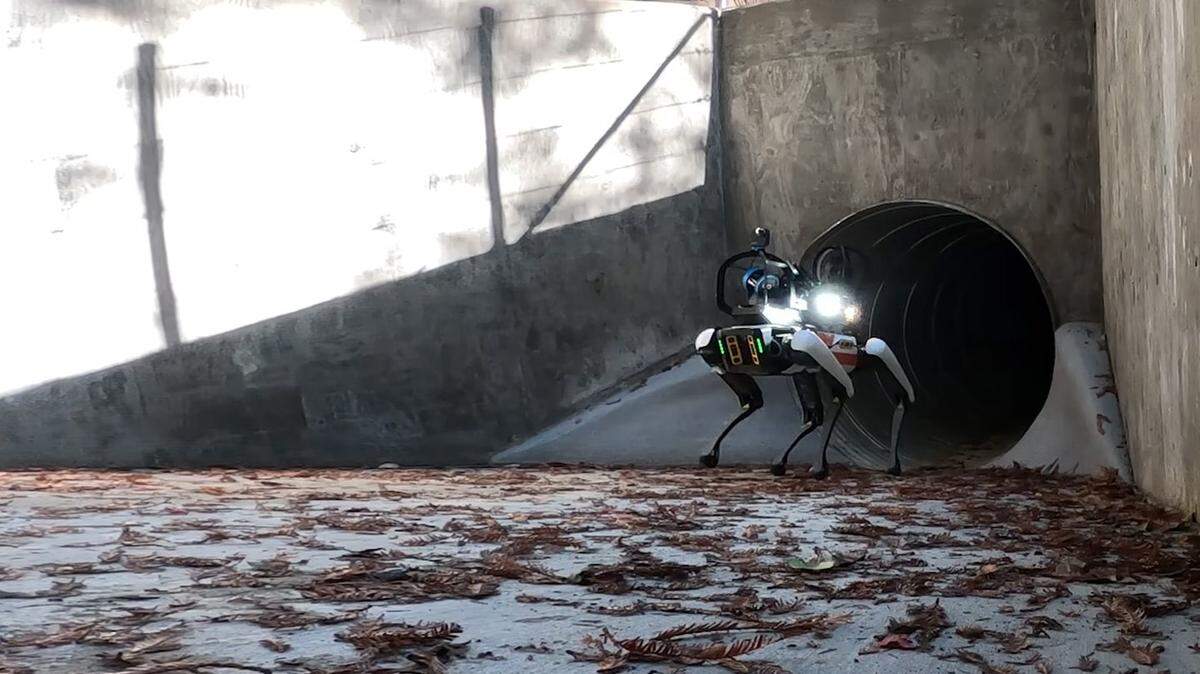
Caltrans is turning to some four-legged friends to help maintain the state’s sprawling highway system.
Read more Firefighers make progress on Holland Fire near Placerville; mandatory evacuations eased
To reduce the need for human inspectors to go into potentially dangerous confined spaces, the California Department of Transportation is instead sending in “Spot,” a headless, robotic dog produced by the technology company Boston Dynamics.
“It’s not a tool that we use every day, but when you need it, you really need it,” said Aaron Chamberlin, a field systems coordinator for Caltrans who works with the robots and teaches other workers how to operate them.
The robots are equipped with sensors and other tools to help engineers quickly gather information that would otherwise take human maintenance workers longer to obtain safely. Spot is deployed based on the needs of a specific construction project or emergency response, rather than day-to-day operations, he said.
Chamberlin said that the transportation department invested in several Spots as part of a broader effort to use robotic technologies as a way to improve safety for Caltrans workers and more effectively maintain and repair the state’s infrastructure.
Avoiding hazards
Over the last century, nearly 200 Caltrans maintenance and construction workers have died on the job. Some were killed by passing motorists, others suffered fatal injuries from being struck by equipment at work sites.
Chamberlin said there was not a large enough sample size to know if the use of these robots has resulted in fewer workplace injuries, but the positive effect on workers’ safety wasn’t difficult to imagine.
“Rather than putting a person at the bottom of a landslide, you can walk the robotic dog out there,” Chamberlin said. “If it did happen to go at that time … and you were to lose the dog, well, we lost the robot dog, versus, having a human there.”
Before sending Caltrans workers into enclosed spaces to conduct inspections, the department is required to meet safety standards for ventilation and traffic control. By using Spot instead, Caltrans can avoid putting workers in deep culverts, stormwater systems, bridge interiors and other areas that pose collapse risks.
“So far, OSHA is not regulating where we put robotic dogs,” Chamberlin joked.
Strong return on investment
A Caltrans spokesperson said each unit costs as much as $250,000, depending on what additional sensors and communications systems are included. The department owns two robots, which are shepherded around the state based on needs as they arise. Essentially that means Caltrans can get a robot to any part of the state in less than six hours, Chamberlin said.
Read more How a tiny police force in Miami-Dade posted big immigration arrest numbers
The department has already seen a good return on investment from the technology, a spokesperson said. Chamberlin pointed to an example from this past winter of a recent collapsed culvert in Eureka that was damaged by a storm. The incident forced Caltrans to shut the road, but the damage was so extensive no human inspector could fit inside the culvert. Instead, Chamberlin said the department was able to “walk” Spot into the culvert and map the failure.
Based on the robot’s initial survey, “we were able to tell our contractors, ‘Hey, you need this excavator bucket, you need this much shoring, you need this much pipe,’ ” he said
The department estimated that Caltrans saved $50,000 to $60,000 by avoiding unnecessary permits and work.
A future with more robots
Spot is just the latest example of Caltrans’ use of robots, which the department has been doing for about a decade.
Chamberlin said Caltrans has been using drones for inspections, graffiti removal and to help resolve disputes with contractors using images of sites captured by flying sensors. (In Alaska, Chamberlin said, the state’s transportation department uses robot dogs to chase antelope off airstrips.)
A Caltrans spokesperson reassured that the purpose of these robots was not to replace workers but rather to give highway and maintenance workers additional tools to do their jobs more efficiently and safely.
Chamberlin said one of his jobs is to find new technology to support Caltrans’ work, and they are still figuring out new ways these robots can be of use.
“I think we’re maybe in the first or second inning of that nine-inning game of where we see these things going in the future,” he said.
Read more Rooting against a Tom Steyer miracle — and any future CA Limousine Progressives | Opinion