 By admin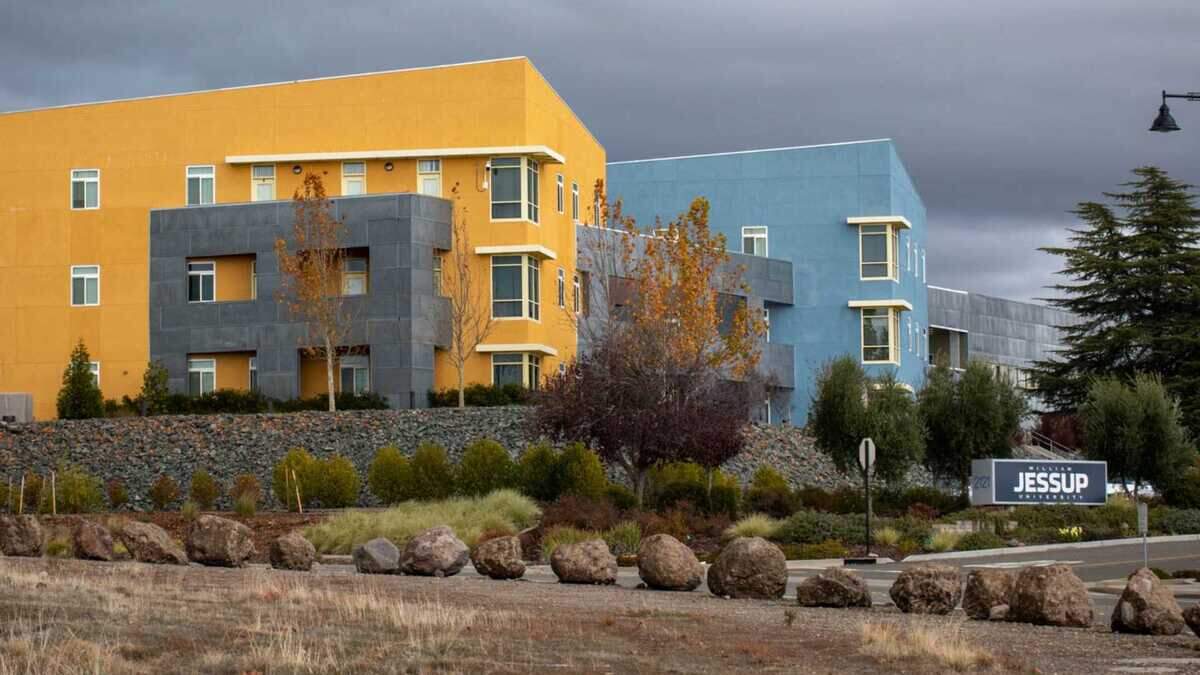
Jessup University has received a $2 million loan from former Intel Chief Executive Patrick Gelsinger and his wife as the Christian university works to stabilize its finances, restructure operations and address its debt obligations.
Read more Sacramento police plan DUI checkpoint Friday night. Here’s when it starts
The loan, made in July, carries an interest rate of 5.5% and is due Aug. 27, 2027, according to an August bondholder presentation by the university and first reported by Bloomberg. The loan, made through the Gelsinger Family Trust, is secured by Jessup’s 402-acre Clover Valley property, which was placed under a permanent conservation easement in 2025.
University officials said the loan was intended to cover a $2 million gap in Jessup’s Bridge to Sustainability fundraising campaign and comes as Rocklin-based Jessup, which has about 1,800 students, continues a broader restructuring effort following years, according to Bloomberg, of operating losses, debt pressures and costs associated with its acquisition of Multnomah University in Portland, Oregon.
Jessup President Meghan Barnard confirmed that the loan was approved through the university’s normal business and governance processes.
She said trustees affiliated with Gelsinger recused themselves from the approval process and that no Gelsinger-affiliated board members were involved in approving Jessup’s relationship with Gloo, a Boulder, Colorado-based artificial intelligence and technology company where Gelsinger now serves as chairman.
“The Gelsinger family has been a longtime supporter of Jessup University,” Barnard said in a statement, adding that the university is grateful for the family’s “continued commitment to Jessup’s mission and long-standing support of Christian education.”
According to Bloomberg, Gelsinger and his wife have longstanding ties to Jessup. Gelsinger previously served as a university trustee and was appointed to a college advisory board earlier this year. His daughter-in-law, Rachael Gelsinger, chairs Jessup’s board of trustees.
Bloomberg also reported that Gelsinger and his family had a longstanding friendship with the late Bryce Jessup, a former university president and son of the school’s founder.
Gelsinger did not respond to The Sacramento Bee for comment.
» Roseville news in your inbox: Get our free Roseville email newsletter here
Jessup said the terms of the loan are disclosed in its recent Electronic Municipal Market Access filing, the municipal securities disclosure system used by bond issuers.
The loan arrives at a particularly consequential moment for Jessup.
The university did not make a $3.139 million debt-service payment due Aug. 1 on its Series 2019 bonds, Jessup officials told bondholders Aug. 5. The payment included $1.609 million in interest and $1.53 million in principal. Jessup also disclosed that its $2.5 million line of credit with Five Star Bank was extended July 31 to mature June 30, 2027.
The university also missed a bond payment in August 2025 before ultimately making the payment.
Bloomberg reported that Jessup’s bonds have traded at distressed levels. A bond due in 2048 traded at about 62 cents on the dollar in January, while a bond due in 2039 traded at about 31 cents on the dollar last year, according to Bloomberg data.
Against that backdrop, the $2 million loan provides additional liquidity as Jessup seeks to execute what it describes as a long-term operational and restructuring plan.
The Gelsinger loan also imposes new cash-management requirements on the university, including a rolling 13-week cash-flow report and a requirement that spending remain within 10% of projected cash flow, according to the bondholder presentation.
“We continue to work constructively with our bondholders and appreciate their ongoing cooperation as we execute our long-term operational and restructuring plan,” Barnard said.
Jessup said its restructuring over the past year has included reducing operating expenses, restructuring portions of the organization, strengthening governance, securing philanthropic support and completing its Bridge to Sustainability initiative.
Through that initiative, the university had sought to raise $6 million but received $4.02 million in donations, according to the Aug. 5 bondholder presentation. The $2 million Gelsinger Family Trust loan was used to bridge what university officials described as the remaining summer financial gap.
The university also recently changed its governance structure. Its board unanimously approved a plan to reconfigure its composition and establish a Presidential Advisory Council. The change followed a strategic initiative launched in December 2025 to strengthen Jessup’s financial position and long-term sustainability.
Read more West Sacramento weighs new garbage company as residents face higher rates
Barnard became Jessup’s seventh president on July 1. Jessup told bondholders that Rachael Gelsinger was appointed board chair July 8 and that board resignations were accepted that day. The university did not identify the resigning board members in the presentation.
The Gelsinger loan is separate from Jessup’s relationship with Gloo, according to the university.
Jessup said it is working with Gloo to modernize its operational and technology infrastructure, producing what Barnard described as “meaningful operational efficiencies and cost savings.”
Gloo, which provides technology services to churches and nonprofits, has also been expanding its work in higher education.
Bloomberg reported that Gloo Chief Executive Scott Beck said during an April earnings call that the company had closed several agreements valued at more than $1 million, including an expansion into the university market through its work with Jessup.
Jessup said, however, that no Gelsinger-affiliated board members participated in approving the Gloo relationship.
In a statement, a Gloo spokesperson said the company is helping Jessup modernize its technology and operations, including through AI-powered tools designed to support students, faculty and families.
“Jessup is an excellent example of the broader transformation happening in universities in how they equip students and the communities where they will lead,” the spokesperson said.
LeAnne VarenKamp, Jessup’s chief operating officer, said at the public bondholder update August meeting that the Gloo partnership has saved the college $1 million in two years.
“The Gloo relationship allowed us to move a total of $3 million in salaries and benefits over two years to a contract. That contract costs about $2 million,” she said. “The net savings over two years is about $1 million, but one of the other benefits has been the ability change our cash flow in a favorable way for Jessup.”
Jessup reported negative one day of cash on hand for fiscal year 2025, compared with 73 days in 2024 and 60 days in 2023.
For Jessup, the immediate financial challenge remains broader than the new loan. The university is attempting to manage its outstanding debt while reducing costs and rebuilding its operating position.
Jessup’s fiscal 2027 budget projects $39.3 million in revenue and the same amount in expenses, including about $23.7 million in compensation and $13 million in general and administrative costs. The university listed projected EBITDA — a measure of earnings before interest, taxes, depreciation and amortization — of about $707,000.
The university also continues to search for a permanent chief financial officer role, according to the bondholder meeting.
Barnard said Jessup has made “significant progress” through the work of its management, supporters and financial partners and that she is encouraged by enrollment for the coming academic year.
“As the new president of Jessup, I’m excited to welcome a class that meets enrollment goals for the new academic year,” Barnard said. “Our forward position is focused on developing sustainable business models for Christian higher education that provide accessibility and affordability for incoming students well into Jessup’s future.”
Read more Fireworks CEO charged in deadly Esparto explosion denied bail after not-guilty plea