 By admin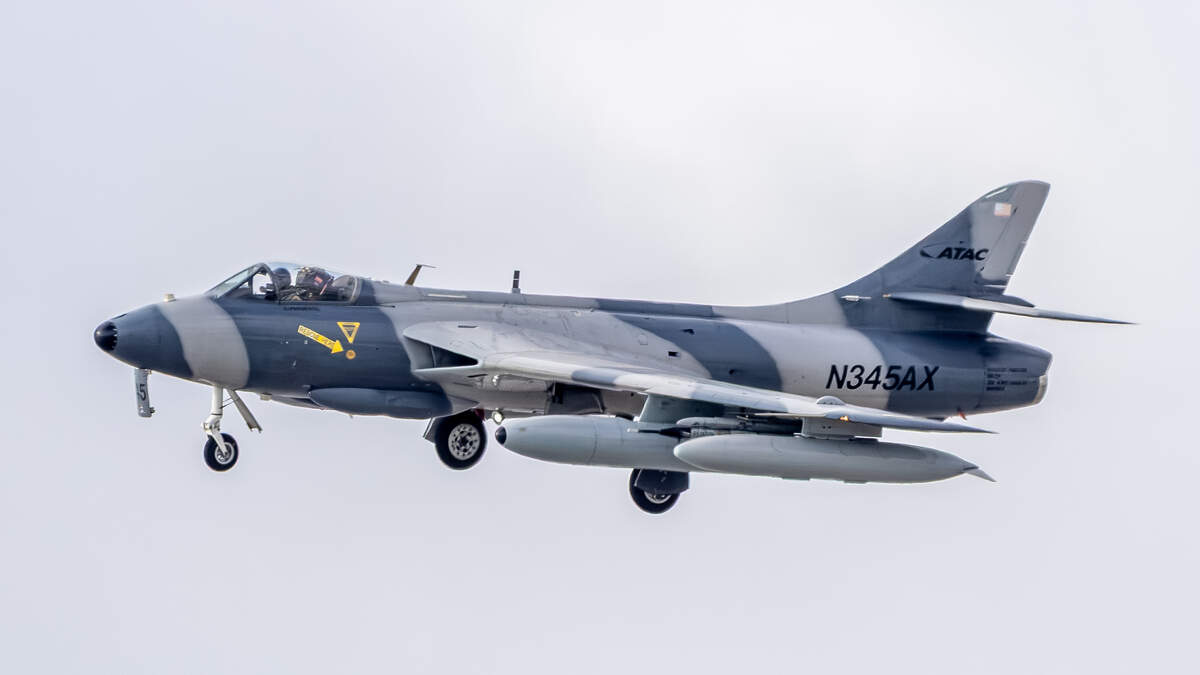
A Cold War-era military fighter jet plummeted into the sea off the Central Coast of California after the pilot safely ejected during a total engine failure on Tuesday night.
Read more ‘Creating an experience of healing’ helps Shana Henry guide educators into leadership
But it was not the first time this type of plane has suffered the same malfunction.
Since 2018, four of the same model aircraft have now crashed into the ocean after a partial or total loss of engine power, a Tribune review of National Transportation Safety Board crash investigations showed. The aircraft has been involved in 10 reported accidents in total in the same time frame, according to the Aviation Safety Network.
All four ocean crashes share nearly identical details of stalled-out engines and pilot ejections from MK-58 or MK-58A Hawker Hunter planes built before 1960 that were left largely unrecoverable in the ocean. None of the crashes were fatal.
Across all three past investigations, only one identified a reason for the sudden loss of engine power: a fuel pump failure.
The MK-58 and MK-58A Hawker Hunter are negligibly different variants of the same single-seat, transonic fighter jet.
All four of the aircraft that crashed in the last eight years were operated by private military contractor Airborne Tactical Advantage Company, also known as ATAC, which helps train crews from the U.S. Navy, Air Force and Marine Corps.
“These aircraft receive a flight clearance from the Navy to fly on the contract and are subject to a strict regimen of aircraft inspections,” ATAC spokesperson John Rupp told The Tribune. “ATAC considers them to be fully safe and capable aircraft.”
Eight of the 10 Hawker Hunter accidents reported by the Aviation Safety Network since 2018 have been operated by ATAC.
Despite the repeated incidents of engine failure, however, the safety record of the Hawker Hunters is not a cause for alarm, pilot and aviation expert Steve Picatti told The Tribune.
“It’s not odd,” he said of the 7-decade-old planes. “There’s a lot of things keeping those things going, and they’re not brand new.”
Picatti is a former ATAC mechanic and was separately a consultant to the National Transportation Safety Board who has worked on and around fighter jets for over 60 years. He said refurbished Hawker Hunter engines in particular are “pretty robust.”
“I think it can be a very safe airplane if it’s maintained properly,” he said.
ATAC operates more than 20 Hawker Hunters worldwide, Rupp said.
According to the military contractor’s website, the Hawker Hunter is deployed in a variety of roles: “The aircraft’s steady performance allows ATAC to use it as a transonic fighter in the air-to-air role, as a stable, precise platform in the air-to-surface role, and the aircraft is a versatile opponent in all fleet integrated training exercises.”
While the operator is responsible for routine servicing of the fleet, the aircraft’s owner Canadian company Lortie Aviation handles plane maintenance, Picatti said. Lortie often operates through its affiliate, Hunter Aviation International Inc.
John Lusa, general manager at Lortie Aviation, told The Tribune that aircraft accidents fall under ATAC’s responsibility as the lessee and operator.
As of Wednesday, the National Transportation Safety Board had opened an investigation into the most recent crash, spokesperson Peter C. Knudson told The Tribune.
4 Hawker Hunters downed from engine failures since 2018
Tuesday night’s crash took place during a Navy training mission off the coast of San Luis Obispo County.
“Mayday, mayday, mayday, I have lost thrust in my engine,” the pilot could be heard calling over the radio as his plane plunged toward the ocean at a speed of over 10,000 feet per minute, according to Automatic Dependent Surveillance–Broadcast aviation data shared by Squawk, an aviation alert page on X.
The plane was flying at an altitude of more than 32,000 feet when it suddenly began to drop, losing signal at 3,425 feet, according to Squawk. It splashed down five-and-a-half miles northwest of Morro Bay at 6:49 p.m.
The pilot ejected before impact and was rescued by a Navy crew. He was in good condition in the hospital as of Wednesday.
ATAC’s modern MK-58A Hawker Hunters are heavily modified versions of aircraft that date back to the 1950s, some of which originally served with the British Royal Air Force. The aircraft that crashed Tuesday was built in 1956.
Picatti, the aviation expert, said engine issues are “not unusual” with these older, refurbished models.
“Engines are supposed to last 600 hours, and these guys fly almost 300 hours a year per airplane, easily,” he said. “So they’re taking a 1970 engine — or actually ‘50s — and running them like a new car would.”
But as long as they are being updated with care, the planes’ older bones are no reason to sound safety alarms, he said.
“It depends on the companies doing it, how much money they have to do it and their integrity,” Picatti said. “A lot of companies aren’t as good as Lortie.”
Three other MK-58 or MK-58A Hawker Hunters have crashed in nearly identical circumstances in 2018, 2022 and 2025 — with the most recent incident also taking place on the Central Coast.
On Oct. 15, an MK-58A Hawker Hunter, registration N335AX, crashed off the coast of Big Sur due to total loss of engine power during a U.S. Armed Forces adversary and tactical training flight, according to a National Transportation Safety Board aviation investigation report.
While en route to the training area, the pilot was informed that another plane would be about 10 minutes late, so he reduced the engine power and slowed the jet to conserve fuel, the report said. Then, the engine stopped.
“The pilot executed the engine malfunction checklist, attempted multiple restarts, however, despite his attempts, the engine would not restart,” the report said.
Similarly to Tuesday’s crash, the pilot ejected over the Pacific Ocean before impact.
Read more Surf resort with 5-acre lagoon get Placer planners’ OK. See what it could look like
The National Transportation Safety Board determined the cause of the crash to be complete loss of engine power, but because the plane was not recovered, the reason for the engine malfunction could not be determined, the report said.
The plane was built in 1959, had last been inspected that August and had been flown for 124 hours since, the report said. The pilot sustained minor injuries.
Another nearly identical crash took place on Dec. 12, 2018, in Hawaii when an MK-58 Hawker Hunter experienced total engine failure during takeoff from Daniel K. Inouye International Airport in Honolulu, according to a National Transportation Safety Board report.
The pilot attempted to restart the engine, but as his airspeed continued to slow, he instead maneuvered the plane toward the ocean, aiming to avoid a passing parasailing boat, and ejected, the report said. The jet was only around 500 feet in the air at the time.
The aircraft hit the water about 2.86 nautical miles southeast from the end of the runway at a depth of about 250 feet, the report said. Two fuel tanks were seen floating on the ocean’s surface, but the rest of the plane was intact and sunk.
Portions of the Hawker Hunter’s instrument panel, fuselage and engine were recovered, but the rest of the aircraft was lost, the report said. All recovered components, however, were fully functional at the time of the accident.
Because the rest of the wreckage was not recovered and could not be examined, a reason for the total loss of engine power again could not be determined, according to the report.
The 1958 MK-58 Hawker Hunter, registration N323AX, had last been inspected on Feb. 20, 2018, the report said.
The final incident took place on June 20, 2022, 40 miles southeast of Wilmington, North Carolina, when an experimental MK-58 Hawker Hunter — described as a “vintage miliary jet” — lost partial power to its engine during a Navy exercise, forcing the pilot to eject 3,000 feet above sea level, a National Transportation Safety Board report said.
The aircraft’s revolutions per minute reduced to 5,000 — 6,800 to 7,200 revolutions per minute were required to maintain altitude and return to an airport, the report said.
After two unsuccessful attempts to restore engine power, the pilot ejected, sustaining a serious back injury, the report said. He was rescued by a nearby fishing vessel.
Some wreckage was recovered from the ocean, and the Hawker Hunter’s fuel system was examined at a maintenance facility.
The examination revealed that a bearing failure in the high-pressure fuel pump governor prevented output pressure from increasing above 850 pounds per square inch — well below the operating range of 1,900 to 2,200 pounds per square inch, the report said.
“That’s not very common,” Picatti said of the fuel pump failure.
The 2022 investigation was the only one to determine a reason for engine failure.
The plane, registration N337AX, had been built in 1959 and last inspected on Jan. 13, 2022, 19 hours of flight time before the crash, the report said.
Picatti, who formerly worked as a lead Lortie mechanic at ATAC for several years, said the frequency of Hawker Hunter accidents due to engine issues probably has less to do with the aircraft mechanics itself and more with use time.
“The reason I think you’re seeing the accidents in that is because these guys actually do a lot of flying,” Picatti said. “300 hours a year for a warbird is a lot of flying. Most people don’t fly their airplane that much in a whole year, and these guys are doing it every year.”
Many of ATAC’s pilots formerly flew Navy fighter jets and are well-equipped to handle the Hawker Hunters, Picatti said.
He also noted that several different diagnoses can fall under loss of engine power.
“They say engine failure — that doesn’t mean that the engine failed,” Picatti said. “The engine might have been in perfectly good shape, and some kind of fuel starvation or fuel problem caused it, or other items.”
He said ATAC’s Hawker Hunters are “constantly going through inspections.”
“There isn’t any part on that Hawker Hunter that Lortie can’t overhaul and sign off, and do it with pretty good quality,” Picatti said. “They don’t have a lot of mistakes in their overhaul stuff: any engines, fuel pumps, and hydraulic pumps and electrical stuff. They can completely overhaul an airplane. … Their inspections are impressive.”
National Transportation Safety Board opens investigation into SLO County crash
The National Transportation Safety Board is investigating Tuesday’s MK-58A Hawker Hunter crash.
The board’s investigations involve three primary areas: the pilot, the aircraft and the operating environment, spokesperson Knudson said.
Investigators will gather information and records on flight track data, air traffic control communications and recordings, aircraft maintenance records, the pilot’s license, ratings and recency of flight experience, he said.
“At this stage, our focus is on determining the facts, circumstances and probable cause of the accident,” Knudson said. “As part of every investigation, investigators review any information that may be relevant, including similar accidents and incidents.”
“It would be premature to characterize prior events as a pattern or speculate about any broader safety review while this investigation is in its early stages,” he added.
A final report is expected within three to six months, he said.
The Federal Aviation Administration, which certifies ATAC to operate, did not immediately respond to The Tribune’s request for comment.
This story was originally published September 25, 2026 at 5:00 AM with the headline “Jet model that crashed into sea off CA coast has suffered engine failures before.”
Read more This new Lodi supper club transports you to a Rat Pack retro fantasy