 By admin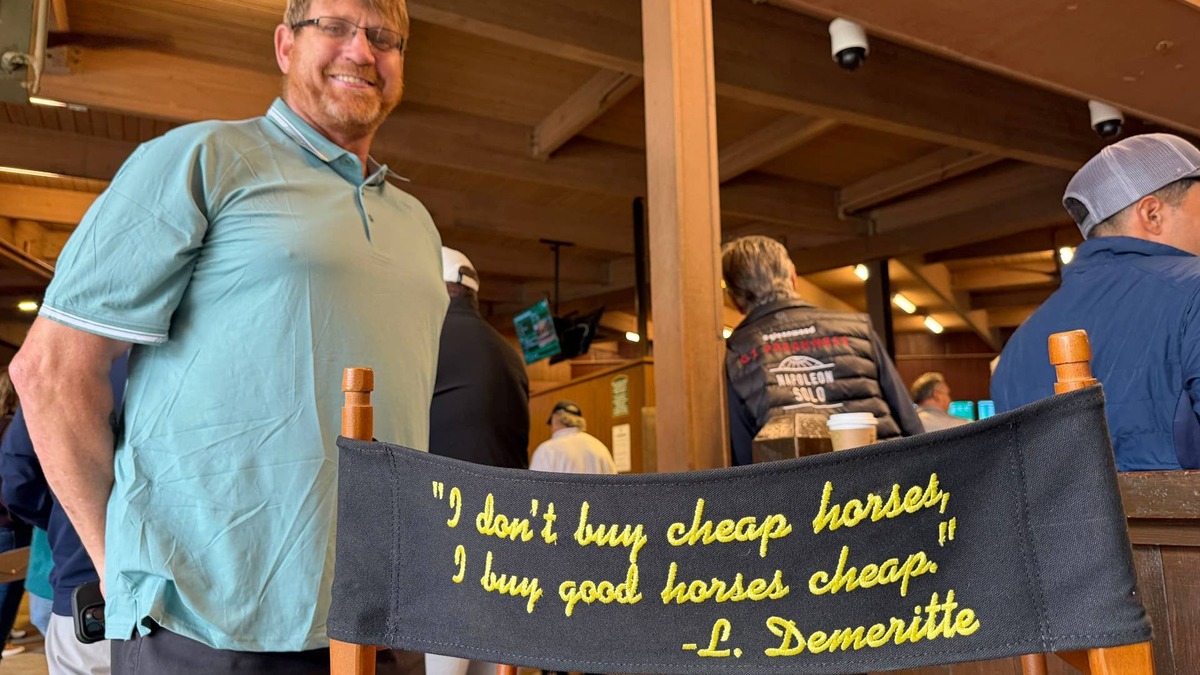
At Keeneland, things become real on the short walkway between the back walking ring and the holding chutes leading to the auction ring.
Read more The Bee’s Top 25: SFL topped by Folsom, Oak Ridge, Del Oro is a combined 23-1
In that liminal space, horses have a clear sightline of their future on the other end of a massive sliding door, minutes before striding before the auctioneer’s stand to decide the rest of their lives. Buyers huddle to decide how much they’re willing to spend before getting in position within the sightline of a bidspotter. Consignors holding iPads and vet reports handle last-minute queries, then hold their breath as their charge’s hip number goes up on the board.
Through all the commotion, it might be easy to overlook Paul McEntee, posted up in a canvas chair, deciding which horses might merit bids based in part on that short walk from potential to realization. His chair, though, is harder to miss.
On the back, stitched in bright yellow cursive, is the motto of the horseman who used to occupy the spot next to him on the precipice of that walkway:
“I don’t buy cheap horses,
I buy good horses cheap.”
– L. Demeritte
The chair is a small monument to McEntee’s longtime friend and fellow trainer Larry Demeritte, who died in May 2025 when cardiac arrest brought an end to a lengthy battle with cancer.
“When he passed away, it affected a lot of people in the horse industry – me, too,” McEntee said. “So, just as a statement to him and so that people didn’t forget him, I wanted to have the chair made.
“Last year was the first year I had it after he passed, and anyone who wanted to sit down during the September sale and tell a story about Larry and how they met him, or how they knew him, I put a post on social media saying, ‘Come down, reminisce, and tell your Larry story,’” he continued. “I have it this year just to commemorate him. As long as I’m here in Kentucky and here at the sales, I’ll bring it here every year.”
McEntee and Demeritte grew close during their time at The Thoroughbred Center, the satellite training facility on the outskirts of Lexington, Ky., where they found common interests in the clocker’s tower, waiting for their horses to post workouts. Both were immigrants; McEntee coming stateside from Ireland, by way of England, and Demeritte hailing from The Bahamas.
They also bought horses from the same level of the market. McEntee proudly listed off the horses he’d snagged for bargain-basement prices who went on to make something of themselves on the racetrack, including Baytown Dreamer, a Mendelssohn colt that earned points on this year’s Road to the Kentucky Derby standings and made over $287,000 after being secured for just $5,000.
Seated next to each other for hours during the marathon middle and later sessions of the September sale, the two horsemen swapped stories and shopped for the next members of their stable, one horse at a time, as they prepared to enter the ring.
In 2022, McEntee had his eye on a gray colt by Exaggerator in the economy-class Book 6 of the Keeneland September sale, and he got up from his spot just before the chutes to get the attention of a back ring bidspotter. What he hadn’t realized was the person sitting next to him had already gotten up to do the same.
“We’re always bidding and looking at similar price-range horses, and several times, if we weren’t standing side by side, I’d be on one side (of the back ring) and he’d be the other, and we’d be like, ‘What the hell are we doing? We need to tell each other which horses we’re bidding on, so not to bid each other up,’” McEntee said. “Larry was standing up there this time, in the middle of the aisle, and I was over to the side, so the first couple of bids, I didn’t realize it was him I was bidding against, and then as soon as I saw it was him who I was bidding against, I stopped.”
The colt hammered to Demeritte for $11,000, on behalf of owner Harry Veruchi. The following year, West Saratoga won the Grade 3 Iroquois Stakes. The year after that, he entered the starting gate for the 2024 Kentucky Derby and launched his trainer to national-level notoriety.
“Now, obviously in hindsight, I’m still glad Larry got his horse,” McEntee said with a wry smile. “It took him his whole career to get his Derby horse, and I wouldn’t wish it for anyone else. I got to walk over for the Derby with him, and it was an amazing day and an amazing experience. He was a true horseman and would talk to anybody about horses. Nobody who I’ve ever known in Kentucky ever had a bad word to say about him.”
Read more Panthers RB Jonathon Brooks to have surgery, put on IR
The two trainers were far from the only ones who base their buying decisions on horses they see for the first time in the back ring at a yearling sale. Especially in the later books of the two-week-long auction, many potential buyers will pick a spot in the back ring and follow horses into the pavilion to bid if they see a spark of something they like. Often, the lower price point outweighs the risk of buying a horse without the intense veterinary scrutiny that the seven-figure offerings demand.
McEntee has his own spin on that method from his unique perch, which includes knowing the market and making sure the market knows him.
“Obviously, I’ve already looked in my sale catalog, and my main aim is trying to get 2-year-olds to Keeneland and Churchill, because the first-time owners and new people getting into the industry, they want a quick return,” he said. “They want to see their investment as quickly as possible. So for that, I’m looking for mares (on a yearling’s catalog page) that have produced 2-year-old winners. I’m looking for some sires that were winners themselves as 2-year-olds; precocious types. If someone’s coming into the ring and they’re 16.3 hands and a May foal, then it’s not going to suit my racing program.
“I’ll go through the catalog before each night, and I’ll highlight ones that I’m particularly interested in, and then once they come here, I’ll look at them walk in the back ring,” McEntee continued. Also, I’ve been in Kentucky for 23 years. I know most of the consignors and a lot of the breeders as well. If they’re selling a horse for $5,000 to $10,000 or $15,000, they want it to stay in Kentucky, because even if they’ve taken a hit on this sale, they’re going to make their money back from their breeder’s awards, so they know me, and they know I stay in Kentucky. But they also know that I will run a horse wherever it belongs. I’ve raced all over the country, so lots of breeders in the latter books come up to me and say, ‘Hey Paul, have a look at my horse,’ and they want to place it with a trainer that they know will hopefully get it to the track and give it a chance.”
McEntee spent his first 11 years as a trainer based at The Thoroughbred Center, but he now stables year-round at Turfway Park, briefly shifting his stable to Keeneland for the meets in April and October.
The “Buy Low, Earn High” philosophy has served McEntee well, with Baytown Dreamer being the latest example in a list that also includes Baytown Bear (RNA’d for $9,500, made $261,177), Baytown Frosty (bought for $4,500, made $204,740), and Brereton’s Baytown (bought for $17,000, made $157,391).
His eye for a horse that’s better than its commercial lot in life likely comes from a five-generation link to the Thoroughbred industry. His brother, Carl, heads up the Ballysax Bloodstock consignment, while Mark is the farm manager at Miacomet Farm in Kentucky. Older brother Phil is a trainer in England.
One thing that didn’t get passed down to the McEntee boys, though, was their frame.
“My dad (Philip McEntee) was a champion jockey in Ireland in 1966, and I’m 6’4,” and all my siblings are all 6-foot-something, and my dad was 5’7″, Paul said. “My mom was the manager of the bar that all the jockeys used to go to, and after about two weeks of throwing my dad out every night, she realized he was going there on purpose.”
The “Baytown” moniker that accompanies many of Paul’s horses, as well as the name of his Baytown’s Legacy Farm, is a tribute to his father, who purchased a horse named Baytown Coke for the McEntee boys to ride as teenagers. After the elder McEntee’s death, Phil Jr. took over his training stable and began to work “Baytown” into the names of his charges, while Paul brought the tradition over the Atlantic.
Fitting then, that Paul McEntee would be well-suited to pay respect to a contemporary, friend, and occasional accidental bidding rival like Demeritte, and use his motto as a guiding message as he continues on for both of them. His career has been built on preserving memories of those no longer with us.
Fortunately, when McEntee set out the empty chair where his friend used to reside and invited others to fill it with stories of Demeritte, he was rarely alone.
“A lot of the stuff would not be able to be printed publicly,” he said with a chuckle. “A lot of expletives and a lot of very fun stories.”
Read more Chris Spatola, ESPN college hoops analyst, dies at 47
Copyright 2026 The Arena Group, Inc. All Rights Reserved
This story was originally published September 23, 2026 at 10:53 AM.