 By admin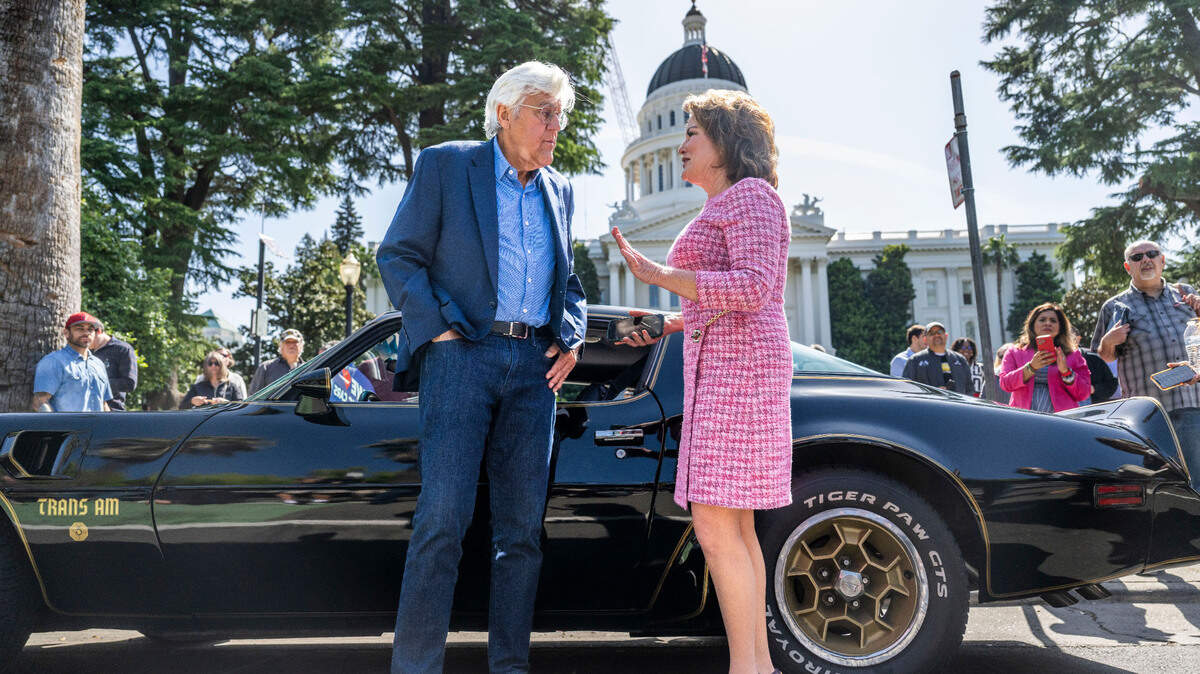
Classic car aficionados gathered Wednesday in a rally for “Leno’s Law 2.0,” the second attempt at a bipartisan bill to reduce smog regulations on classic cars manufactured later than 1976.
Read more ‘Leno’s Law 2.0’ proposes reduced smog restrictions on classic cars
Senate Bill 1392, authored by Sens. Dave Cortese, D-San Jose, and Shannon Grove, R-Bakersfield, would extend smog exemptions to cars manufactured between 1976 — the current cutoff year — and 1986. The bill takes its name from car enthusiast and former talk show host Jay Leno, who has championed the measure.
“For most people, this is a second, third or even a fourth car that was their grandfather’s or their dad’s,” Leno said. “And they’re trying to keep it exactly as it was. They’re not making the car more dangerous.”
Classic car owners displayed their vehicles outside the Capitol during the rally, mirroring last year’s advocacy efforts for the bill’s first version. In an address at the event, Cortese said the cars are an important part of California’s culture and history.
“These cars are works of art,” Cortese said. “They represent years of craftsmanship, countless hours spent restoring something that can be passed from one generation to the next. From a grandfather teaching his grandchild how to work (on cars) to a community coming together for home ridership, these vehicles are part of California’s story.”
Under current law, cars over 35 years old may also be exempt from specific portions of the smog test as long as they are legally classified and insured as collector motor vehicles.
According to California vehicle code, a “collector motor vehicle” is used primarily for historical and display purposes and owned by a collector. A collector is defined as the owner of “historic vehicles” — cars over a century old or with a specific historic engine type — or of “special interest vehicles.” To be classified as a special interest vehicle, a car must be unaltered from the way it was originally manufactured and preserved as a leisure pursuit, per current law.
Leno’s Law 2.0 would make these requirements less stringent. The measure would change the definition of a “collector motor vehicle” to fulfill one of three categories: a car at least 35 years old insured as a collector motor vehicle and driven less than 1,000 miles per year; a historic vehicle; or a special interest vehicle. As a result, car owners don’t need to be legally defined as “collectors” to obtain exemptions from smog checks.
Starting in 2027, the law would also grant full smog exemptions to vehicles manufactured before 1981 that fit the definition of a “collector motor vehicle.” Each succeeding year, exemptions would be extended to more vehicles based on the year they were manufactured. This incremental expansion would continue until 2032, when cars manufactured before 1986 would become exempt.
Bill Magavern, Coalition for Clean Air policy director, said the proposed changes would increase air pollution, posing significant environmental impacts despite the relatively small number of vehicles exempted.
“California has, by far, the worst air pollution in the United States,” Magavern said. “We should be doing everything we can to reduce that pollution. … This bill would go in the opposite direction and increase exhaust emissions that are damaging to human health.”
Read more CalHR says it didn’t meet with state scientist on unfunded raises before July
According to data from the Board of Automotive Repair, in the 2023-24 model year 117,862 vehicles manufactured between 1976 and 1985 were registered for smog checks. The California Air Resources Board estimates that exempting these vehicles from future inspections would result in an additional 1.58 tons of nitrogen dioxide emissions, Magavern said.
The Coalition for Clean Air is one of several groups — including the American Lung Association, the California Air Pollution Control Officers Association and the San Francisco Bay Physicians for Social Responsibility — that has registered its opposition to the bill.
“(Smog checks) are an equitable way of achieving emissions reductions essential to meeting federal and state health based Clean Air Standards,” said Brendan Twohig, CAPCOA legislative advocate, in a committee hearing. “While we appreciate California’s rich automotive history, unfortunately this bill will substantially increase air pollution.”
However, advocates of the bill say, in its amended form, it would have a negligible environmental impact.
“There’s not enough of these old cars around to even make a difference,” Leno said. “And as time goes on, more and more of these cars go off the road. You’re making criminals out of people who didn’t do anything but just hold on to their car a little too long and take care of it, which I think environmentally is actually better than buying a new car.”
The original “Leno’s Law” was blocked in the Legislature last year. The bill, SB 712, proposed a broad exemption from annual smog checks on vehicles manufactured before 1986. Eligible cars would receive special license plates denoting the car as a historic vehicle and be insured as collector motor vehicles.
“We did address the compromises,” Senator Grove said. “And I think that’s exactly what we wanted — to make sure that … everybody who was looking for something will be able to call (the bill) their own.”
Leno said the bill ensures classic car owners aren’t criminalized for driving their vehicles on a limited basis. According to Leno, it can be difficult to find a gas station with the equipment and expertise needed to perform smog inspections on older cars.
“So you have an old car, it’s been legal your whole life, and now it’s illegal because you can’t find a station to do the emissions test,” Leno said. “What do you do? It’s your car, so you keep driving it, and you keep hoping a policeman doesn’t see you. And now you’re just making criminals out of people that want to do the right thing.”
The bill currently awaits a vote by the Assembly Appropriations Committee. If it passes, it will return to the Assembly and Senate floors for further deliberation before reaching Gov. Gavin Newsom’s desk.
Read more CalHR says it didn’t meet with state scientist on unfunded raises before July