 By admin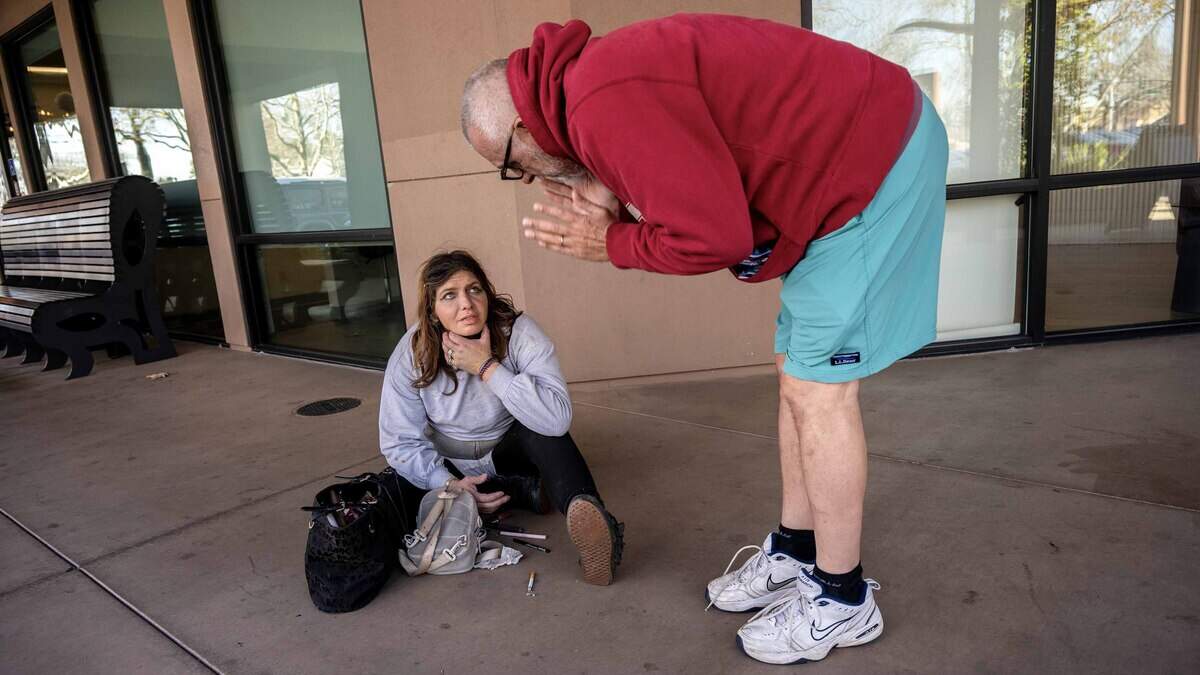
This column is the second of five detailing a promising college student’s descent into homelessness, and how government services have only exacerbated her downfall. It also is part of “The Poverty Line,” a series examining how safety-net systems are faring amid California’s rising affordability and mental-health crises.
Read more It’s the first day of fall in California. See how quickly we’ll lose daylight
In what is arguably his signature policy effort, Gov. Gavin Newsom set out to transform the state’s mental health system with a new judicial process known as Newsom’s goal was to provide much-needed treatment that has evaded thousands of Californians.
CARE stands for Community Assistance, Recovery and Empowerment. When CARE Court started in Sacramento County in December 2024, Christopher Carlisle was among the first to apply on behalf of his daughter, Califia, now 32. Addicted to one drug or another and diagnosed with schizophrenia after she dropped out of Sacramento State in 2014, Califia has been homeless and living on the streets somewhere near campus for 10 years.
Christopher Carlisle and a local behavioral health center failed twice over the years to compel care for Califia through court-ordered conservatorship. For this father, CARE Court was his final hope that some institution would finally help his daughter.
“We were thrilled when we heard about CARE Court,” he said.
But the optimism was short-lived.
Califia Carlisle did not get her day in CARE Court for one simple reason: She refused to be examined by a county mental health specialist. And that was that.
Why? Because the California Legislature made this court powerless. It eliminated any enforcement mechanisms that were originally envisioned by Newsom and its legislative sponsors. There was nothing that Christopher or the presiding judge, Lawrence Brown, could do.
California isn’t winning the war against homelessness because the statehouse in Sacramento has restricted the response. We have placed the rights of the addict, or the person with schizophrenia who is unaware of the illness, above those of family members and the state to break the cycle of self-destruction.
As a result, addiction and mental illness go untreated in California. It is why we hear and see the suffering on our streets.
“We left people to fend for themselves,” said Darrell Steinberg, the former Sacramento mayor and state legislator who has worked on mental health issues throughout his career. “And we’re living with the results.”
CARE Court is an adjunct to local superior court systems. Family members, police and providers are among those who can petition the court on behalf of someone in potential need.
The enabling legislation passed in 2022 required Califia to be evaluated within 60 days of her father’s petition. And for Christopher Carlisle, that’s where the problems began.
Carlisle felt that the CARE Act placed the burden on him to arrange a professional evaluation of Califia, a tall task for a family member. He asked the court for help. And on Feb. 25, 2025, according to records provided by the father, Judge Brown ordered Sacramento County Behavioral Health Services to search for Califia and evaluate her.
Christopher Carlisle said that behavioral health workers did find Califia, “but they weren’t empowered to do anything, to hold her, to find out if this is drugs or schizophrenia.” All Califia had to do to avoid CARE Court was refuse to cooperate, which she did. Her case was soon closed.
CARE Court is a confidential process, but participants are free to discuss what happens.
For county behavioral health workers, evaluating someone petitioned to participate in CARE Court, particularly someone who is homeless, is no easy task.
“Here’s somebody coming in trying to ask you a bunch of information,” said Ryan Quist, director of behavioral health for the county. CARE Court participants are “a vulnerable population.”
Read more Grand jury report into death of Nolan Wells released. Here are the details
If a person is battling drug addiction, the chances of helping that person overcome addiction are minimal. By Quist’s estimate, “95% of them aren’t interested in engaging.”
Visiting Califia one winter afternoon near the Home Depot off Folsom Boulevard, she asked if it was OK to take a hit of methamphetamine before a brief interview. Despite many attempts, I have not had a meaningful conversation of any length with her — only a few sentences. Asking her about her goals for this year, for example, she responded: “Really get down to it. I want to get it right.”
Her boyfriend, 39-year-old Justin Hartung of Ohio, says Califia “is not a severe drug addict, nothing like that. A little bit of weed here and there. She doesn’t drink, (but) smokes cigarettes. But other than that, she’s pretty drug-free.”
By all outward appearances, Hartung is being protective of someone he appears to love. Christopher Carlisle says his daughter has repeatedly suggested they smoke methamphetamine together.
Original versions of the CARE Court legislation gave judges like Brown the ability to “order” treatment. This was meaningful, despite falling short of involuntarily detaining a CARE Court participant for treatment.
But as Senate Bill 1338 (by Susan Eggman of Stockton and Tom Umberg of Santa Ana) made its way through the Legislature, Democrats stripped CARE Court of its ability to order anything. It all happened under the watch of then-Assembly Speaker Anthony Rendon of Paramount and Senate Pro Tempore Toni Atkins of San Diego.
In the Capitol at the time, said Eggman in a recent interview, “being a progressive meant that forced care was never OK,” she said, citing the opposition of groups like the American Civil Liberties Union. To be a proper progressive in the Legislature, “you stood with the ACLU on all things.”
This year, state Sen. Catherine Blakespear, D-Encinitas, pushed CARE Court reform legislation (SB 1016) that would have allowed law enforcement under certain circumstances to detain anyone resisting an evaluation long enough to conduct one. The Assembly Health Committee, led by Mia Bonta, D-Fremont, on July 2 unanimously approved amendments that deleted the enforcement mechanisms from Blakespear’s bill.
“It changed because the committee required it,” Blakespear said in a subsequent interview. “There is a dogma that persists in Sacramento … that says people should not be forced to do anything they don’t want to do.”
Christopher Carlisle sat in committee chambers hoping to support the bill. Now he opposes it. He is close to giving up on the Legislature as a solution. Now his focus is trying to keep his daughter alive.
“She’s losing more teeth,” he said, an apparent side effect of stimulant use, including methamphetamine. “She’s almost down to just the front two on top.” This winter, he managed to get her to a dentist for an evaluation. It quickly ended, he said, when the dental assistant mentioned that she would have to stop smoking for dental implants to succeed.
Soon after, I met father and daughter outside the dentist’s office near Fair Oaks Boulevard and Howe Avenue. Califia was sitting on the sidewalk next to the building with a sad face, knowing that she had disappointed a father that she clearly loves. But she wasn’t about to give up her cigarettes, or any other vice for that matter.
Christopher drove Califia back to her life on the streets near the Home Depot at Howe Avenue and Folsom Boulevard. And then he headed home.
There, he and his new wife, Anne, also an attorney (a graduate of Stanford Law School), were busier than ever. Their home had grown by one precious little soul, someone who was born in the middle of a November night in 2024 behind a Sacramento liquor store.
Read more Your guide to California’s 7th Congressional District race
Califia Carlisle, much to their shock, had been pregnant.