 By admin
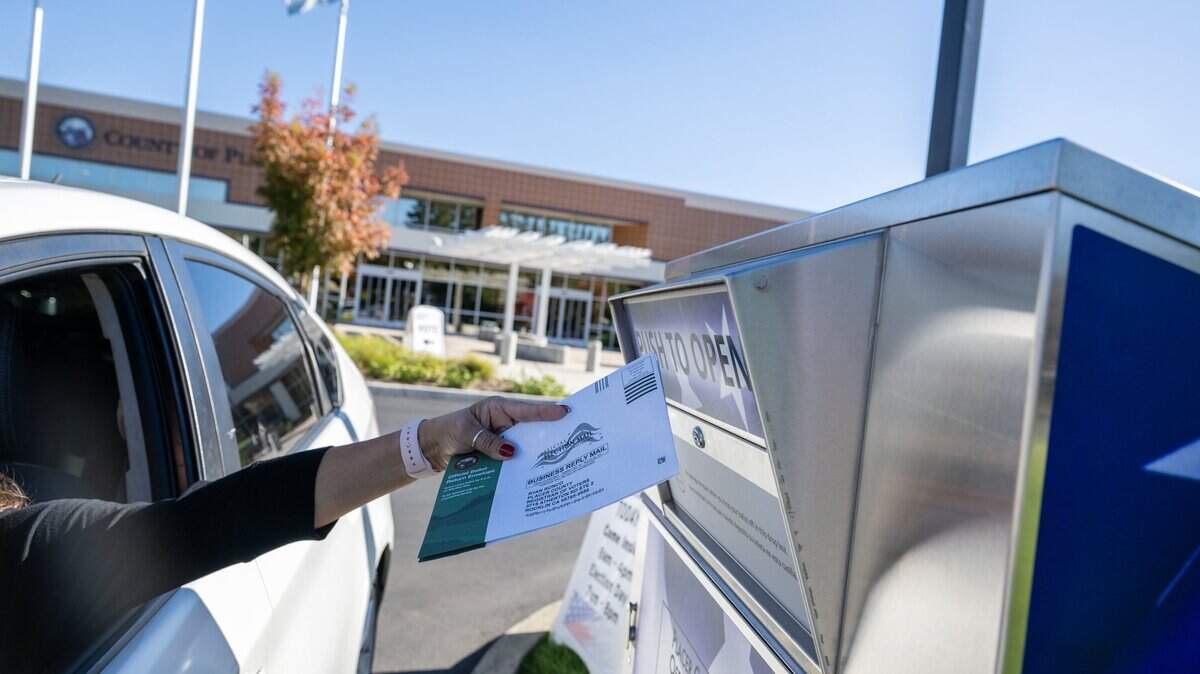
Federal prosecutors working under President Donald Trump filed a lawsuit last week arguing California’s voter rolls include some 20,000 likely noncitizens, accusations state election officials vigorously deny.
Read more California’s ‘black box warning’ bill faces challenges from social media group
In legal filings Tuesday, Los Angeles County Assistant Registrar Monica Flores made what Trump’s allies viewed as a telling admission: her office “has no information beyond the voter’s own attestation with which to determine citizenship, and has no lawful means of obtaining such information.”
In a post on X, First Assistant U.S. Attorney Bill Essayli called the statement a “massive concession.” A wave of conservative commentators amplified Flores’ declaration as proof of California’s lax approach to preventing noncitizen voters.
Gov. Gavin Newsom’s press office responded that the state adheres to the National Voter Registration Act of 1993, and urged Essayli, a former GOP assemblymember, to “brush up on your election law.”
The back-and-forth raises important questions: What does California do to prevent noncitizen voters and how does it differ from other states?
» Election news in your inbox: Sign up for our election newsletter here
How does California prevent noncitizen voters?
There is no federal law requiring verification of voters’ citizenship.
And it’s important to note that noncitizen voting is extremely rare. Recent audits of voter rolls in states like Nevada, Iowa and Michigan failed to find any evidence of widespread noncitizen voting. Even if the U.S. Department of Justice is successful in convicting 28 alleged noncitizens for voting-related crimes, the prosecutions would amount to about 0.0001% of registered California voters.
California’s system appears to rely mostly on trust, with the threat of prosecution. Noncitizens who knowingly violate the prohibition on casting ballots can face fines or up to a year in prison under federal law or a state sentence of up to three years in county jail.
People registering to vote for the first time in California must check a box, under penalty of perjury, attesting that they are U.S. citizens who are eligible to vote.
Secretary of State Shirley Weber’s office takes information presented by voters when they register, like their Social Security or driver’s license number, and matches it to state records to verify a voter’s identity. There’s no central database of U.S. citizens living in California the office could use to confirm citizenship.
What’s less clear is whether Weber’s office uses DMV or Social Security numbers to check for citizenship. In a series of emails, Weber’s office did not directly respond to questions about its process.
An unnamed spokesperson did say that people applying for AB 60 driver’s licenses, intended for people without legal status, aren’t given the option to register to vote at the DMV.
Registrars emphasize they don’t have their own tools to check voters’ citizenship status.
Carla Hass, a spokesperson for the El Dorado County Elections office, said in an email that the county sends registrations it receives to the Secretary of State’s Office.
“The Secretary of State’s Office then matches the date of birth, and last four digits of the voter’s Social Security (if provided by the voter) or a California ID to ensure it matches the voter’s name provided,” Hass said in an email. “We are unaware of anything at the state level which verifies a voter’s citizenship.”
Weber, top Democrats and many nonpartisan election experts argue the state’s system is working as-is.
“It’s already illegal to vote if you’re not a citizen,” said Rep. Scott Peters, D-La Jolla, on a call with reporters last week. “We don’t have to pass a law to do that. That’s already illegal, and the reason you don’t hear about it much is because it just doesn’t happen very often.”
Read more Gavin Newsom grants clemency for 57, including 4 in Sacramento County gun crimes
How do other states handle citizenship checks?
California is not unique in taking voters’ at their word — under threat of perjury — about their citizenship. According to the National Conference of State Legislatures, “in most cases, citizenship is addressed by asking for a voter’s attestation.”
That said, some states do additional checks of existing registered voters. A handful of states, like Arizona, North Carolina, and Colorado, use jury lists to identify people who were excused from jury duty because they aren’t citizens, according to the nonpartisan nonprofit Voting Rights Lab. Other states regularly collect lists of people who showed noncitizen forms of documentation at the DMV and compare those names to ones on the voter roll to flag potential noncitizen voters.
Regardless of the source of the data, election experts from the Voting Rights Lab and other groups caution that states risk disenfranchising potentially eligible voters if they rely too much on a single data source.
There’s been a growing national push to pass state and national laws, like Trump’s SAVE America Act, that would require people to provide documents proving their citizenship when they register to vote. Despite pressure from Trump, the bill has yet to make it out of Congress amid concerns it would suppress voters. The push came as Trump falsely claimed that Democrats are illegally registering large numbers of undocumented immigrants.
The Trump administration has also attempted to force states to use a database called the Systematic Alien Verification for Entitlements to remove ineligible voters.
California and other states resisted those efforts, noting concerns about the accuracy of the data on SAVE. In Texas, for example, election officials told the Texas Tribune and ProPublica the system routinely flagged citizens as ineligible voters.
U.S. District Judge Sparkle Sooknanan blocked the administration from forcing states to use SAVE earlier this month, calling it an “inaccurate database” and saying the DOJ “cannot run roughshod over longstanding laws.”
Other, mostly Republican states have used SAVE to conduct voter roll maintenance, although some, like Arizona, have run into legal challenges after incorrectly flagging eligible voters.
Six states and Guam have laws requiring voters to produce documentary proof of citizenship in order to register to vote, according to a tracker from the NCSL. Six other states require voters to produce proof of citizenship only if a voter’s citizenship can’t be verified using government data.
How would Proposition 39 change things?
Prop. 39 would require California voters to produce government-issued ID before casting a ballot. It would also require local election officials to “use best efforts to verify citizenship attestations using government data” and publish an annual report showing what percentage of a county’s voter rolls have been citizenship-verified.
The proposition doesn’t say what data officials should use to verify citizenship. The measure’s sponsor, Assemblymember Carl DeMaio, R-San Diego, said they purposefully left the language open-ended to allow election officials to draw from future tools. As it stands, he said election officials would likely assess citizenship using data from the federal government, jury duty, and state and federal benefits data.
In an interview, DeMaio argued Prop. 39 would force election officials and Democratic policymakers to address what he viewed as the state’s unusually lax enforcement of citizenship rules.
“We’re forcing them to do their job,” he said.
The measure’s critics, however, argue the system would end up sidelining eligible voters to address a nonexistent problem stoked by Trump’s election misinformation. Brittany Stonesifer is a voting rights attorney at Common Cause California, which opposes the measure. She noted California’s system of voter’s identity using attestation, DMV data, and Social Security numbers is used by at least 22 other states.
“DeMaio’s claim — like most of what he says about Prop 39 — is false,” Stonesifer said in a statement. “Studies repeatedly show that our elections are secure and that noncitizen voting is exceedingly rare.”
Read more Gavin Newsom, Nancy Pelosi rally in San Francisco against voter ID ballot measure
This story was originally published October 23, 2026 at 12:07 PM.