 By admin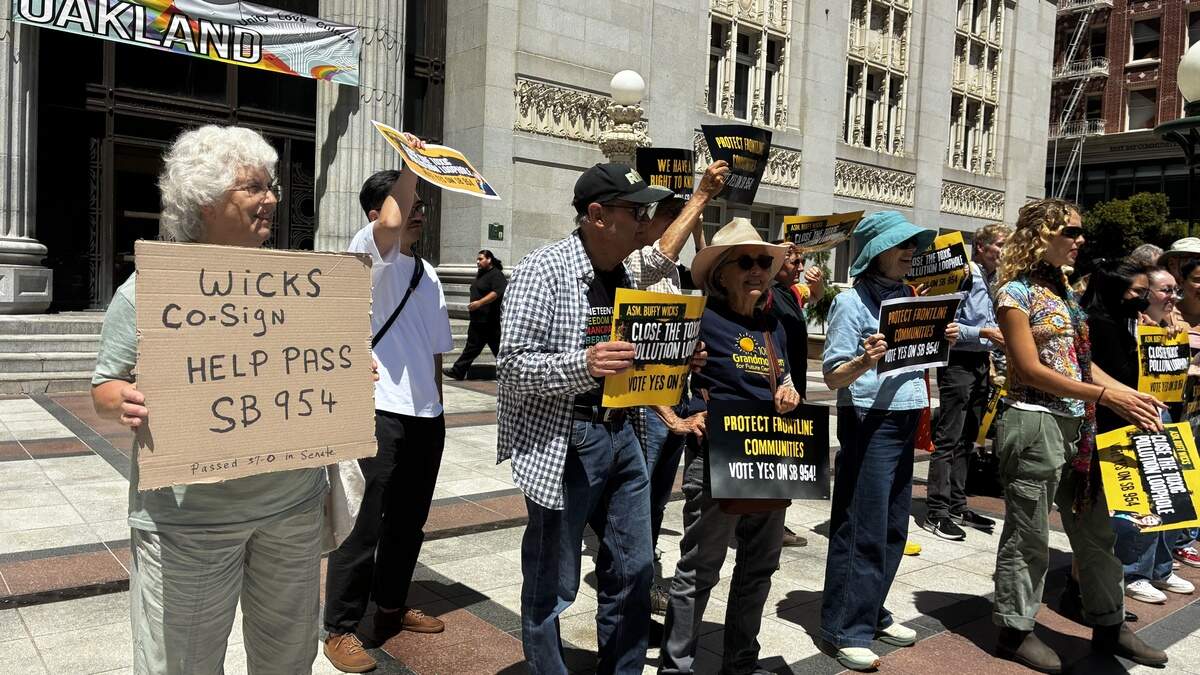
As chair of the Assembly Appropriations Committee, Buffy Wicks has considerable sway over which bills will live or die in her chamber following an Aug. 14 deadline.
Read more He was a Kings’ nemesis. His old Texas mansion has closet as big as midsize home
On that day, the Appropriations committees in both Assembly and Senate will announce whether large stacks of bills in front of their committees get to advance. As chair, Wicks has outsized influence over whether a bill gets held back, and the Appropriations Committee can do so without offering a public explanation. That gives the Oakland Democrat considerable power to kill even politically popular measures, and that means stakeholders pay close attention for any clue toward her disposition on bills.
So on Thursday, a small group of a little more than two dozen environmental justice advocates convened in Oakland to march to Wicks’ district office and present her staff with a letter asking the lawmaker to back Senate Bill 954. The bill removes an exemption to the California Environmental Quality Act for advanced manufacturing facilities, a sweeping category of projects that includes chemical plants and other industrial enterprises with a legacy of pollution.
Wicks’ East Bay district has a particular legacy of industrial manufacturing facilities and the environmental and public health problems they can cause being sited in communities inhabited by minority and low-income Californians, Veronica Eady, director of the West Oakland Environmental Indicators Project, said at the rally.
“We require and rely on legal frameworks like the California Environmental Quality Act and our leaders, our elected leaders, to be looking out for us,” Eady said.
Wicks abstained from a committee vote
The exemption was put in place last year as part of a last-minute legislative deal with Gov. Gavin Newsom to create broader CEQA exemptions for housing development, and a large group of lawmakers complained at the time that the advanced manufacturing facilities exemption had been shoved upon them with no time for vetting. Those lawmakers pressed legislative leaders to revisit that exemption this year, and SB-954 is the resulting compromise, its proponents say.
But Wicks, a longtime advocate for more housing construction, abstained from voting on the measure when it passed through a different committee she sits on, the Assembly Committee on Natural Resources. That’s raised fears among advocates that she might use her role as Appropriations chair to quash the bill. Wicks’ staff did not respond to requests for comment from The Sacramento Bee on Thursday. Advocates who delivered the letter and met with a member of her staff in Oakland said they did not get a clear indication of the lawmaker’s intentions with the bill.
Still, the bill carries considerable momentum, as its sponsors consider it the result of an agreement with legislative leaders last year that lawmakers would have a chance to reconsider this particular CEQA exemption.
“SB 954 is clean-up legislation that more than 30 state lawmakers have demanded to ensure that CEQA exemptions don’t go too far, and when new facilities are built, the environment, workers and the communities next door are protected as they should be,” bill sponsor Sen. Catherine S. Blakespear, D-Encinitas, who chairs the Senate Environmental Quality Committee, said in a statement. “As the bill moves through the Assembly, I welcome input on how to fine tune legislation that we all agree is needed.”
Read more Courtney Barnett resets her sound as Sacramento concert calendar heats up in August
Some proponents of closing the exemption say they believe Wicks may have amendments in mind but does not intend to hold back a bill that passed the Senate 23-9, has a wide range of labor, conservation and environmental organizations behind it and drew broad support from other Democrats in two Assembly committees. Wicks is also generally a staunch vote for environmental protections, with her voting record notching a lifetime score of 95% on the California Environmental Voters ranking system.
“She is known as being a housing champion, and I think the important distinction here is that this bill is not about housing at all,” Shannon Olivieri Hovis, that group’s chief strategy officer, said. “Any argument that somehow trying to fix this toxic pollution loophole is somehow undermining our need to build housing is just a complete fallacy.”
The bill is opposed by the California Chamber of Commerce, a number of regional economic development councils and groups representing construction and real estate firms, chemical manufacturers and other commercial interests. Some pro-housing development groups also oppose the bill. Its opponents say the measure brings unweildy environmental and labor standards amid a general decline in the state’s manufacturing industries.
Part of must-pass budget deal
Last year, with just days before the Legislature had to meet its budget deadline, Newsom conditioned his signing of the must-pass fiscal bill on passage of legislation to spur housing development by carving exemptions into CEQA, the state’s landmark environmental law which delays building projects and is often blamed by critics for the state’s affordable housing crisis.
Most of the exemptions were for certain housing categories, child daycare centers and infrastructure projects. But the advanced manufacturing facility exemption was also included, which environmentalists and advocates for community input in construction projects say opened the door to a wide range of potential industrial polluters being able to escape public scrutiny and stringent environmental review.
“In practice, projects as wide-ranging as lithium mining, hydrogen production, water bottle manufacturing, and carpet recycling,” could fall under the definition Newsom signed into law, 35 senators and assembly members wrote in a letter to Assembly Speaker Robert Rivas, D-Hollister, and then Senate President Pro Tempore Mike McGuire, D-Healdsburg.
“At the time of the bill’s passage, commitments were made on the Senate floor to clean up these outstanding issues,” the lawmakers wrote in the letter.
On Thursday, SB-954 proponents also released polling showing that 64% of voters opposed the advanced manufacturing facilities exemption. The poll was conducted by the firm FM3 Research between March 5-11, 2026, and was commissioned by the Planning and Conservation League, a bill supporter.
Read more Inclusive fitness for kids with developmental disabilities is Carmichael gym’s goal
This story was originally published July 30, 2026 at 6:13 PM.