 By admin
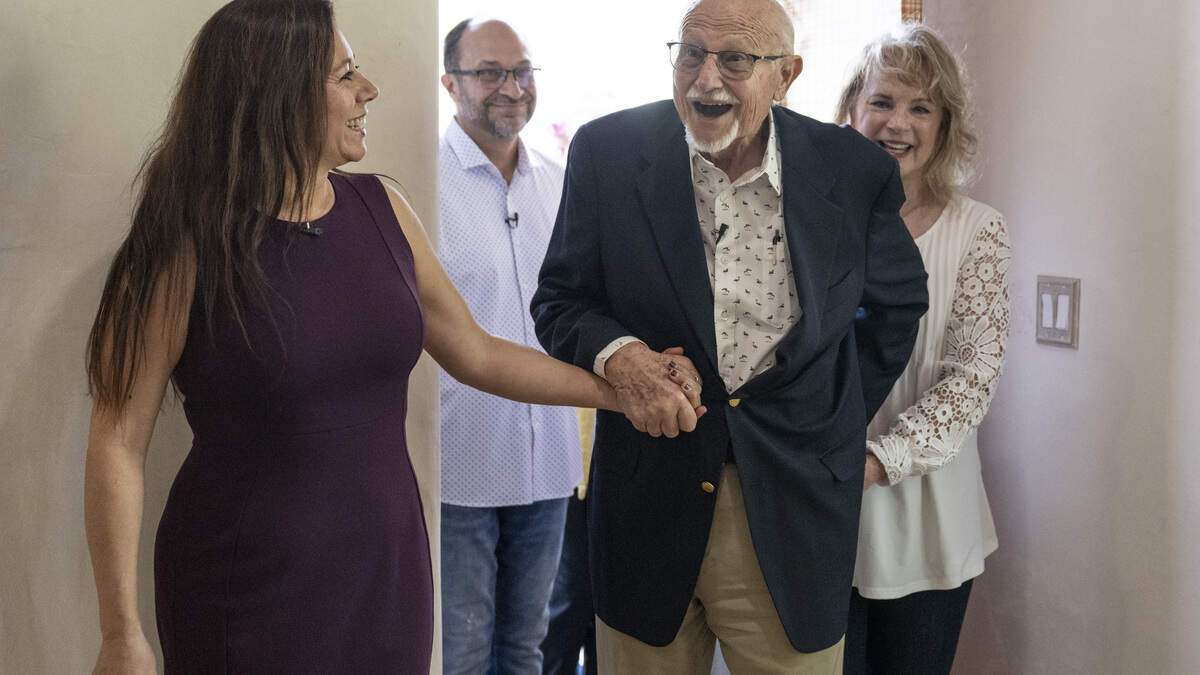
As he stepped over the threshold of his new home for the first time, John Treherne’s jaw dropped.
Read more Rocklin school, advocacy group sue over apartment project approved next to campus
Surrounded by floor to ceiling windows, new furniture and dozens of friends and family, Treherne stared around in awe, amazed at his new living situation.
“I love it,” he said. “This is so crazy.”
The 1,200 square foot accessory dwelling unit — an independent residential structure on the same lot as a larger single-family home — features 2 bedrooms and 2 bathrooms, solar panels, 10-foot ceilings, a 10-hour fire resistance rating and a “flame wall” that mimics a fireplace. It’s also the first of its kind in Sacramento for one reason: It was entirely 3D printed.
The company behind the build, K4k Construction, hosted a housewarming last week and unveiled the 3D-printed ADU to friends, family and the home’s new residents, Treherne and his wife, Judy. The Trehernes, both 81, were kept from seeing inside the ADU during its construction, even though the company owned by their daughter Estelle Gonzalez her husband Dave Gonzalez built the project in their own backyard.
“Today I’m seeing things that I never knew they were really up to,” John Treherne said. “Everything they’ve done is so perfect for us.”
3D printing a house
The idea to 3D print a home for the Trehernes started off as a joke, according to Estelle Gonzales, the Trehernes’ daughter and K4k’s 3D printing engineer.
“We are blessed with a large enough backyard in our Natomas neighborhood,” Gonzalez said, “So we said, ‘Hey, why don’t we 3D print your house in our backyard?’ and my dad said, ‘You know, I think I’m okay with that.’ So they’ve been on this journey with us and just very patient.”
And patient indeed. While 3D printing the structure — a process that involves a large robotic arm depositing or “printing” layers upon layers of concrete until walls are formed — took only 12 days, according to Gonzales, the total process took about 3 years, with much of the time being taken up by subcontractors completing the plumbing, electricity and HVAC as well as the city’s permitting process.
According to Gonzalez, the city of Sacramento basically had to write new housing codes for the project. She said the city was “very open to it and very curious about it, but because it was so new, and we are the first permitted 3D-printed home in Sacramento, it took 18 months for us to get completely permitted.”
Another challenge for the project was the neighborhood homeowners association. According to the project’s architect, Kaneshka Salehi, the ADU’s original design had to be scrapped in favor of the current one because the ADU’s exterior needed to complement the property’s original home.
The setbacks didn’t stop the Gonzalezes. According to Estelle Gonzales, 3D-printed homes are sturdy, have lower insurance and energy costs, are mold- and termite-resistant and, most important of all, fire-resistant.
She said it was the appeal of building something that could help address the devastation caused by California wildfires that got her and her husband into the 3D printing business in the first place.
Estelle Gonzalez had just finished getting an engineering degree following a switch from a 20-year career as a dental hygienist when her husband, Dave Gonzalez, founded K4k Construction. Inspired by a growing 3D-printing industry in Florida and Texas, Dave Gonzalez decided he could use the technology to help California’s housing crisis.
Since then K4k Construction has worked on 3D printing construction projects in Los Angeles, including helping print a replacement home for an Altadena house destroyed by fire.
According to Gonzalez, the company’s next project is a 3-bedroom, 3-bathroom 3D-printed Airbnb near Lake Almanor in Plumas County, which is currently in the permitting process.
Read more Highest king tides in 18 years projected in Bay Area for Thanksgiving, Coast Guard warns
“We’d love to do more of these types of homes in Sacramento,” she said, adding that 3D printing “is just going to start blowing up. It’s going to start catching on a lot faster, and we’re going to get a lot more experts that are feeling more comfortable using that kind of technology to just create and design and dream and actually do something a little different.”
The home’s occupants
For Judy and John Treherne, their new home could not have come at a better time. John Treherne said they moved from Rancho Cordova and have lived in the Gonzalez home for three years while awaiting completion. The new home will give the Trehernes a comfortable place to retire.
“I’ve served in ministry since I was 17 years old, and I’m 81 now. I just retired last year,” John Treherne said.
The Trehernes were missionaries in Africa for 20 years, where their two youngest children were born and Estelle grew up. When they moved back to California, John served as a pastor at Capitol City Church in Rancho Cordova for 15 years and then at Heights Church in Citrus Heights for 17 years before retiring.
“This is hugely significant for my parents,” Gonzalez said.
As the construction continued on the home, Judy Treherne had a series of strokes.
Estelle Gonzalez remembers her mother was standing on their back porch watching the 3D-printing work just before it happened. Gonzalez looked over at Treherne from where she was standing on the robot as it was printing, and they waved at each other.
“We were all kind of dancing because we were on the last wall,” Gonzalez said. “And the very next morning she had a stroke that took out her eyesight, so that was one of the last sights that she probably has of me.”
Since then, John Treherne has become her main caregiver, with assistance from his daughter.
As the Trehernes toured their new home for the first time on Saturday, John led Judy around the home she could not see pointing out the different features to her including a sign that said “Treherne House,” a framed photo of John Treherne as a young man and a motif of three herons carved into the wall by the front door — the meaning of the name “Treherne.”
As they walked around, they also noticed pieces of paper stuck to each piece of furniture labeled with the names of friends and family, many of whom had gathered to celebrate the new house. Each paper signified that someone they knew had donated that piece of furniture to the new house.
“That’s been one of the most tender spots and crying points that I’ve had today,” Treherne said looking at the papers. “Simply because I see their names and I know they bought that piece for us.”
After finishing the tour, the Trehernes gathered in the living room with 40 to 50 friends who had come to support them.
“We’re absolutely blown away,” he told the gathered group. “This is the house that trust built, first in God and second in my daughter and son-in-law and third in all the church folk who have been involved. I’m brought to tears when I look at all of this.”
As if Treherne were finishing a sermon, at the conclusion of his comments a friend started playing Treherne’s favorite song, “Oh Happy Day” by The Edwin Hawkins Singers. When the chorus hit, the whole room sang, “oh happy day,” in unison.
Read more California State University faculty authorize union to call strike. When could it start?
“We’re home,” he said.