 By admin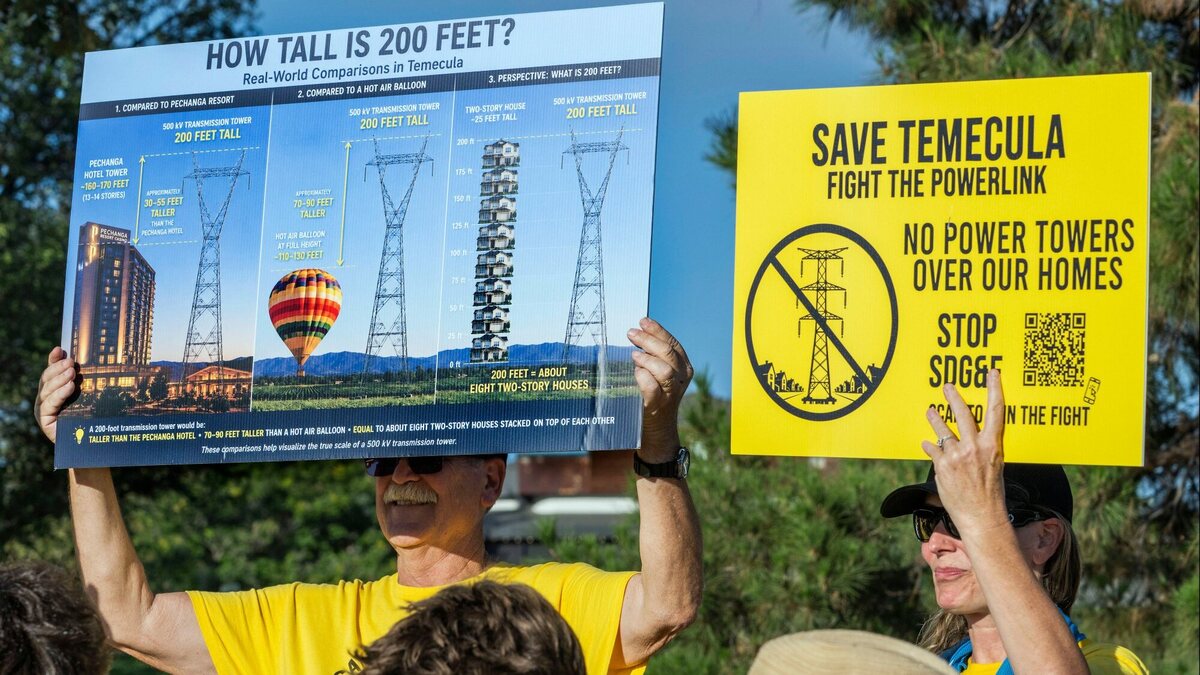
An out-of-town corporation’s massive project inspires a grassroots Temecula backlash.
Read more Pedestrian injured in early morning Oxnard crash; nearby roads closed
It happened 20 years ago when a proposed gravel quarry met fierce resistance from the southwest Riverside County city.
Today, veterans of the Liberty Quarry fight see parallels in the current pushback against the Golden Pacific Powerlink, a 140- to 150-mile electric transmission line estimated to cost $1.62 billion that might go through Temecula.
“It feels very similar on a lot of fronts,” said Temecula City Manager Aaron Adams, who was an assistant city manager during the quarry showdown.
Expand
Powerlink foes see it as a dire threat to Temecula, a city of 112,000 with higher-than-average home prices, a reputation for good schools and a scenic neighboring wine country.
“The word I keep saying now is monstrosity of a project,” Temecula Mayor Jessica Alexander said. “I want no part of this and I will do whatever it takes to stand with our residents in our city to push back against this monstrosity.”
The project’s developer, San Diego Gas & Electric, insists the lines’ route is not set in stone and rigorous studies are on tap to determine how the project would affect its surroundings.
“We understand the questions and concerns a large project like this would raise,” SDG&E Project Manager Erica Martin said.
“They are reasonable questions, and they’re really important questions for ultimately deciding where … this transmission line should go. We welcome them.”
SDG&E is hosting open houses where the public can learn more about the project. One is scheduled from 4 p.m. to 7 p.m. Wednesday, Aug. 26, at the Embassy Suites in Temecula.
The utility is asking the public to register for the event. Go to goldenpacificpowerlink.com and click “More Information” under “You’re Invited!”
Pending approval, SDG&E hopes to start construction in fall 2029, with state regulators wanting the power lines up and running by mid-2032 or “2034 at the latest,” Martin has said.
The project began as part of requested by the California Independent System Operator, a nonprofit corporation overseeing the state’s long-distance electric grid. The plan forecasts California’s power needs and what new infrastructure is needed to meet demand.
“They identified the need for transmission here,” Martin said. “If it wasn’t SDG&E building it, it would be another developer because this is a part of the statewide transmission grid.”
The first route proposed by SDG&E, a for-profit utility, starts at an existing substation in eastern San Diego County. Towers approaching 200 feet tall would carry 500-kilovolt lines through Anza-Borrego Desert State Park before entering Temecula from the east.
The route would follow Temecula Creek and Temecula Parkway on the city’s southern edge before heading west and ending at a to-be-built substation just north of Camp Pendleton and the decommissioned San Onofre nuclear power plant.
This week, SDG&E unveiled three alternate routes, including one that skips Temecula to the south. Martin said the original route “best meets the project’s objectives based on the analyses completed to date. However, no final route has been selected.”
Critics fear the power lines could spark wildfires.
Los Angeles County fire officials blame an idle transmission tower for igniting the 2025 Eaton Fire that killed 19, destroyed 9,400 homes and businesses and devastated Altadena.
Towers felled by earthquakes or wildfires also could block emergency evacuation routes, opponents warn.
“If you build towers by (Temecula Parkway) and those towers go down, you basically trap about 15,000 residents with no way of getting out, said Mark Winkler, president of the anti-project group Save Temecula.
The towers would go through “basically one of the largest wind tunnels in the state (and) 3 miles from the most active fault line we have in Southern California,” Winkler said, adding their creek bed location would make them vulnerable to flooding.
Martin downplayed the wildfire risk.
“The voltage is so high, the towers are so tall, and the spacing between the facilities is very wide,” she said. “It’s about 1,400 feet between towers, so the risk of an ignition coming from a 500-kilovolt line is slim to none.”
SDG&E has “a strong partnership with Cal Fire in not only protecting and reducing any risk from our facilities but … how to fight fires that are anywhere near electric infrastructure,” Martin added.
Read more Week in photos: Free park passes + electric cars + Little Italy + Dolores Huerta
The Temecula City Council opposes the project.
Besides public safety, Alexander, Temecula’s mayor, is also concerned about the towers impeding medical helicopter flight paths to the city’s hospital as well as the potential for the project to lower property values amid concerns over health risks posed by transmission lines.
“The question I think that we really need to ask is how is this even benefiting the residents here because I’m not seeing any benefit,” Alexander said.
The project’s original route also crosses near or through Pechanga Band of Indians territory and the Santa Margarita Ecological Reserve, raising concerns it could disrupt wildlife habitat and tribal land.
“SDG&E’s preferred route cuts through Pechanga’s ancestral cultural resources and threatens the broader non-Tribal community,” Tribal Chairman Mark Macarro said in an emailed statement. “The Pechanga Band strongly opposes this project.”
Martin stressed the project is in the early stages. Independent, technical studies required by the regulatory process will address critics’ concerns, she said.
“We understand why residents would ask about the safety of the line because of their families, their neighborhoods (and) their communities,” Martin said. “We are absolutely committed to the safe construction and operation of this line no matter where it’s located.”
As for the quarry fight, it started in 2005, when Granite Construction of Central California proposed using explosives to extract up to 270 million tons of aggregate — tiny rocks used in construction and other fields — from a hillside just south of Temecula and west of the 15 Freeway.
Granite and its supporters, including a coalition of construction trade unions and chambers of commerce, said the quarry would have supported high-paying jobs, boosted a sagging economy and provided a vitally needed local aggregate source.
Residents, city officials and the Pechanga tribe fought back. They argued the quarry would pollute the air with diesel truck exhaust and hazardous silica dust, wreck the Santa Margarita reserve and desecrate a sacred tribal site.
After months of tense public hearings attended by hundreds if not thousands — supporters wearing green; opponents clad in orange — the quarry battle ended in 2012 when the tribe bought the quarry site from Granite. Temecula marks the event annually with Pechanga Pu’éska Mountain Day.
As with the quarry, “the community is gathering together to protect the city,” Robbie Adkins, part of the anti-quarry movement, said via email.
“The big difference is that when we started the battle against the quarry, people didn’t believe it was a threat. It took years and years of educating people to understand how damaging the quarry would have been.”
“The power lines are a different story,” Adkins said. “Because of recent fire disasters caused by power companies’ failures, the fight seems to be gathering steam much more quickly.”
Susan Miyamoto, also an active member of the quarry resistance, agrees.
“With the power lines running directly through the city, residents can immediately visualize how the project would affect them and their neighborhoods, and that along with social media I think made it easier for opponents to get support right away,” she said via email.
Save Our Southwest Hills, an anti-quarry grassroots group, “laid a lot of the groundwork for that,” Miyamoto added. “The organizing playbook for mobilizing a community against a profit-driven corporate giant was already there from the quarry battle.”
Unlike the quarry fight, which played out in hearings held by Riverside County’s planning commission and Board of Supervisors, the powerlink will be argued in front of the California Public Utilities Commission, a state agency, noted Adams, Temecula’s city manager.
“It’s a different animal. It’s a different venue where there will be interveners that are arguing before the (commission) — the City of Temecula being one of those, but probably not the only one,” he said.
Powerlink foes should be prepared for a long fight, Miyamoto said.
“Stay persistent, don’t let setbacks deter you,” she said. “That’s really the core lesson from the quarry battle.”
Adkins said powerlink opponents “have to keep talking, keep showing up, keep up the social media. We didn’t have that … we used the newspapers and phone trees.”
In recent years, culture-war issues — many involving Temecula’s conservative-majority school board — have defined city politics. Adams sees the powerlink fight bringing residents together.
“All you need is a tragedy like this to unite people against the common enemy, and there’s nobody that wants to see this alignment where it’s proposed because it is so entirely disruptive,” Adams said.
“It feels very much like Liberty Quarry because we’re on the same page, arguing for the same thing.”
Read more A Gold Rush standoff in Sacramento 176 years ago led to a riot. Then shots rang out
Rob Nikolewski of The San Diego Union-Tribune contributed to this report.
Copyright 2026 Tribune Content Agency. All Rights Reserved.
This story was originally published August 16, 2026 at 5:46 AM.