 By admin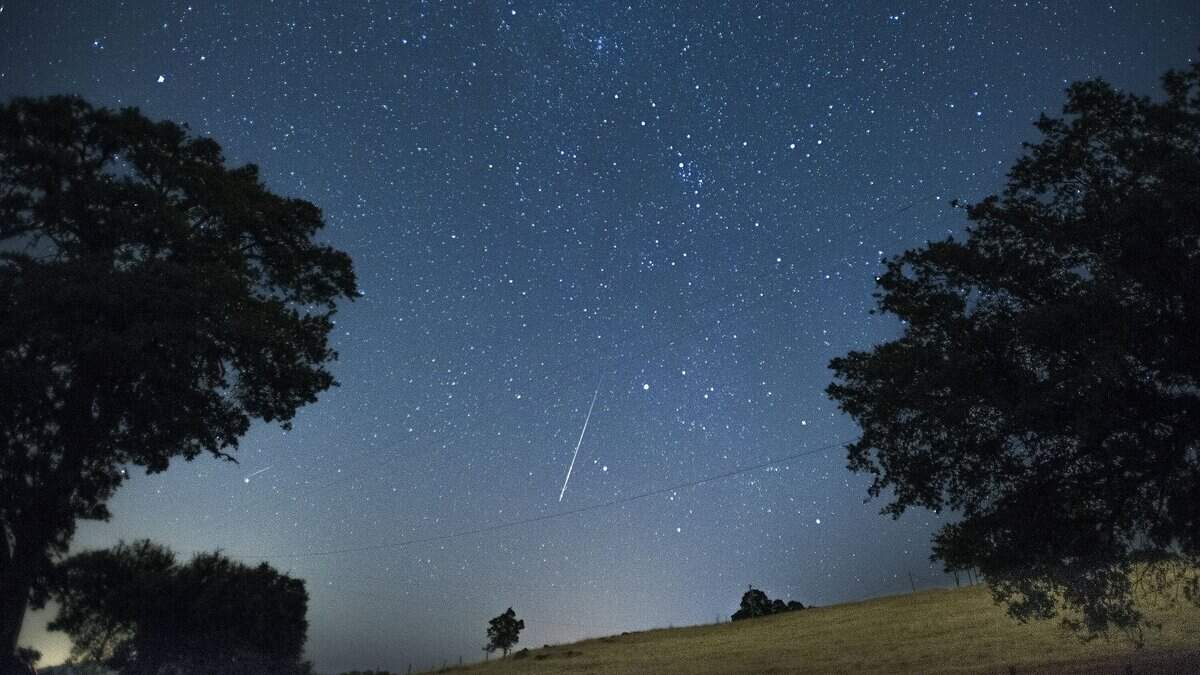
When Rodd Kelsey began to talk to the crowd, it was almost too dark to see him.
That was intentional. About 50 people came to The Nature Conservancy’s Dye Creek Preserve in Tehama County on a Friday night in early September. Most were astronomy nerds or amateur astronomers from across Northern California, and they brought an assortment of beginner to high-power telescopes.
Read more LGBTQ+ journalists mark 35 years of progress and history in California
Bats swooped above the crowd’s shoulders, catching mosquitos. They were illuminated as dull streaks of red, as the group’s flashlights were covered with red tape to reduce the light.
Rodd Kelcey, a program director with The Nature Conservancy, spoke about why the growing darkness overhead is worth protecting. He is a bird biologist by education, and his love of birds has grown his appreciation for the dark.
Skies like this are getting harder to find. A 2023 study in the journal Science, built on more than 50,000 observations from volunteer stargazers, found that the night sky brightened about 10% a year from 2011 to 2022. At that pace, Earth’s night doubles in brightness about every eight years. In California, most of the population needs to venture to remote corners of the state to see the stars in their full glory.
“Most songbirds migrate at night,” Kelsey said. “In many species the young make their first trip south without their parents. They navigate with two tools: They learn the rotation of the stars, and researchers believe a light-sensitive reaction in their eyes lets them detect Earth’s magnetic field, a built-in compass calibrated to the cycle of day and night.”
“When you actually leave lights on, you are actually screwing up both of those systems,” Kelsey said.
California light pollution map
To show just how bright California’s night sky has grown, The Bee modeled where skies are brighter at night across the Golden State. This involved dispersing NASA satellite measurements of outward shining light at night and diffusing the light through the atmosphere. Because light scatters as it travels through the sky, being in the vicinity of larger cities can increase light pollution over great distances.
The Central Valley’s flatness aids in dispersing light. With no mountains to block it, light pollution carries for hundreds of miles. For this reason, the night sky from Sacramento south to Fresno is not fantastic. Stargazers can improve the view by heading into the Sierra, and it will certainly be worth it if they can venture far and high enough. Even then, the Central Valley’s light will dim the stars more than you might realize. Only at highest peaks of the Sierra can you catch a view that resembles the time before city lights.
Metropolitan Southern California is also a poor place to stargaze. The light glow there is nearly inescapable even at elevation. Travel far enough east in the Mojave, and the stars will begin to shine as they once did.
Read more Sacramento’s week-in-review: SMF parking fees, Auburn flock cameras and more
Far Northern California is the true prize. The Klamath mountains, the northern Coast Range, the Shasta highlands, have little light pollution. The only moderately sized city in the area is Redding, and there are plenty of nearby mountains to escape behind and catch the stars. It is one of the reasons these dark sky events at the Dye Creek Preserve, just east of Red Bluff, has been growing more popular.
“The big skies are amazing,” said Andrea Craig, the Dye Creek Preserve manager, who arrived in 2006 for a seasonal botany job, fell in love with the land, and stayed.
Dark skies as a natural resource
After Kelsey speaks, the crowd disperses to already set-up array of telescopes. Some are nimble and light, fitting on a hiking backpack with ease. Others are top-of-the-line machines, pointed at distant galaxies millions of light-years away. One is set up to display on a TV for the crowd, showcasing the light from millions of stars and galaxies too dim to see with the naked eye.
Sydney Chamberlin sees the problem from both ends of the telescope. She trained as an astrophysicist studying gravitational waves and black holes before sidestepping into her current role at The Nature Conservancy, where she directs climate and nature-based solutions projects. Her parents, who met at a planetarium, are in the crowd at Dye Creek.
“We don’t really speak a lot about the night sky as a natural resource, but it is,” she said.
The conservancy doesn’t weigh darkness when deciding what land to protect, Kelsey said. It hasn’t had to. The group targets large, unbroken landscapes where wildlife can roam, and the dark skies often come with them. Dye Creek covers about 35,000 acres, with roughly 100,000 more acres of protected land behind it in national forests. On the horizon, Lassen Peak looms from Lassen Volcanic National Park. Events like this one, he said, are helping make darkness an explicit part of the conservation conversation.
The fixes are not complicated. Turn lights off at night, shield them so they point at the ground, use red bulbs where light is needed. The conservancy has started to implement these practices at its preserves across the state.
Read more California ‘home sales and prices rise.’ Where to find homes for as low as $270K
“This is a very, very solvable problem,” Kelsey said.