 By admin
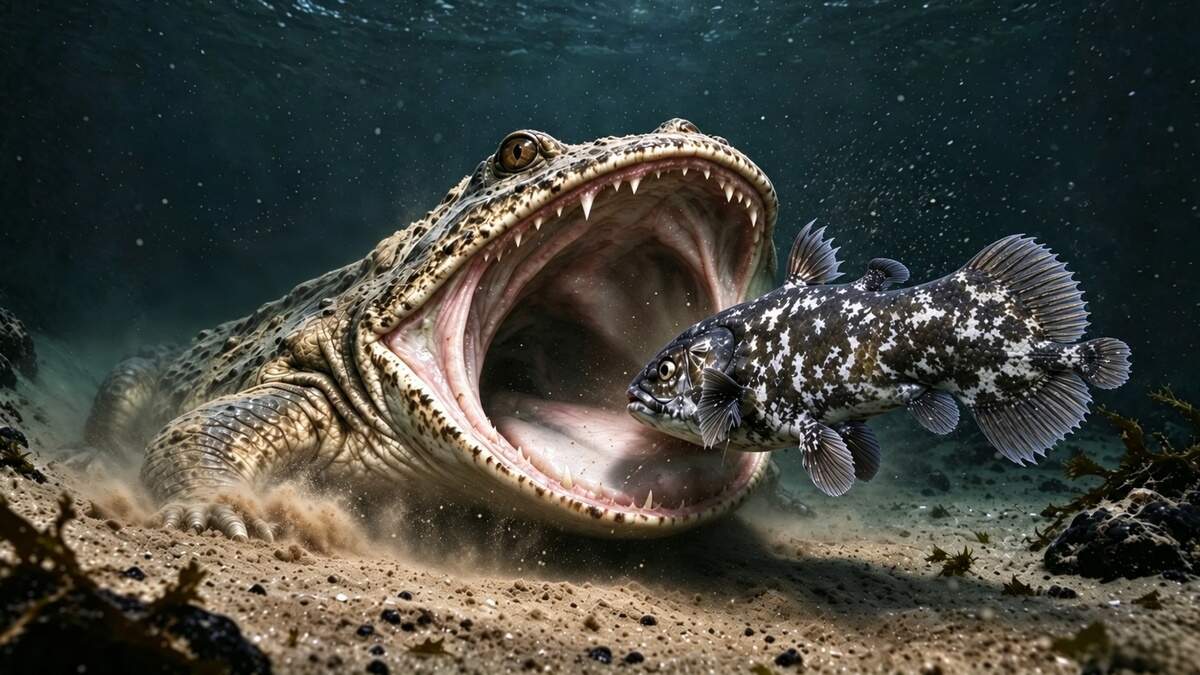
There are more than 8,000 species of modern amphibians. None of them call the ocean home and less than 2% of them are able to tolerate salt — and even then, only to some extent. Now, scientists have discovered fossil evidence of the first fully marine amphibian.
Read more Body of missing Mount Whitney hiker recovered from snow after week-long search
Named Gerrothorax maritimus, the salamander-sized ocean creature’s skeletons were discovered in China’s Guizhou Province in an area that was once covered by ocean and located hundreds of miles away from large land masses. The two nearly complete skeletons that serve as the foundation for the new research date to the Late Triassic period nearly 237 million years ago.
“We’ve been mostly studying marine reptiles and the fish from this place, but now we also have this amphibian and it’s a sort of very unusual member of the lineage,” said Ryosuke Motani, a co-author of the study and a professor in the Department of Earth and Planetary Sciences at UC Davis.
“If you think about today’s amphibians, this animal is unusual because it’s big. It’s probably, body mass-wise, about the same as the giant salamander, but what’s different is that giant salamanders are elongated whereas this animal is really chunky.”
The study by researchers from UC Davis, Peking University in Beijing and the Geological Museum of Guizhou was published in the journal Nature Ecology & Evolution on Monday. The research was supported by the National Natural Science Foundation of China.
The well-preserved skeletons allowed the researchers to reconstruct how the amphibian looked and lived in the ocean. The creature had a flattened body that was covered in bony armor, according to a news release from the university. It was almost three feet long with a disc-shaped body.
Apart from potentially serving as a defense mechanism against predators, the bony armor is what allowed Gerrothorax maritimus to live in marine environments, according to researchers.
Read more Plan ahead for tickets: Concerts and musical acts coming to Sacramento in 2027
Today’s amphibians cannot live in marine environments due to their salt-intolerant skin. Their permeable skin allows them to use it for respiration and water intake. However, that also means they must live in or near freshwater environments because their skin does not have the mechanism to filter out salt.
With Gerrothorax maritimus, on the other hand, the bony armor would have prevented water absorption through its skin, requiring the amphibian to drink salt water with its mouth. This water would be absorbed through its digestive tract and filtered by its gills.
Based on the armor and the shape of the amphibian’s skull, the researchers believe it was a bottom-dwelling suction feeder. According to Motani, the creature would probably wait at the bottom of the ocean and suck in prey when it came close. This feeding style is similar to the wobbegong, a modern, bottom-dwelling carpet shark, he said.
The scientists concluded Gerrothorax maritimus lived in the ocean because the fossils were found in deep sea sediments and were nearly complete skeletons. Geochemical analyses of the fossils provided additional evidence.
“Carcasses at sea, unless they sink to the bottom right away, tend to dry out and lose limbs prior to sinking to the bottom,” Motani said. “But these animals had their fingers preserved, so that means they probably died near where they lived.”
Other four-limbed animals, including mammals, reptiles and birds, all have species capable of surviving without food or water from land. With Gerrothorax maritimus, amphibians have joined the club.
Read more A $5 spin at a Sacramento-area casino turns into a payday of more than $100K