 By admin
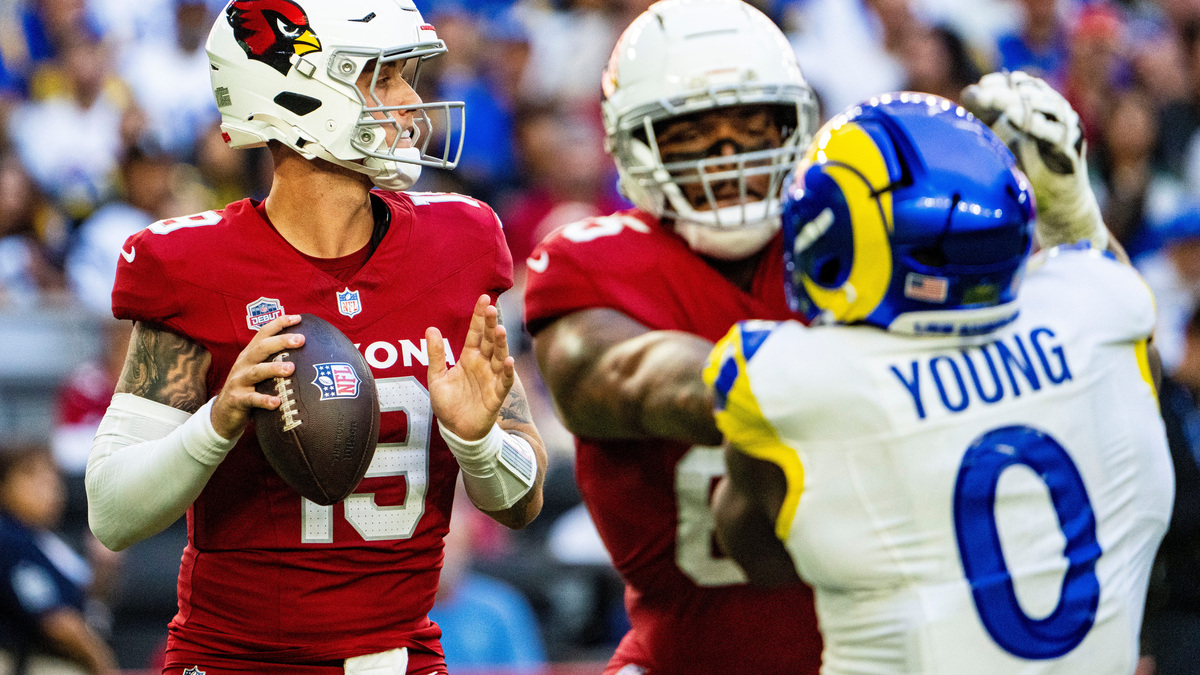
If you opened a box score on Monday morning and attempted to judge Carson Beck’s NFL debut purely on statistics, it might read as wildly disappointing. Those numbers would tell you that he completed 11 of 18 passes for 108 yards and two interceptions, while taking five sacks.
Read more The Group Chat: Arkansas Field Storm Cost $500,000, Is It Worth It?
Through that lens, his performance was similar to debuts from players such as Clayton Tune and Luke Falk, hardly the comparisons any rookie wants to see.
The top-line numbers, though, overlook a crucial bit of context: the woeful performances of those around Beck. It would be hard to overstate just how poorly the rest of the Arizona Cardinals offense played, from wide receivers dropping easy catches to offensive linemen allowing instant pressure.
“When you just look at (Beck’s) element and what he had to do, he did everything we asked him to do,” head coach Mike LaFleur said.
So, what did Beck actually show in his debut? Here’s a look.
Positives
Entering the NFL, Beck’s intelligence was viewed as his standout quality.
A six-year college veteran and three-year college starter, he knows how to command a pro-style offense. That much was evident early, as he repeatedly scanned the field, found open receivers and delivered well-placed balls into intermediate areas.
Beck’s biggest completion of the day came on the Cardinals’ second drive. He quickly recognized that the Rams were in match coverage with one high safety, meaning that there was no help on top of Devin Duvernay’s corner route. With good protection, he was able to wait for Duvernay to get into his break, then deliver an excellent ball over his shoulder for a 31-yard gain.
But Beck’s best play may not have even come on a completion.
Facing third and 7 on the opening drive, Beck saw Myles Garrett jump offside and knew he had a free play. With no risk, he took a deep shot, trying Reggie Virgil on a go route against Emmanuel Forbes in man coverage. The ball was again perfectly placed, but Virgil was unable to make the grab, as Forbes got a late hand in to help force the incompletion.
“I thought he delivered an excellent ball to our receiver,” LaFleur said. “And I know our receiver can make that play.”
There was even more to that play, though, than initially met the eye. The game plan, according to LaFleur, dictated that the Cardinals would adjust their cadence on long third downs to try to draw the Rams offside. But on the first drive, LaFleur said that he “chickened out” with his play calls, fearful of committing a false start.
Beck wasn’t fazed. He used the cadence anyway, drawing the offside that set up the free play. That’s veteran quarterback play, performed by a rookie in his first game.
Beck also showed, from the start, that he understood how to operate the Cardinals’ plan.
Entering the game, the Cardinals were at a clear talent disadvantage, both with their offensive line against the Rams pass rush and with their wide receivers against the Rams secondary. If they kept extra bodies in to pass protect, they would be running a group of backup wide receivers into double coverage. If they protected with five, they would be leaving Aaron Donald and Myles Garrett one on one with third-string offensive linemen.
LaFleur opted for the latter strategy.
“I trusted Carson that he was gonna go through his progressions, we’re gonna distribute the field and we’ll get that ball out,” LaFleur said.
That’s exactly what Beck did.
The first pass play of the game was a prime example.
With no extra bodies in pass protection, the Cardinals left Donald and Garrett in one-on-one matchups, with Isaac Seumalo and Josh Fryar, respectively. Both players did well to win their assignments, but Beck knew he might not have much time in the pocket. So rather than waiting for routes to develop downfield, he simply got the ball out quickly into Trey McBride’s hands for a 10-yard gain.
That might not end up on any highlight reels, but it showed a strong understanding of his role within the offense.
“I’m very encouraged about what I saw,” LaFleur said. “And I’m excited to continue to work with him.”
Negatives
The most concerning part of Beck’s day was his sack total.
Some of that, of course, was on the offensive line. On one third-and-2 off play action, Beck was sacked before he even hit the top of his drop, thanks to a whiff from right guard Isaiah Adams.
Read more Ground stop chaos: Week 11’s wildest college football road trips, ranked
But on other occasions, Beck could have done more to avoid a negative play – or to perhaps even create a positive one. This was one of the knocks on his prospect profile, as he was perceived to lack to the athleticism necessary to create off schedule. That showed up in his debut.
On Beck’s third sack of the day, he initially did well to escape one tackle attempt on a quick pressure. But as he stepped up into the pocket, he saw Donald in his peripheral vision and dived to the turf, surrendering a sack on third-and-6. Had he looked downfield, he would have seen Simi Fehoko working open on a crossing route for a first down.
That would be an exceptionally difficult play under pressure, and it’s certainly not the expectation for any quarterback, much less a rookie in his debut. The sack was primarily on Adams, who failed to pick up a stunt. But making difficult plays under pressure is one way that the league’s better quarterbacks differentiate themselves. Beck has room to grow in that area.
Beck’s last sack of the day, by contrast, was the one he could have most easily avoided.
Again, Adams was beaten quickly, this time because he was caught lunging off the snap (if this was an analysis of Adams’ day, the negatives section would be the entire article). Beck, though, had running back Bam Knight spotting up underneath as a checkdown option before the pressure got home. He tried to escape the sack, but he should have recognized his own athletic limitations and distributed the ball quickly to Knight for a first down.
Beck’s downfield accuracy also waned when he faced pressure in the pocket.
The most analyzed miss of Beck’s day came on a deep shot to Zay Jones, and for good reason. LaFleur schemed up a perfect play call, using an intermediate out route to occupy two defenders and get Jones wide open for what should have been at least a 40-yard gain.
Multiple things went wrong here. Jones “certainly could have kept (his route) a tick higher,” LaFleur said, to create an easier adjustment back to the ball. He also could have made the catch anyway.
But Beck was culpable as well. Instead of placing his pass toward the sideline, he floated his throw behind Jones, forcing a difficult adjustment back in the direction of the deep safety.
“The pocket collapsed on him just a tick, not enough where it totally affected the throw,” LaFleur said. “But I think if he could’ve stepped into a little bit more, gotten it a little bit flatter, that’s one that we can execute.”
Later in that quarter, Beck had another opportunity for a chunk gain, but again delivered an inaccurate pass under mild pressure.
This time, the pressure came off his blind side. Beck stepped into the pocket, away from the pressure, but he never seemed to get his feet right and missed Simi Fehoko badly on a crossing route, throwing multiple steps behind him.
As with the play to Jones, it was a throw that a quarterback needs to make – and one that Beck likely would make from a perfectly clean pocket. The next step is finding a way to be more consistent on those throws when moved off his spot.
But in an NFL debut, these are minor nitpicks. Beck showed plenty about which the Cardinals can be encouraged, and his continued development will be the central storyline of their final seven games.
“There’s things to improve,” LaFleur said. “But again, it was a sharp debut for him.”
This article originally appeared on Arizona Republic: What Carson Beck showed on film in NFL debut
Read more The Weekend Report Card: College Football Week 11 graded from the stands
Reporting by Theo Mackie, Arizona Republic / Arizona Republic
USA TODAY Network via Reuters Connect
Copyright Reuters or USA Today via Reuters Connect
This story was originally published November 17, 2026 at 8:47 AM.