 By admin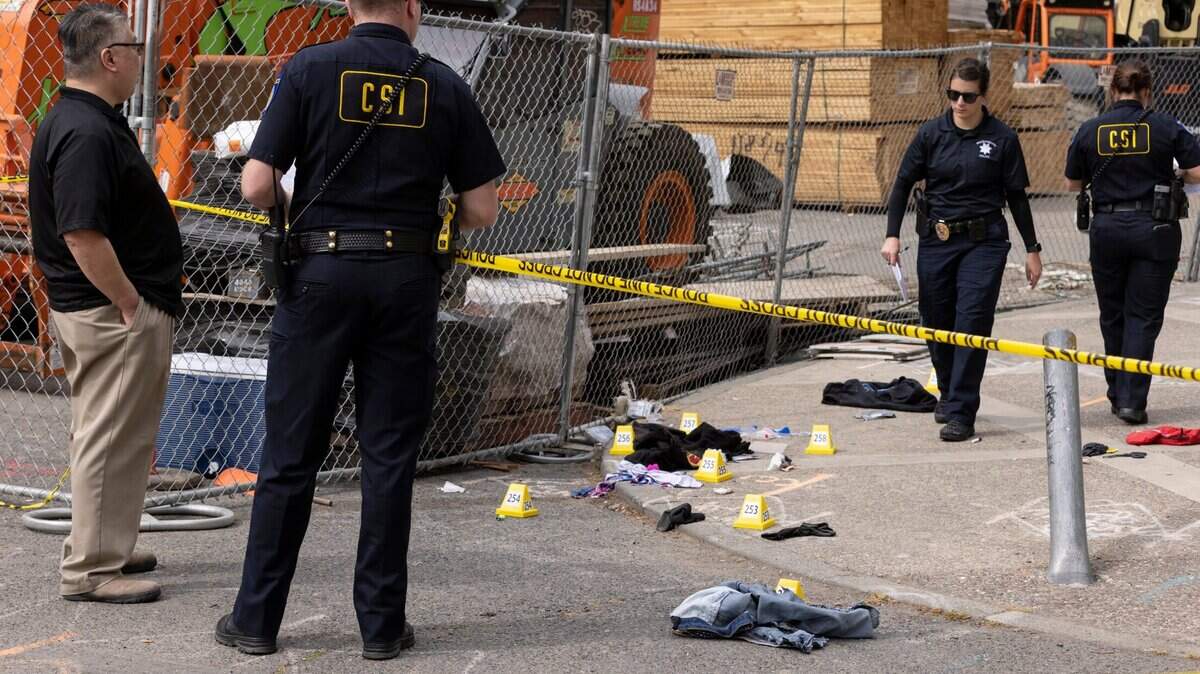
AI-generated summary reviewed by our newsroom.
Read our AI Policy.
- Juries acquitted or deadlocked because prosecutors struggled to prove defendants’ intent.
- Dominguez was found legally insane and convicted of involuntary manslaughter.
- Prosecutors said Payton and Martin joined a planned gunfight.
The crimes were horrific. And there was no dispute over whether the defendants were involved.
Read more Padilla introduces a new bill to counter Trump’s ‘attacks’ on federal elections
Carlos Dominguez stabbed two people to death in Davis and nearly killed a third. Mtula Payton and Dandrae Martin participated in a gunfight that left six people dead at a busy downtown Sacramento intersection.
So why did two separately empaneled juries last week reject murder charges in their cases?
The answer is complex, highlighting the dramatic differences between the public perception of a case and the careful, plodding way that evidence must be presented in a courtroom, experts said. Politics also plays a role, as elected district attorneys grapple with the best way to respond to a shocking and grisly murder.
But key to these two cases — as well as other recent trials that resulted in deadlocked juries or acquittals — is the difficulty prosecutors face when the charges they must prove involve a defendant’s state of mind, according to legal experts interviewed for this report.
“Murder starts with intent to kill,” said Tom Johnson, a Sacramento defense lawyer who also spent many years as a prosecutor.
But that is hard to prove.
Inside a defendant’s mental state
In court, three psychiatric experts testified that Dominguez suffered from schizophrenia and was severely psychotic when he killed David Breaux and Karim Abou Najm, and stabbed survivor Kimberlee Guillory nearly to death in 2023. Last year, a jury acquitted him of first-degree murder charges in the case and deadlocked over a charge that he attempted to murder Guillory.
On Tuesday, a second jury acquitted him of second degree murder and attempted murder, convicting him instead of involuntary manslaughter.
That case also hinged on the defendants’ mental state: neither of the men started the shooting, and they were not proven to have fired the specific shots that killed people. Instead, the prosecution argued that they should be convicted under laws saying people can be found guilty of murder under a legal doctrine known as mutual combat, under which people who agree to a gunfight cannot later claim that they acted in self-defense. The shootout, prosecutors argued, amounted to a planned confrontation among rival gangs.
But lawyers for Payton and Martin argued that another person, Sergio Harris, opened fire in the crowded intersection as patrons streamed from local bars, causing Payton and Martin to fire in self-defense. The men did not agree to a gunfight or any confrontation, defense lawyers Reid Kingsbury and Linda Parisi said.
To prove that they were guilty of first- or second-degree murder, prosecutors would have needed to establish that they planned to open fire that night — a difficult task made harder by the fact that neither man was the one who initially opened fire.
“I would take a long time to look at all the facts and evidence and see what statements they may have made about their intent,” said Mark Reichel, a defense attorney who has argued cases in both state and federal courts. “What was in their mind at the time of the shooting? Was it self-defense?”
Adding to prosecutors’ difficulty in proving intent is a shift in attitude among some jurors in recent years, said Johnson.
“Juries are definitely more attuned to defense arguments than they were in the past,” Johnson said. “Police conduct is getting a much longer look than in the past.”
Jurors are also somewhat limited in how they can develop conclusions about a person’s state of mind from the facts of a case, he said.
For example, jurors are instructed that they can draw a “reasonable inference” from facts presented in court, Johnson said. But if such an inference could point to either guilt or innocence, the jury is told to accept the conclusion that points to innocence, he said.
Does public opinion play a role?
Members of the public are often shocked and dismayed when juries deadlock or acquit high-profile defendants.
Read more Cooper Lutkenhaus, 17, captures 800 meters at USATF Outdoor Championships
One reason is that in court, dramatic details that flash by quickly in a news report are presented slowly and bit-by-bit as evidence, each new fact argued over in a process that can take days or even weeks, said Reichel. Something that seems so obvious to members of the broader community can take on an entirely new meaning in the courtroom.
District attorneys — elected officials who must face the voters every four years — are often under pressure to charge cases quickly, as news organizations report on sensational murders or other crimes, and public outrage mounts.
In a case like the Davis stabbings that terrified a community, there might have been a public outcry if former Yolo County District Attorney Jeff Reisig hadn’t charged Dominguez with murder, Reichel said. The same is true in other high-profile cases, such as the K Street shootout, he said.
But a higher charge in a homicide case would also require prosecutors to prove that the defendant intended to kill someone, a higher bar to reach.
Members of the public, perhaps aware only of news stories about court proceedings or statements made to reporters by attorneys, might be surprised by the rulings that result, said Charles Denton, a lecturer at UC Berkeley Law.
“What the district attorneys or the defense attorneys say to you as members of the press, and what ultimately comes out in the courtroom, often are very, very different things,” he said.
A possible solution might be to amend California’s criminal statutes to allow for more nuanced definitions and levels of murder, Denton said.
Existing law requires prosecutors to shoehorn criminal homicides into first- or second-degree murder, or voluntary and involuntary manslaughter, Denton said. But many cases do not fit nearly into those categories. As a result, some defendants are being charged and convicted at a higher level than they might deserve, while others, though culpable, might ultimately be acquitted or convicted of very low level offenses.
“I would add a couple of degrees between second and manslaughter, a couple of step-downs,” Denton said. “And then I would have a couple of step-downs between voluntary manslaughter and involuntary manslaughter.”
Letting the community decide
Another reason that some cases play out in court when lesser counts might have been easier to prove, or a guilty plea negotiated, is a belief among prosecutors that some crimes are so heinous that the community — in the form of a jury — should be the one to decide a defendant’s fate.
“There are some cases that are so horrific that a jury should make a decision — rather than an alternative of a plea bargain or something of that nature,” said former Sacramento County District Attorney Anne Marie Schubert.
The results of the Dominguez and K Street shootout cases disappointed survivors and victims’ family members. Dominguez, who was declared legally insane the day after the verdicts, will be sent to a state mental hospital. The future of Payton and Martin, who are still in custody, is not yet clear as prosecutors weigh whether to re-try them.
“The pain suffered by the victims’ families and by the Davis community cannot be measured by any verdict,” said Yolo County District Attorney Melinda Aiello after the verdict in the Dominguez case.
Whether to continue with the case despite Dominguez’ mental condition was the subject of “many, many conversations” and taken very seriously, she said in a statement sent to reporters.
But in the end, Aiello said, the “serious and aggravated nature” of his actions led her team to press forward.
“We decided it was important that members of the Yolo County community needed to make the decision regarding guilt,” she said.
Read more Corey Heim captures Brickyard 400 in stunner
Bee Staff Writer Darrell Smith contributed to this report.