 By admin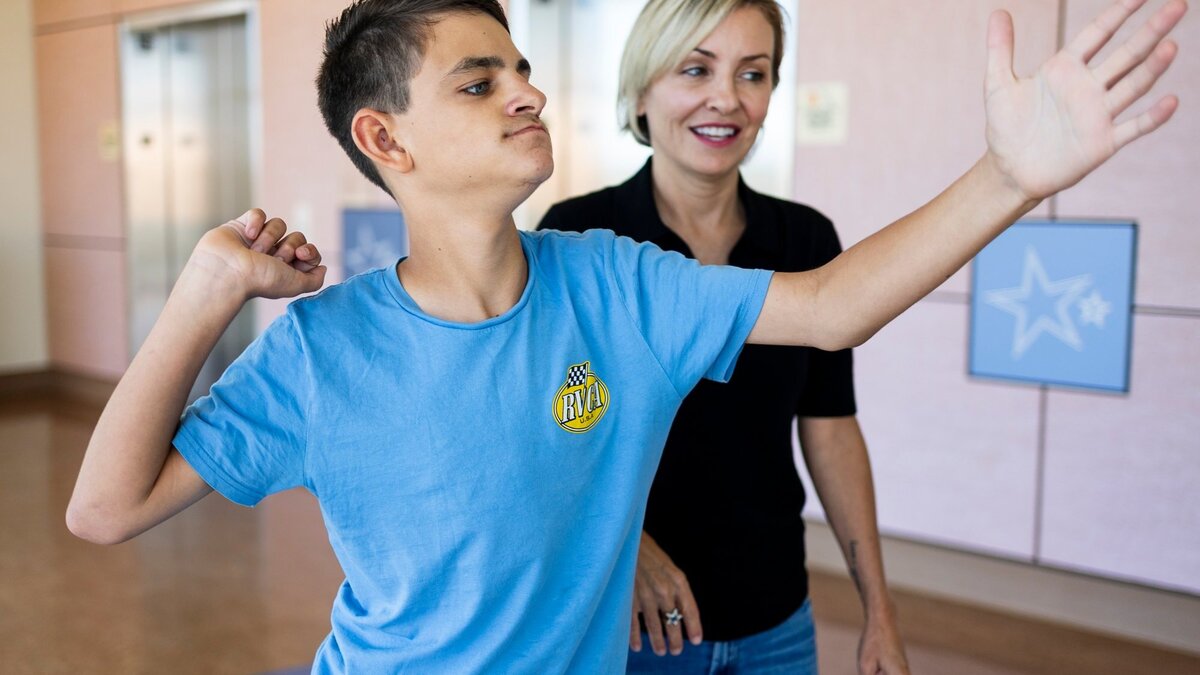
Connor Dalby could not walk for the first 14 years of his life, so his newfound ability to scamper down hallways is miraculous on its own.
But the experimental drug that reduced his severe and frequent seizures by 90% has also conveyed a host of other benefits. For his mother, Kelley Del Real, other improvements are equally transformative, not just for Connor, but for a family that has cared for him around the clock since his symptoms appeared a few days after his birth.
“Yes, the walking was a big surprise, but he has also gained the ability to use his hands for different things that he wasn’t able to do before,” Del Real said. “He is a lot calmer overall.
“Before, he was constantly irritable and just always uncomfortable, but that has shifted a lot. It has improved his sleep, and, overall, it’s a huge change in our quality of life.”
No, this drug has not been a universal fix.
Connor, 17, is still on the severe end of the autism spectrum with developmental and epileptic encephalopathy, a rare form of epilepsy. He still cannot speak for himself and, while he is able to stand on his own and excitedly move where he wants to go, he still often needs guidance from a caregiver.
And the drug, called an “antisense oligonucleotide,” or “ASO,” is far less fast-acting than, say, a pair of aspirin to treat a stubborn headache.
“The effects wear off a week or two before his next dose, and then the effect of the dosing isn’t immediate; it takes another week or two to take effect,” Del Real said.
The lag between one dose, delivered directly into his spinal cord, and the next allows some symptoms to return.
But the payoff is well worth the effort.
“We get a solid five, six weeks where he’s doing really well with everything,” Del Real said.
And, some benefits do persist even when the drug has worn off or not yet taken effect. Previously, Connor was in the habit of screaming every time a vehicle he was riding in slowed down. That tendency has gone away entirely. And his habit of waking up for hours at 2 or 3 a.m. every night has also ended.
“Now, he goes to sleep at about 9:30 at night, and he sleeps until about 4:30 a.m., which, for him, that’s phenomenal,” Del Real said. “We’re all able to sleep.”
While her son still needs round-the-clock care, the situation is much less dire than it was at age 2 when seizures were so frequent that Connor had to be temporarily placed on hospice status.
“It was clusters of seizures all day, all night,” Del Real said. “After 50 or 100, you know, you’d just lose count.”
Those days were the hardest, because the seizures seemed to lock Connor in developmental stasis.
“He did nothing but sort of lie on his back on a feeding tube,” she said. “He didn’t smile anymore, there was no laugh, I certainly didn’t think that there was anything going on with him.
“Like, I didn’t think he knew I was his mother.”
By age 4, there was still no precise explanation for Connor’s seizures, and he was buried under the overlapping side effects of multiple ineffective medications.
Del Real, also raising Connor’s brothers Chase and Cameron, was thankful for her parents moving across the street from the family home to provide some respite. She began to experiment with diet and started removing some seizure medications that weren’t working. Once he was stable enough to exit hospice, a genetic analysis spotted a random mutation in one of his SCN2A genes that caused his seizures. But there was no treatment available.
Previously a high school English teacher, Connor’s mom had zero experience with genetics but felt, now that modern genetic sequencing had pinpointed a cause, science ought to be able to deliver a solution. Online research indicated that seizures associated with this particular gene were often caused by malfunctioning sodium or other ion channels, the structures in neurons that provide the charge for the brain’s intricate patterns of electrical activity.
Read more Heat advisory in place for San Diego County Mountains until Monday evening
She learned that a few researchers were exploring certain medications that could influence the effects of SCN2A mutations and made contact with scientists and other parents on the same quest.
Eventually, they started RogCon Biosciences, which licensed its therapeutic agent targeting “gain of function” SCN2A treatment to Praxis Precision Medicines, where Del Real now works. That drug is now in phase three clinical trials and shows promise in significantly decreasing seizures.
It turned out that Connor’s particular mutation did not fit the niche of the therapy.
But Del Real ended up connecting with Stan Crooke, the founder and former chief executive officer of Carlsbad’s Ionis Pharmaceuticals. Crooke, she said, was stepping down to start the n-Lorem Foundation dedicated to promoting “n-of-1” clinical trials to help single patients with rare genetic conditions.
It was through this route that Connor was put in touch with Dr. Olivia Kim-McManus, who obtained special permission from the U.S. Food and Drug Administration’s Investigational New Drug program, which allows administration of experimental treatments to very few patients. In this case, Connor and a patient in Chicago had medications tailored to their specific genetic characteristics and were treated under protocols reviewed and approved by the FDA.
Kim-McManus, a child neurologist and director of Rady’s Precision Therapeutics Neuro-Interventional Program, worked with colleagues at UC San Diego and Ionis Pharmaceuticals in Carlsbad to design an ASO treatment that capitalizes on the fundamental fact that children get half their genes from their mothers and the other half from their fathers. They published the results of this work online in the journal Nature Medicine last week, about two and a half years after Connor’s first dose.
One of Connor’s two SCN2A genes causes his brain cells to overcharge, causing seizures. But his second copy works just fine. His experimental drug knocks down signals from the mutated gene but spares those from the good copy.
And it appears that these benign differences in the SCN2A gene, while they do vary from person to person, do not have infinite variability. So, this ability to block a bad signal and let a good one through could generalize to patients with a wide range of harmful mutations rather than requiring scientists to make a one-off drug for each patient.
Detecting such mutations shortly after birth and administering a drug quickly has the potential to help children avoid the developmental delays caused by constant seizures.
“We have already identified numbers of patients that could potentially benefit from sequencing infants,” Kim-McManus said. “There’s a massive potential impact here.”
Dr. Timothy Yu, a neurologist at Boston Children’s Hospital and an assistant professor at Harvard University, recently published trial results using ASOs to treat seizures in a pair of 2-year-old girls by more broadly targeting messenger RNA that was causing seizures.
After reading the Kim-McManus paper, he called the selective knockout approach used with Connor “elegant,” noting that a similar technique was attempted unsuccessfully in a Huntington’s disease treatment and in 2023 for the treatment of a patient with a neurological disorder called KIF1A.
“These benign differences, if they’re found in, let’s say, 25% of us, it turns out that those are sweet spots because then you have the opportunity for kids to have one good copy, and there is a difference that you can exploit,” Yu said. “It means you don’t necessarily have to make a different drug for every single patient; you’ve got just enough commonality that you can wedge in a drug to discriminate between the good copy and the bad copy.”
As to Connor’s sudden ability to begin walking once his seizures abated, Kim-McManus said that result was unexpected and was something she had to see for herself. Yu, who happens to be a San Diego native, agreed.
“That’s highly, highly unusual,” he said. “I’d really, really say it’s something worth celebrating.”
Funding for the trial came from the California Institute for Regenerative Medicine.
Read more They said it: World Cup a winner for downtown San Jose
Copyright 2026 Tribune Content Agency. All Rights Reserved.
This story was originally published July 26, 2026 at 5:14 AM.