 By admin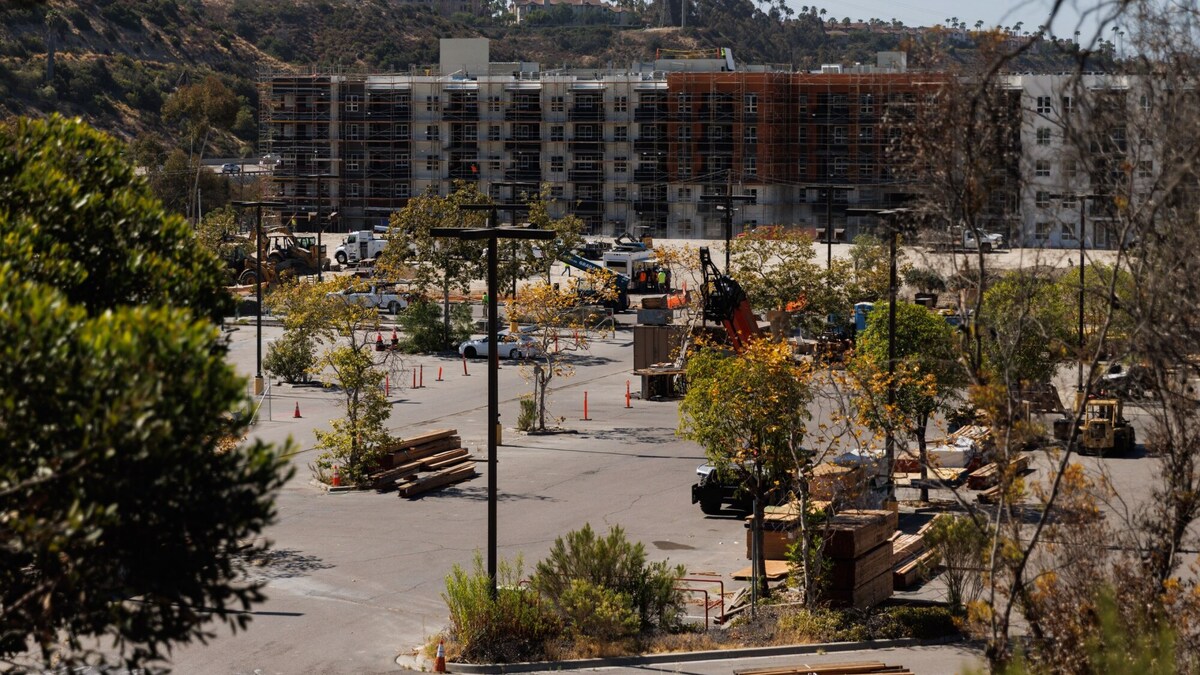
The landscape of San Diego is being transformed by a new trend: Tall apartment buildings are replacing what were once well-recognized businesses like Fry’s in Serra Mesa, Perry’s Cafe near Old Town and a Rite Aid in Hillcrest.
Read more Heat advisory in place for San Diego County Mountains until Monday evening
City officials say the trend is being spurred by aggressive zoning changes in neighborhoods across the city that have come with recent community plan updates, which have rezoned many commercial properties as sites for dense housing.
Developers say another factor is falling demand for commercial space because of online shopping and other trends, which has made residential projects relatively more profitable for property owners and developers.
And they say San Diego is particularly appealing because local rules usually let them build without a lengthy public approval process.
“San Diego is a hot location to invest right now, and a lot of that is because there is more certainty to the development process than ever before,” said Brad Termini, whose firm, Zephyr Partners, is developing the Perry’s site. “San Diego is seen as a shining light.”
City officials say other benefits of the trend include helping to shrink the city’s housing shortage and reducing the chances that defunct commercial properties sit vacant for many years, potentially becoming decaying eyesores.
“In a lot of instances, there isn’t a market for those types of uses any more,” said Heidi Vonblum, the city’s planning director. “It’s not in the best interest of the city or the specific community for properties to remain vacant over any period of time, but especially over decades.”
Vonblum said her staff has worked more closely with developers in recent years to ensure the zoning changes the city includes in community plan updates prompt quick, aggressive building. That requires making sure the zoning changes allow projects with enough units that they pencil out as profitable for a developer.
“When we update community plans, we do economic analyses to determine what types of uses are feasible,” Vonblum said. “And that’s financially feasible, not what we would like in an ideal world.”
Vonblum and Termini, who is also part of the planned redevelopment of the area around the sports arena with the Midway Rising project, said the trend of tall housing replacing commercial buildings is happening all over the city.
Other projects include a complex with 172 apartments on the former site of Guy Hill Cadillac in eastern Pacific Beach near Interstate 5, and a series of tall apartment buildings planned for five vacant parcels near Scripps Ranch High School that had been zoned for life science and research businesses.
In addition, a housing development is planned on commercial land in Rancho Bernardo on Bernardo Court, and mid-rise apartment buildings are expected to be added to the Mission Valley mall as part of a large renovation.
Construction is nearly completed on the 310-unit first phase of what will eventually be more than 1,110 apartments on the former site of the San Diego location of Fry’s, a regional consumer electronics chain that went out of business five years ago.
And construction recently began on a 223-unit project at the site of Perry’s on Pacific Highway just west of Old Town. The restaurant was one of San Diego’s most famous and popular breakfast places for decades.
To Vonblum, it’s notable that nearly all the projects where tall housing will be built on former commercial sites don’t rely on city density bonuses or controversial incentives or any kind of state mandates.
Instead, developers are simply using new zoning put in place by community plan updates, which amend neighborhood growth blueprints with public input and then get approved by the City Council.
“It’s not due to a bonus program or an intervention from the state that overrides local zoning,” Vonblum said. “It is occurring through intentional and thoughtful community plan updates that have allowed us to plan for additional growth.”
The Fry’s project is allowed by the Kearny Mesa community plan update adopted in 2020, the Perry’s project by the Old Town community plan update in 2018, and the housing at Guy Hill Cadillac by a specific plan approved in 2019 for properties near what was soon to become the Balboa Avenue trolley station.
Read more They said it: World Cup a winner for downtown San Jose
No housing has been approved for the former Rite Aid site, a full-block parcel on Robinson Avenue occupied only by a now-closed Rite Aid and a large parking lot. But Vonblum and Termini said the site almost certainly will become high-rise housing because of the zoning and the location in the bustling center of Hillcrest.
“The Rite Aid in Hillcrest is one of the most appealing development sites in San Diego,” Termini said. “It’s phenomenal.”
That’s partly because a community plan update approved in 2024 for Hillcrest upzoned the property and allowed many other commercial spaces to become high-rise housing with ground-floor retail.
Such projects are called “mixed-use,” and many of the properties where housing is slated to replace commercial are zoned mixed-use. They aim to reduce the need for car trips and to boost quality of life by giving residents easy access to groceries, dry cleaners and other businesses located on-site.
Termini said retailers often crave mixed-use projects over standalone retail sites and said retail space in whatever project is built on the Rite Aid site will be larger than the closed drug store was.
In some parts of San Diego, neighborhood leaders are not as upbeat.
Most community plan updates in San Diego get approved by the City Council over the objections of neighborhood leaders in community planning groups, who often argue for less new housing and say the city doesn’t provide the infrastructure to support it.
Victoria LaBruzzo, leader of an umbrella organization for planning groups called the Community Planners Committee, said projects where housing replaces commercial vary so widely that they should be judged case by case.
She believes the Fry’s location just west of Interstate 15 off Aero Drive, relatively far from single-family areas, can handle dense housing. But some other locations make less sense, she said.
“So much of it is just location-dependent,” said LaBruzzo, suggesting that dense projects on wider streets are typically less impactful than projects on narrow streets.
Many Hillcrest residents have lobbied for the city to buy the Rite Aid site and create a park, contending more high-rise housing in the area would damage community character. Vonblum said the city couldn’t afford that.
“It’s usually not a financially viable option,” she said.
But Vonblum noted that the Hillcrest community plan update – called a “focus plan amendment” to the wider Uptown Community Plan – requires some park space that will be publicly accessible on the Rite Aid site.
LaBruzzo also criticized the city’s “by-right” development policy that allows most projects that comply with a site’s zoning to avoid hearings at the Planning Commission and the City Council. That has created a situation, she said, where projects just pop up before nearby residents even know something is coming.
“It’s hard for ‘average Joe citizen’ to know what’s going where and why,” LaBruzzo said. “It’s hard to keep up.”
Both Vonblum and Termini said by-right development has been key to spurring more large housing developments in recent years.
“Developers don’t have to relitigate whether it’s an appropriate use in a particular location – that’s already been done with the community plan update,” Vonblum said.
The local chapter of the Building Industry Association praised the new trend of high-density housing being built on what were commercial sites.
“This shows builders are being creative in finding opportunities to add more homes,” said Aimee Faucett, the chapter’s chief executive. “Transforming commercial properties into new homes is the kind of smart, infill development that makes better use of existing infrastructure and delivers housing our city needs.”
Read more Range Rover Built the Ultimate Garage Pair-and It Includes a Bespoke Classic
Copyright 2026 Tribune Content Agency. All Rights Reserved.
This story was originally published July 26, 2026 at 5:14 AM.