 By admin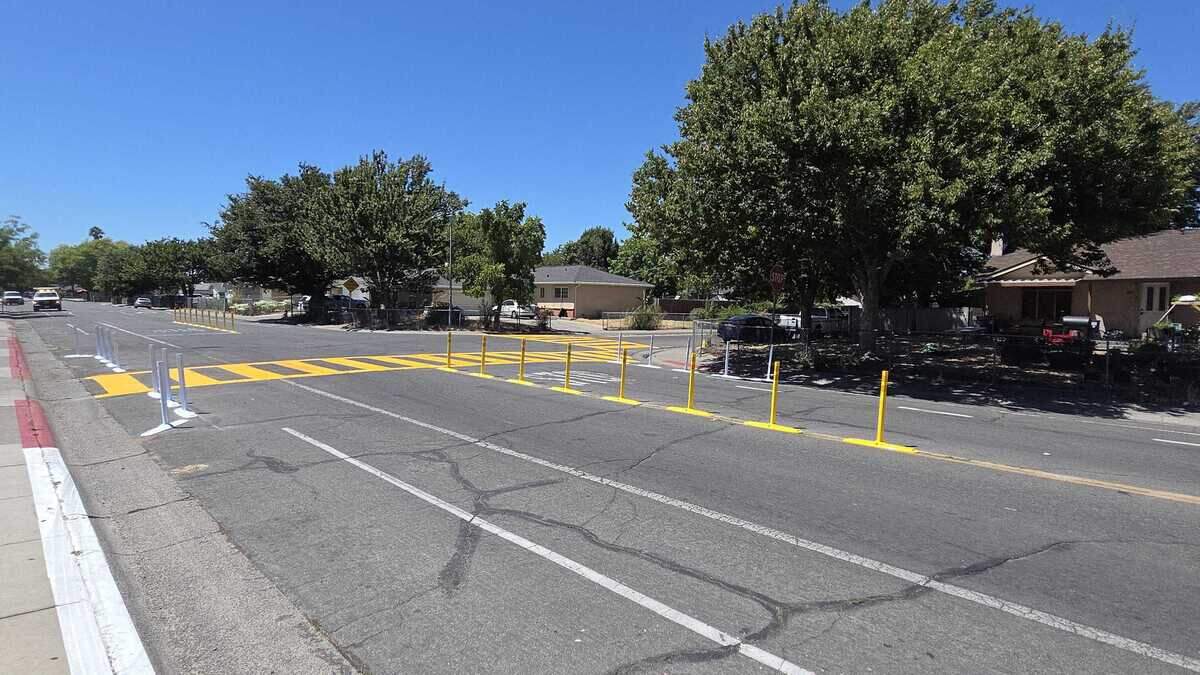
Assembling the team meant to speed up low-cost traffic safety improvements in Sacramento has taken more than a year longer than city officials initially expected.
Read more Roseville council to consider vision for restoring historic Fiddyment Homestead
Last year, the city approved more than $4.6 million for the then-named Transportation Safety Team and temporary safety improvements as part of its “Vision Zero” pledge to eliminate traffic deaths and major injuries by 2027. These “quick-build” fixes include restriping lanes and crosswalks with paint, adding signs and installing temporary barriers like plastic bollards.
The work is sometimes dismissed as “paint and plastic,” said supervising engineer Phil Vulliet, who was promoted from within the city to lead the team. He said even relatively simple changes could reduce dangerous driving speeds.
“I’m not going to pretend it’s going to take these people that habitually speed and make them super conscientious drivers,” he said. ”But if I can carve 5 to 10 miles an hour off their travel speed, that has exponential benefits.”
In the absence of a dedicated team, the Department of Public Works continued implementing quick-build projects, spending more than $1 million on the work.
However, Public Works has yet to fill four of the six positions created for the team. City officials, including Vulliet, said more could be accomplished once it was fully staffed.
Quick-build goals
In March 2025, the City Council unanimously voted to staff a six-person team within the Public Works Department that would design and implement targeted traffic safety infrastructure.
The vote signaled a pivot to faster fixes than traditional transportation improvements, which can take years and sometimes decades because the city often relies on grant funding. Quick-build projects, by comparison, were expected to take three to six months.
About $2 million in existing non-grant transportation funds and about $2.6 million in tax funds were set aside for the team.
Councilmember Caity Maple, who represents south Sacramento communities including Oak Park, championed the idea — initially proposed by former Councilmember Katie Valenzuela — because she was saddened and frustrated by continued reports of preventable traffic deaths. More than 300 people had died on Sacramento streets between the Vision Zero pledge in 2017 and the city council’s quick-build team vote in 2025. This year, at 28 people have lost their lives.
Though the city said it had pursued its Vision Zero goal, it had not changed its funding structure, leaving Public Works reliant on gas and sales tax revenues and competitive grants. Maple said she would advocate in the next budget cycle for general fund money to go toward the city’s Active Transportation Commission safety recommendations.
Around the time of the 2025 council vote, Megan Carter, Public Works transportation division manager, said she expected the Transportation Safety Team to take each project through planning, design and implementation in three to six months. The goal was to finish 40 road safety projects each year, with at least one being a larger interim project that could eventually become a permanent improvement.
Carter said the city expected all six positions — a supervising engineer, senior engineer, two assistant engineers, a traffic investigator and an administrative analyst — to be filled by July 1, 2025.
Transportation Safety Team status
As of mid-August, Vulliet was one of two people hired into new positions created for the Transportation Safety Team initiative.
Vulliet became supervising engineer Feb. 23, overseeing both the Transportation Safety Team and the Traffic Investigations Team. The hiring process then began for the other quick-build positions.
“They didn’t want to hire those positions without me being in place,” Vulliet said.
Two traffic investigators, including one who filled the new position created for the quick-build team, began work earlier this year. Investigators covered different sections of Sacramento and collectively assisted with quick-build projects, rather than having one investigator dedicated solely to them.
Without a fully assembled team, traffic investigators had led much of the work, documenting complaints, meeting with residents and helping design quick-build solutions, Vulliet said.
“The investigators will do a lot of legwork,” Vulliet said. “They are frequently the beginning of any given quick-build project.”
Read more PG&E to pay SLO County $16 million to make up for lost Diablo Canyon tax money
Interviews were set this month for some of the engineering positions, Vulliet said, pending if the interview panel was prepped to city standards.
Work status
The city does not have data showing whether it had met some goals Carter outlined for the team, including how many quick-build projects had been completed. The city instead tracked traffic investigations and work orders, which included work beyond quick-build projects, Vulliet said.
There have been just under 1,200 investigations since June 30, 2025, with about 180 in the queue. Just over 1,690 work orders have been filed and 673 have been completed. Quick-build projects typically include between 10 and 20 work orders.
Some of those completed work orders were near Rosa Parks Middle School at 68th Avenue and Tamoshanter Way, where two people were hospitalized after an October crash. The city installed curb extensions, added yellow paint to the crosswalks and installed tuff curbs with flexible posts between traffic lanes near the crosswalks.
Maple said that while she pushed for a team dedicated to quick-build projects, she was pleased with the work completed so far.
“We would love it if we could staff up faster, and I know they’re working really hard to do that. But also, the work is happening,” she said.
More than $1.2 million had been spent on quick-build projects, using existing gas tax money and new Measure A safety funds provided by the Sacramento Transportation Authority. Additional money came from the city’s Major Streets Construction funds.
The team’s goal remains to complete projects within three to six months. However, Vulliet said the timeline could “vary widely” between locations because engineers were still being hired, construction staffing was limited and some projects were more complicated.
Projects also would be prioritized based on factors including collision history and proximity to schools or parks.
The team, Vulliet said, is not directly responsible for the larger quick-build projects that serve as a temporary fix while the city pursues further grant funding for a permanent solution. Those projects, including the Marysville Boulevard Vision Zero Quick Build, are handled by the city’s Engineering Services Division.
Moving forward
Even without a fully-staffed Transportation Safety Team, Vulliet said progress has been made, including on efforts beyond specific quick-build projects.
Vulliet said he was working to streamline the speed hump nomination process and wanted to expand the types of quick-build improvements, including traffic circles. Last month, the city approved a contract for on-call signage and striping contractor services for up to $900,000 in projects, according to City Council documents.
“That’s a new tool for us, and we’re kind of figuring out how to use that best,” Vulliet said.
With a fully assembled team, he said he hoped to improve data on quick-build projects and eventually create a webpage where the public could track their locations. Once the engineers were hired, Vulliet said he wanted to move some tasks away from investigators, allowing them to focus more on working with residents.
Maple said she hoped a fully staffed transportation team could spend more time analyzing data and investigations so the city could more equitably determine where and when improvements were needed.
Vulliet said his exact vision for the team is dependent on the skills of the people he eventually hires. But essentially, “I’d like to keep both of our on-call contractors and our city crews pretty dang busy,” he said.
“I don’t know what the ceiling is for delivering these types of improvements, but I’d like to find it,” Vulliet said.
Read more Sacramento weekend roundup: Cockfighting bill, inaugural Bugtopia and more
This story was originally published August 17, 2026 at 7:00 AM.